—— Manhattan Rents Surge to Record $5,000 in July; US Weekly Unemployment Claims Rise; US Wholesale Inflation Decelerates More Than Estimated in July; Anthropic Investors Target $2tn Valuation in Planned October IPO; Cerebras Shares Slide After Chipmaker Signals Slower Growth; Microsoft Cuts Carbon Removal Investments as AI Spending Surges; AMD Planning Up to $5 Billion Sale in Biggest Bond Issue Ever
1. Manhattan Rents Surge to Record $5,000 in July
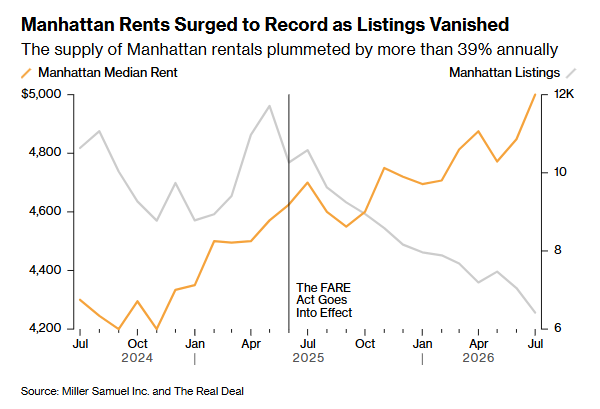
Manhattan rents surged to the highest level on record in July as a historic collapse in available listings collided with the summer apartment hunt rush.
The median rent on new leases signed in July hit $5,000, up 6.4% from a year earlier, according to new data from appraiser Miller Samuel Inc. and The Real Deal. That’s twice the increase measured in shelter prices nationwide, which advanced 3.2% from a year earlier, according to the US Bureau of Labor Statistics.
The jump comes alongside a sharp drop in supply: Listing inventory last month plunged more than 39% year-over-year in Manhattan, one of the steepest declines the market has seen in a decade. The trend continued across the East River, where the median rent in Brooklyn also hit a record $4,500 in July, while inventory fell by 27% compared to last year. The decline in listings can be in part attributed to a growing share of inventory “going private” thanks to landlords and brokers increasingly keeping listings off public portals like StreetEasy or RentHop, according Jonathan Miller, the director of markets at StreetMatrix. “That’s not normal,” Miller said. “There’s a lot of inventory that’s going behind paywalls that the market can’t see.”
Leasing volume in Manhattan is down nearly 19% even as prices hit records — a sign that scarcity, not demand alone, is driving costs higher, he said.
Nationwide, median rents for one-bedrooms were flat in July from the same time last year, according to a report by rental site Zumper. Many other major cities have seen rents fall, including In Los Angeles and Miami. In San Francisco, though, one-bedroom rents jumped 23% from a year earlier, while active listings fell about 30%.
Bloomberg – Manhattan Rents Hit $5,000 Record While Listings All But Vanish
______
2. US Weekly Unemployment Claims Rise
Filings for US unemployment benefits rose last week after hovering near historic lows.
Initial claims increased by 9,000 to 209,000 in the week ended Aug. 8, according to Labor Department data released Thursday. The median forecast in a Bloomberg survey of economists called for 202,000.
Continuing claims, a proxy for the number of people receiving benefits, fell to 1.78 million in the previous week.
The increase in filings could reflect typical summertime volatility in a period when seasonal employment patterns and the timing of holidays often affect the data. Economists will look for more than one week’s worth of data before reassessing the recent stability of the labor market.
The four-week moving average of new applications, a metric that helps smooth out volatility, was unchanged at 199,000 last week.

Bloomberg – US Jobless Claims Edged Up to 209,000 Last Week
______
3. US Wholesale Inflation Decelerates More Than Estimated in July
US wholesale inflation decelerated in July from a year earlier by more than estimated, helped by a further decline in energy and food costs.
The producer price index rose 4.7% from July 2025 after a 5.5% annual increase in June, according to Bureau of Labor Statistics data out Thursday. On a month-over-month basis, the PPI was unchanged.
Excluding food and energy, producer prices climbed 4.2% from a year ago and 0.2% compared with June. The PPI report follows consumer price data showing moderating inflation, adding to evidence that the initial war-driven energy shock is continuing to fade. That said, the recent flare-up in the Middle East is raising concerns about stubborn inflation. Federal Reserve officials will have access to additional consumer and producer price data before their next policy decision in mid-September, as well as another report on the labor market. So far, policymakers are having to weigh lingering inflation pressures against a recent slowdown in hiring.
Energy prices declined 3.1% from June, the second straight decline, while food prices dropped by the most since the start of the year.
Several components of the PPI are also of particular interest to the Fed because they feed into its preferred inflation gauge, the personal consumption expenditures price index.

Bloomberg – US Producer Price Growth Decelerates by More Than Forecast
______
4. Anthropic Investors Target $2tn Valuation in Planned October IPO
Anthropic investors expect the AI start-up to float at a valuation of $2tn or more in October, a dizzying figure that would eclipse SpaceX and make the AI lab’s debut the largest ever initial public offering.
Half a dozen of the company’s backers told the FT that Anthropic’s rapidly rising revenue would enable it to more than double its current valuation in a planned autumn float.
A listing at that level could unlock billions of dollars in gains for the five-year-old company’s early investors but would also test public markets that are growing more nervous about the AI boom.
Anthropic’s backers say booming demand for the lab’s advanced AI models and tools justifies their lofty expectations. Investors expect the Claude maker’s annualised revenue to be between $100bn and $120bn by the end of 2026 — using the start-up’s preferred measure, which infers full-year sales from recent performance — up by more than 10 times over the course of 2026.
“If Anthropic is growing 800 per cent a year, you’d think at the incredibly low end they would trade at 30 times [revenue],” said one investor in the group. “That would make them a $3tn company.”
Anthropic lacks a publicly listed US peer that would provide a benchmark for its valuation. But companies that are seen as AI beneficiaries, such as data intelligence group Palantir and cloud company Nebius, have traded this year at roughly 55 times revenue.
Several investors said senior Anthropic executives had yet to fix the valuation target for the IPO, even in private conversations. But investors have built their own financial models.
Financial Times – Anthropic investors bet on $2tn valuation in record IPO
______
5. Cerebras Shares Slide After Chipmaker Signals Slower Growth
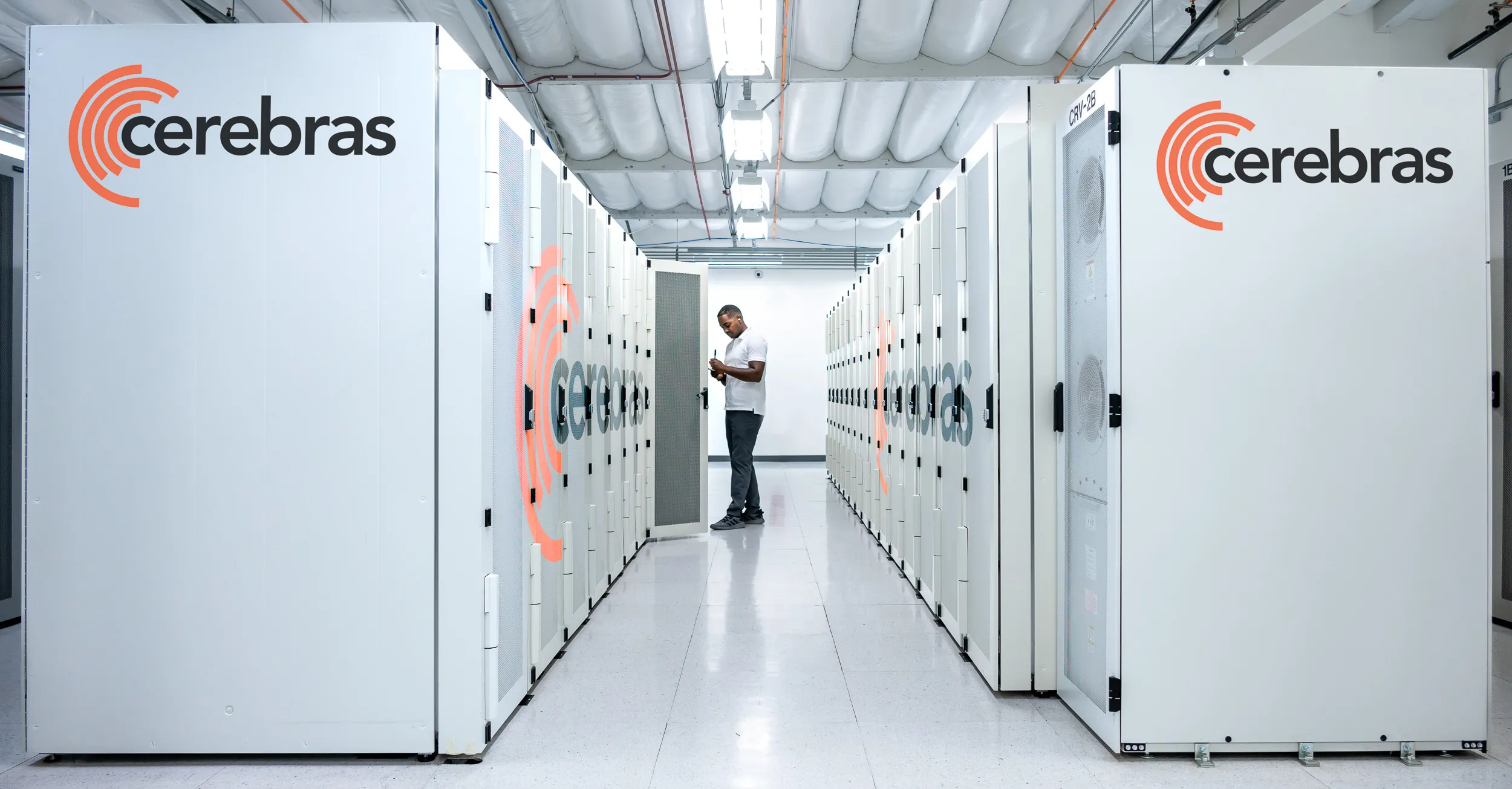
Cerebras Systems Inc. shares slid after the company projected slower growth than some investors anticipated, a sign the company is still in the early stages of popularizing a novel chip design.
Revenue will be about $215 million in the current quarter, Cerebras said in a statement Wednesday. Though that topped the $212 million average estimate, some predictions exceeded $220 million, according to data compiled by Bloomberg.
The forecast was part of Cerebras’ quarterly earnings report — its second as a publicly traded business. And Wall Street is still setting its expectations for the chip designer and cloud-computing provider. Given the massive spending on data center technology, investors may have expected more of that money to show up in Cerebras’ sales, said Paul Meeks, head of technology research at Freedom Capital Markets.
“There might be a little bit more of a gap between the build-out and the revenue than people expect,” he said.
Investors also have been waiting for Cerebras to line up more customers. It announced a $10 billion agreement with OpenAI in January and an Amazon.com Inc. pact in March. But the company’s main technology remains a relatively niche product in an industry dominated by Nvidia Corp.’s AI processors.
The shares plunged as much as 16% to $219.10 after markets opened in New York on Thursday.
Cerebras Shares Tumble After Growth Underwhelms Investors
______
6. Microsoft Cuts Carbon Removal Investments as AI Spending Surges
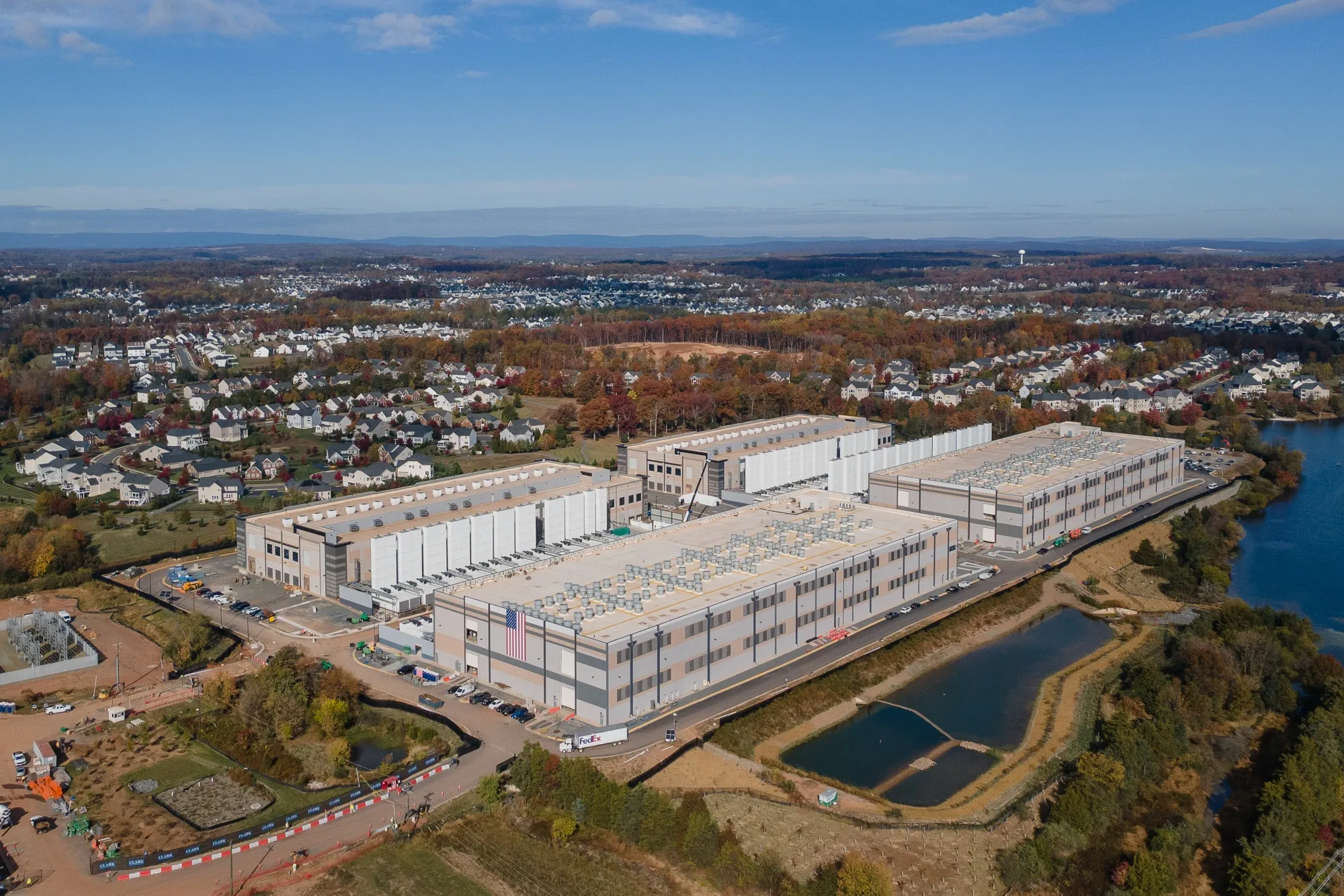
Microsoft Corp. dramatically cut back investments in carbon removals in the first half of the year, as it ratchets up spending on artificial intelligence.
The company bought 8.55 million metric tons of carbon removal credits in the year through mid-July, which is about 80% less than it purchased over the same period in 2025, according to calculations by BloombergNEF. That puts Microsoft on track for its first retreat since 2023 from a market it entered in 2020.
At the same time, Microsoft’s carbon footprint has been growing. AI’s seemingly insatiable demand for electricity, coupled with the slow rollout of cleaner solutions, resulted in a 25% increase in the company’s emissions last year, according to its latest sustainability report. The development comes as Microsoft and other hyperscalers are locked in an AI arms race in which efforts to achieve scale appear to be on a collision course with previously stated climate goals. Bloomberg News reported in April that Microsoft was pausing some of its carbon removal purchases due to financial considerations. The company said back then the program hadn’t ended. Despite this year’s retreat, Microsoft remains the top buyer by far in the voluntary carbon removal market, accounting for almost half of all transactions so far in 2026.
Given Microsoft’s outsized role, any shift in its commitment has a significant impact on the market. Global sales of carbon removal credits totaled 18 million metric tons through mid-July, tracking 66% below 2025 levels, according to BNEF data.
Bloomberg – Microsoft Cuts Purchases of Carbon Removals by 80% Amid AI Push
______
7. AMD Planning Up to $5 Billion Sale in Biggest Bond Issue Ever
The highly anticipated initial public offering of Yushu Technology Co., known as Unitree Robotics, drew huge demand from retail investors as China’s leading humanoid robot maker opened books in Shanghai.
The retail portion of the IPO was 5,526 times subscribed, with individual investors submitting 9.8 million orders, according to an exchange filing released on Monday.
The Hangzhou-based company sold 40.4 million shares at 150.8 yuan apiece, raising about 6.1 billion yuan ($904 million) to become mainland China’s first publicly traded humanoid robot maker. The company is expected to debut on Shanghai’s STAR Market this month. The offering gives Unitree a market value of approximately 61 billion yuan. The high level of interest underscores the investor appetite for physical AI companies, one of Beijing’s strategic priorities. The strong subscription was also likely aided by backing from strategic investors including AI startup DeepSeek, reinforcing confidence in Unitree and the growing convergence of artificial intelligence and robotics.
About 20% of the shares for sale have been allocated to strategic investors including DeepSeek, a Tencent Holdings Ltd.-affiliated investment vehicle, and investment arms of major state-owned enterprises such as China National Petroleum Corp., China Southern Power Grid Co. and China Telecom Corp.
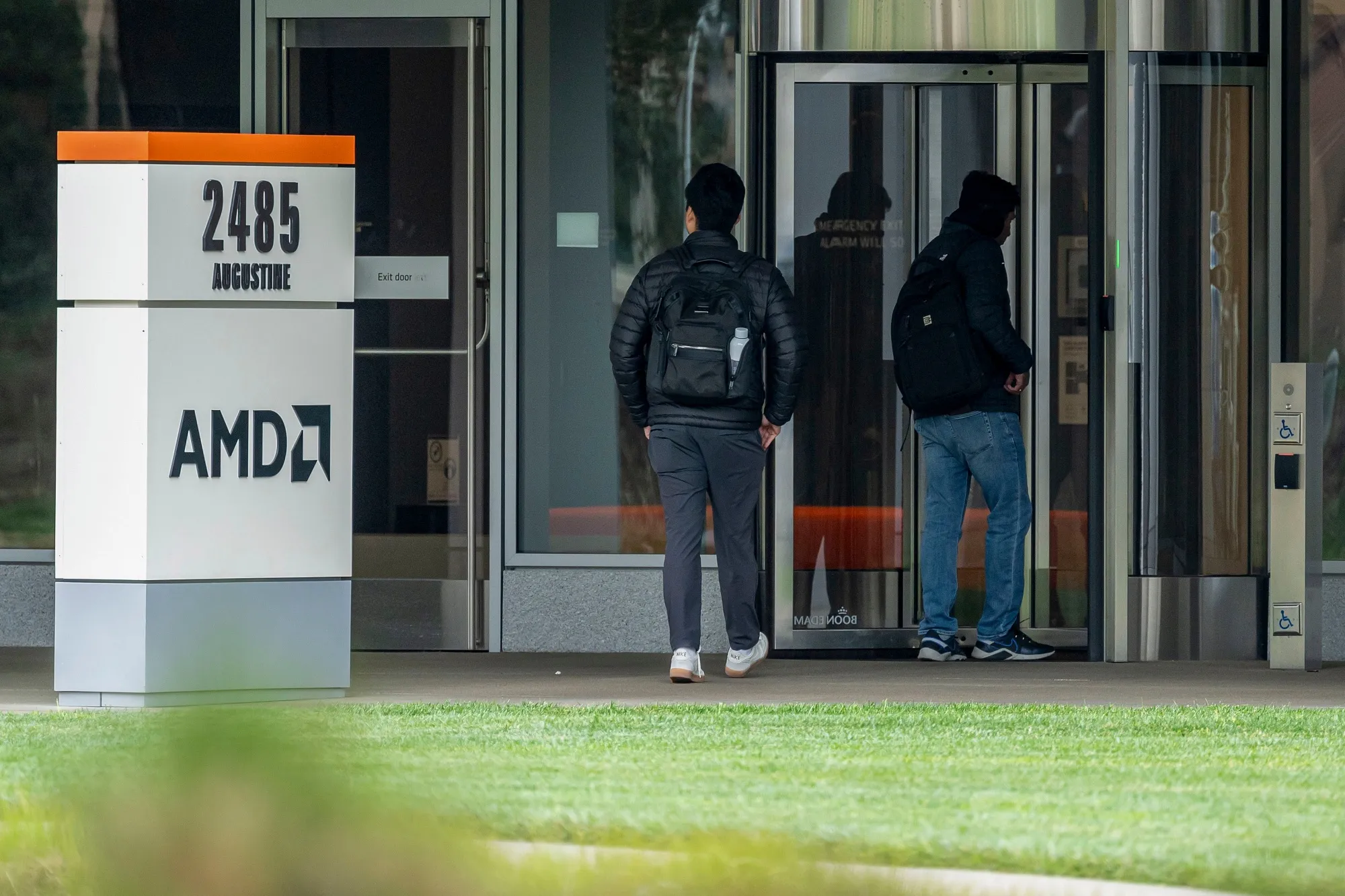
Bloomberg – AMD to Raise as Much as $5 Billion From Debt Offering
______