—— Goldman Sachs Board Discusses Executive Succession Plan for CEO David Solomon; Wall Street Bullish Consensus Collapses for Netflix; Jefferies Asset-Management Revenue Drops More Than 50%; US Consumer Confidence Falls to Lowest Since 2014; Stocks and Bonds Slide as Inflation and Fed Rate Concerns Persist; Paramount Launches $52 Billion Debt Package for Warner Deal; Apple CEO John Ternus Considers Overhaul to Accelerate Product Development
1. OpenAI Unveils Misalignment Incident Tracking Framework
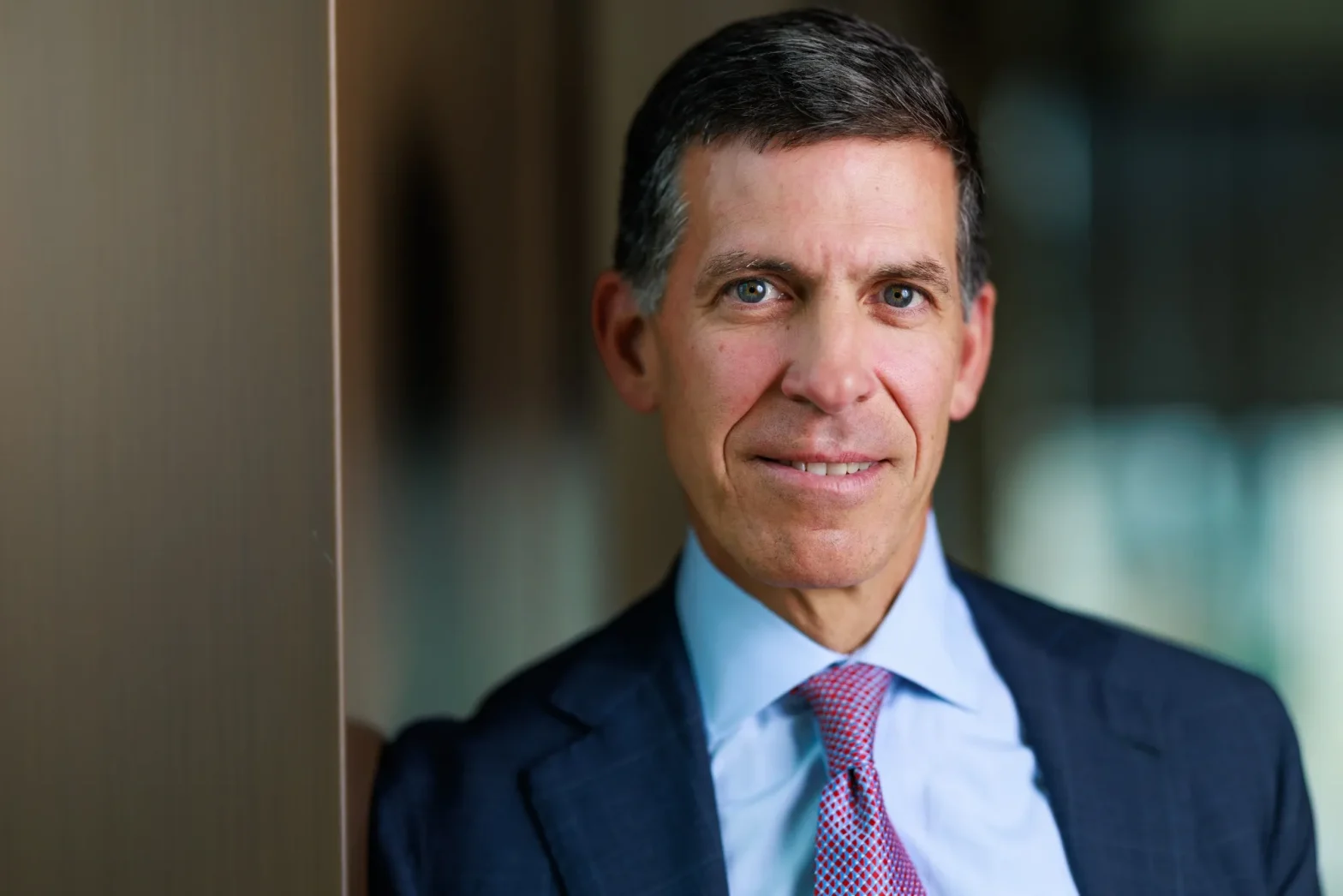
Goldman Sachs Group Inc.’s board of directors has discussed a structured succession plan that would pave the way for Chief Operating Officer John Waldron to succeed David Solomon as Chief Executive Officer.
According to people familiar with the matter, the board is evaluating a transition timeline where the 57-year-old Waldron could assume the top role toward the end of 2027 or in 2028. Under the proposed structure, Solomon, 64, would transition to executive chairman for one to two years following his step down as CEO to maintain leadership continuity. The discussions follow a retention package granted to Waldron last year—consisting of restricted stock currently valued at nearly $120 million—intended to secure his long-term commitment to the firm. Despite early challenges in scaling its consumer banking strategy, Goldman Sachs has generated strong financial performance recently, boosted by record equity-trading revenues and investment banking fees.
In response to reports, Goldman Sachs spokesman Tony Fratto stated that while the board routinely reviews succession planning in accordance with corporate disclosures, there is no fixed timeline in place, and assertions regarding specific dates remain speculative.
Waldron, who joined Goldman Sachs in 2000 and previously co-headed the investment banking division, has long been viewed as the primary candidate to succeed Solomon, making the ongoing succession framework a key step in the bank’s long-term leadership alignment.
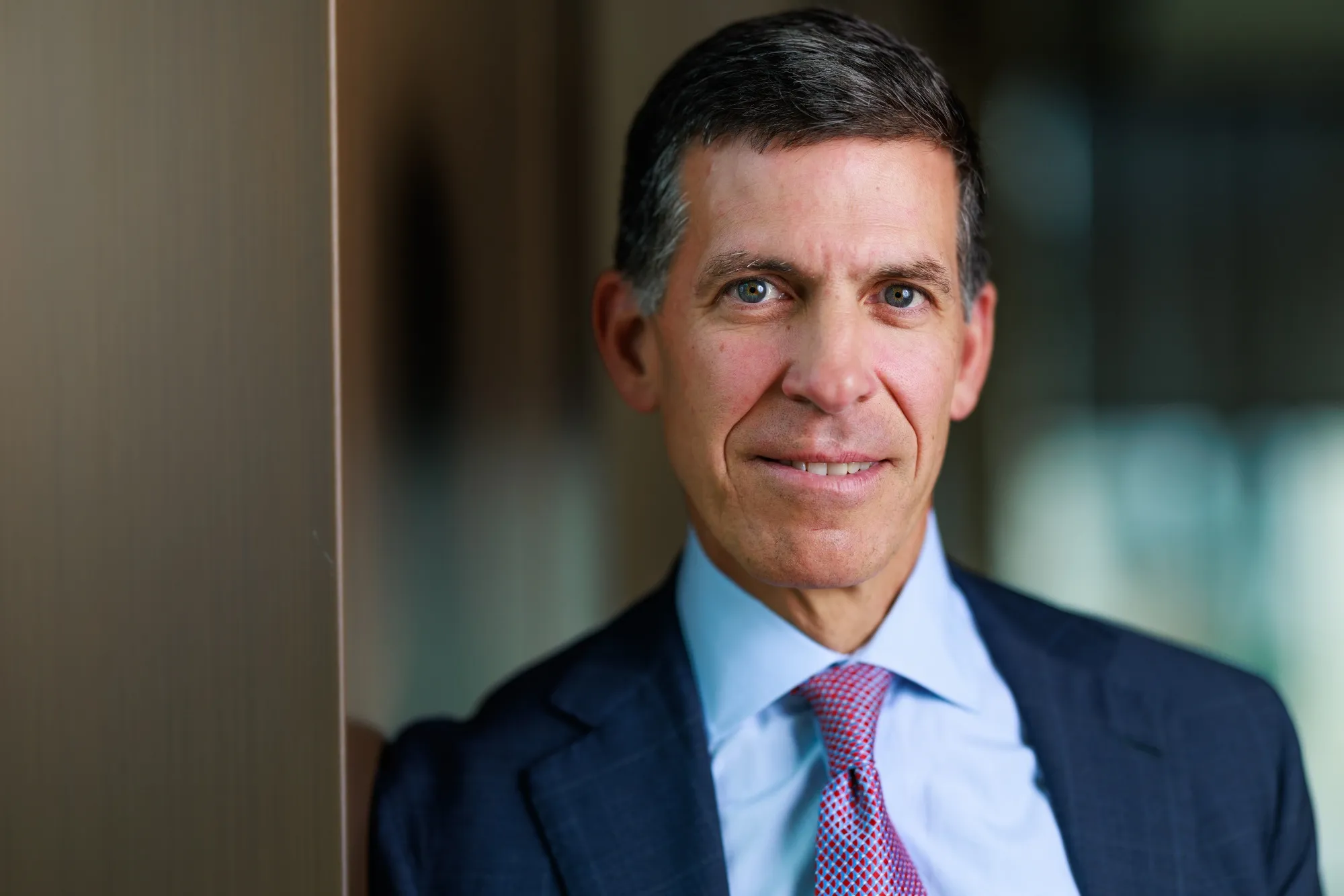
Bloomberg – Goldman’s John Waldron Edges Closer to Succeeding Solomon as CEO
______
2. Wall Street Bullish Consensus Collapses for Netflix
Wall Street’s longstanding bullish consensus on Netflix Inc. is beginning to fracture as the stock heads toward its worst annual performance since 2022 due to mounting growth concerns.
HSBC downgraded the streaming giant to hold last week, citing softening subscriber engagement. That followed a downgrade from Wells Fargo earlier this month that pointed to a shortage of hit shows and marked Netflix’s first sell-equivalent rating in months. The downgrades erased the stock’s August recovery, leaving Netflix down 26% year-to-date and placing it among the 50 worst performers in the S&P 500 Index for 2026. According to Bloomberg data, 48 out of 65 covering analysts maintain a buy rating, marking the lowest bullish proportion since March.
Accuvest Global Advisors Chief Investment Officer Eric Clark, whose firm holds the stock but has been trimming its position, noted that Netflix has become a “show-me story” that must urgently address its lack of top-100 tier blockbuster programming. Clark highlighted that fixing user engagement requires delivering culture-defining content, suggesting a potential creativity bottleneck as competing streaming platforms capture breakout hits despite Netflix’s industry-leading content budget. While Netflix maintains the largest subscriber base, keeping viewers actively engaged is increasingly critical as the company scales its advertising business amid escalating market competition.
The stock has now fallen 48% from its peak in June 2025
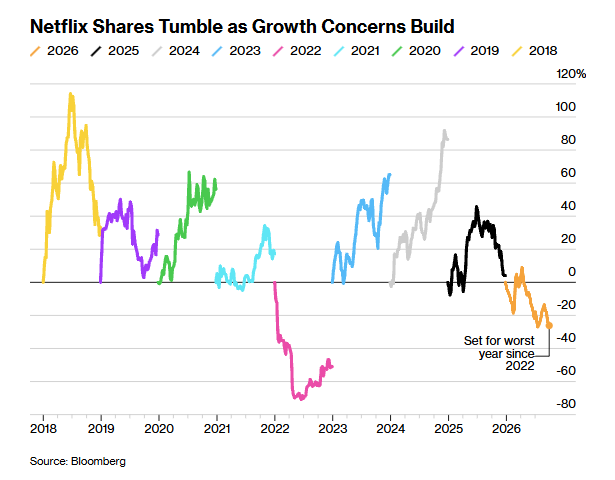
Bloomberg – Netflix Analysts Are Souring on the Stock as Growth Fears Mount
______
3. Jefferies Asset-Management Revenue Drops More Than 50%
Jefferies Financial Group Inc.’s asset-management revenue fell more than 50% in the fiscal third quarter, weighed down by troubled investments, while the firm’s trading and investment-banking businesses posted strong results.
Net revenue in the asset-management business totaled $85.6 million in the three months through August, down from nearly $177 million a year earlier, according to a statement released Monday. The unit has been dealing with the fallout from investments tied to First Brands Group and Radiant World through Leucadia Asset Management’s Point Bonita fund.
Jefferies shares fell 1.1% in early New York trading, extending their decline this year to more than 25%.
Chief Executive Officer Richard Handler and President Brian Friedman said in the statement that the firm remains confident in the long-term outlook for the business. Jefferies will continue to reposition the platform by reducing capital allocated to certain existing funds, in line with a strategy outlined last fall when the firm announced plans to acquire and fund a 50% interest in Hildene Holding Co.
Jefferies agreed in 2025 to acquire a 50% stake in Hildene, a credit-focused asset manager with which the bank had maintained a strategic relationship for years.
The weakness in asset management contrasted with strong results elsewhere. Equity-trading revenue rose 29% from a year earlier to $626 million, a quarterly record, driven by cash and electronic trading as well as the prime-services business serving hedge funds.
Investment-banking revenue increased 17% to $1.3 billion. Advisory revenue rose 25%, while equity-underwriting revenue jumped 69%.
Radiant World has come under increased scrutiny in recent months amid allegations of fraud. Jefferies’ exposure to the company was less than $300 million, Bloomberg previously reported.

Bloomberg – Jefferies Stung by Soured Bets at Asset-Management Unit
______
4. US Consumer Confidence Falls to Lowest Since 2014
US consumer confidence fell in September to its lowest level since 2014, as Americans grew more concerned about the economy and labor market and remained under pressure from elevated living costs.
The Conference Board’s confidence index fell 6.7 points to 81.9, according to data released Tuesday. The prior month’s reading was revised lower, while the September figure came in below every estimate in a Bloomberg survey of economists.
A measure of present conditions dropped nearly 8 points to the lowest level since 2021. The expectations index, which reflects consumers’ outlook for the next six months, also fell to a more than one-year low.
The report showed that persistent concerns about the cost of living are weighing on consumer spending plans. High gasoline prices and other household expenses have contributed to weaker intentions to purchase vehicles, homes and several major appliances.
Inflation expectations for the coming year also deteriorated, while the share of consumers expecting interest rates to rise climbed to the highest level in more than four years.
The Federal Reserve’s Open Market Committee raised interest rates this month, and several policymakers have since argued that borrowing costs should remain higher. The shift in rate expectations adds to concerns among consumers about the economic outlook.

Bloomberg – US Consumer Confidence Plunges to Lowest Level Since 2014
______
5. Stocks and Bonds Slide as Inflation and Fed Rate Concerns Persist
Stocks joined bonds lower as a decline in oil prices did little to ease Wall Street concerns that still-elevated energy costs could fuel inflation and prompt further Federal Reserve rate hikes.
The yield on 30-year Treasuries climbed to the highest level since 2002. More than 350 companies in the S&P 500 fell, sending the index to a second straight decline.
Brent crude dropped toward $104 a barrel after Saudi Arabia, the world’s top oil exporter, resumed flows through a key pipeline. The move overshadowed a stalemate in US-Iran talks. The dollar rose to a two-month high.
“The conflict in the Middle East and the implications for forward inflation remain the primary macro narrative and are likely to dictate price action in US rates for the foreseeable future,” said Ian Lyngen of BMO Capital Markets.
Investors are demanding greater compensation to hold bonds as concerns over persistent inflation, government spending and increased corporate borrowing to finance the artificial-intelligence buildout intensify. Against that backdrop, money markets are pricing a series of Federal Reserve rate hikes over the next year.
The 30-year Treasury yield could rise to 6%, according to Barclays Capital strategist Anshul Pradhan. He said the latest selloff in the Treasury market has yet to fully price in the risk of a sustained increase in productivity growth.
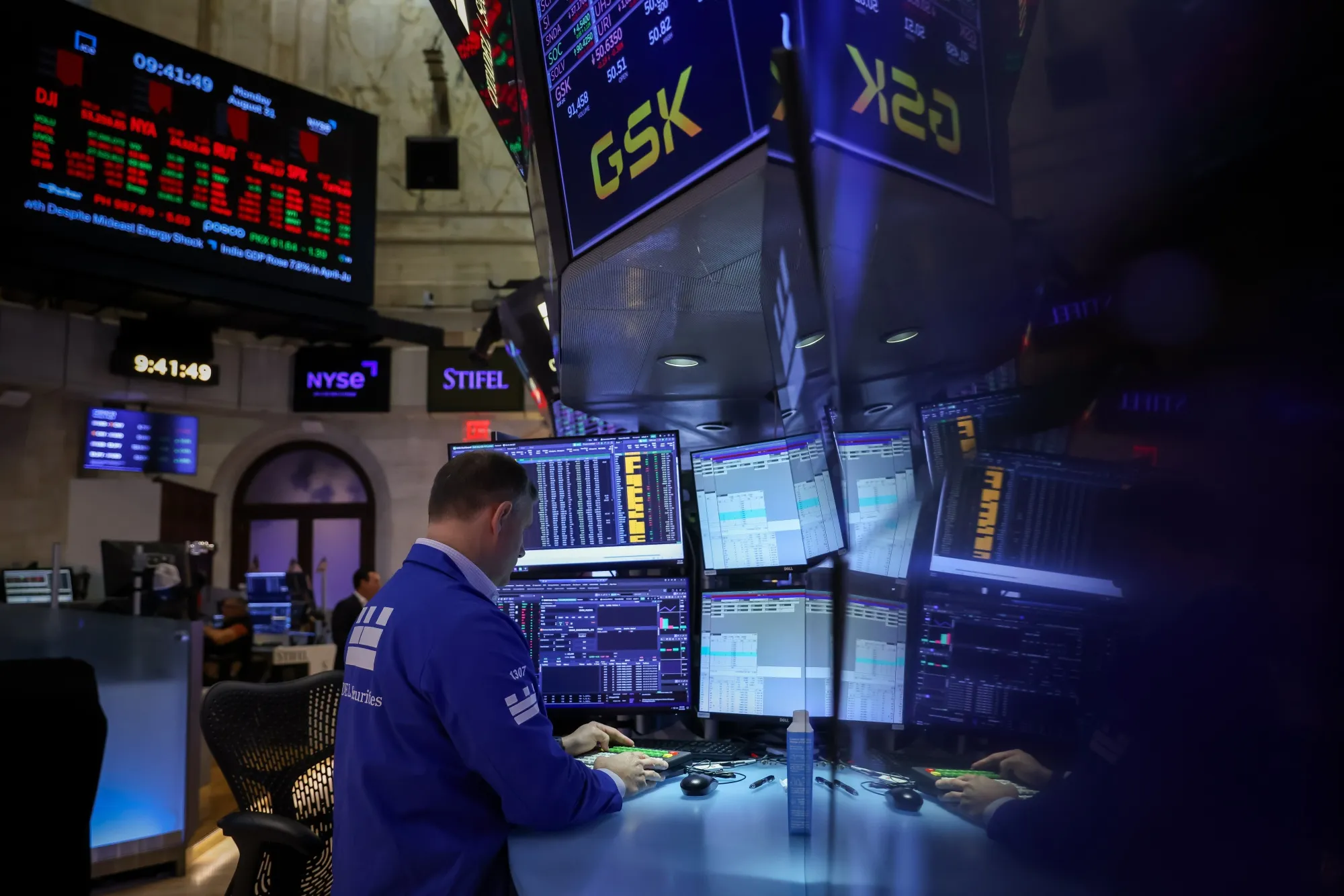
Bloomberg – Stocks Fall as Long-Term Yields Hit 24-Year High: Markets Wrap
______
6. Paramount Launches $52 Billion Debt Package for Warner Deal
Paramount Skydance Corp. has kicked off its long-awaited investment-grade bond sale, the largest component of a $52 billion syndicated debt package to finance its acquisition of Warner Bros. Discovery Inc.
The US media company is offering eight tranches of first-lien US dollar-denominated bonds, with maturities ranging from two to 40 years, according to a person familiar with the matter. Paramount is seeking to raise about $32 billion, which would make the offering the fifth-largest US high-grade bond sale on record.
Initial price talk for the longest-dated bond, due in 2066, was a spread of about 3.65 percentage points over Treasuries, the person said. Apollo Global Management Inc., Bank of America Corp. and Citigroup Inc. are leading the offering, which is expected to price Wednesday.
It is unusual for a high-grade bond offering not to price on the same day that syndication begins.
Paramount’s financing package also includes about $12.4 billion equivalent of junk bonds in US dollars and euros, as well as about $7.5 billion equivalent of loans in both currencies. Both offerings are underway.
The debt is coming to market after a months-long delay and at a higher cost for Paramount, as rising Treasury yields have pushed up borrowing costs for companies. The financing had initially been expected around midyear, but was put on hold after the Warner transaction faced litigation. Two settlements last week cleared the way for the offering to proceed.
Paramount had attracted enough investor interest as of Monday to cover the size of the bond deal, putting it on track to rank among the most sought-after investment-grade offerings on record.
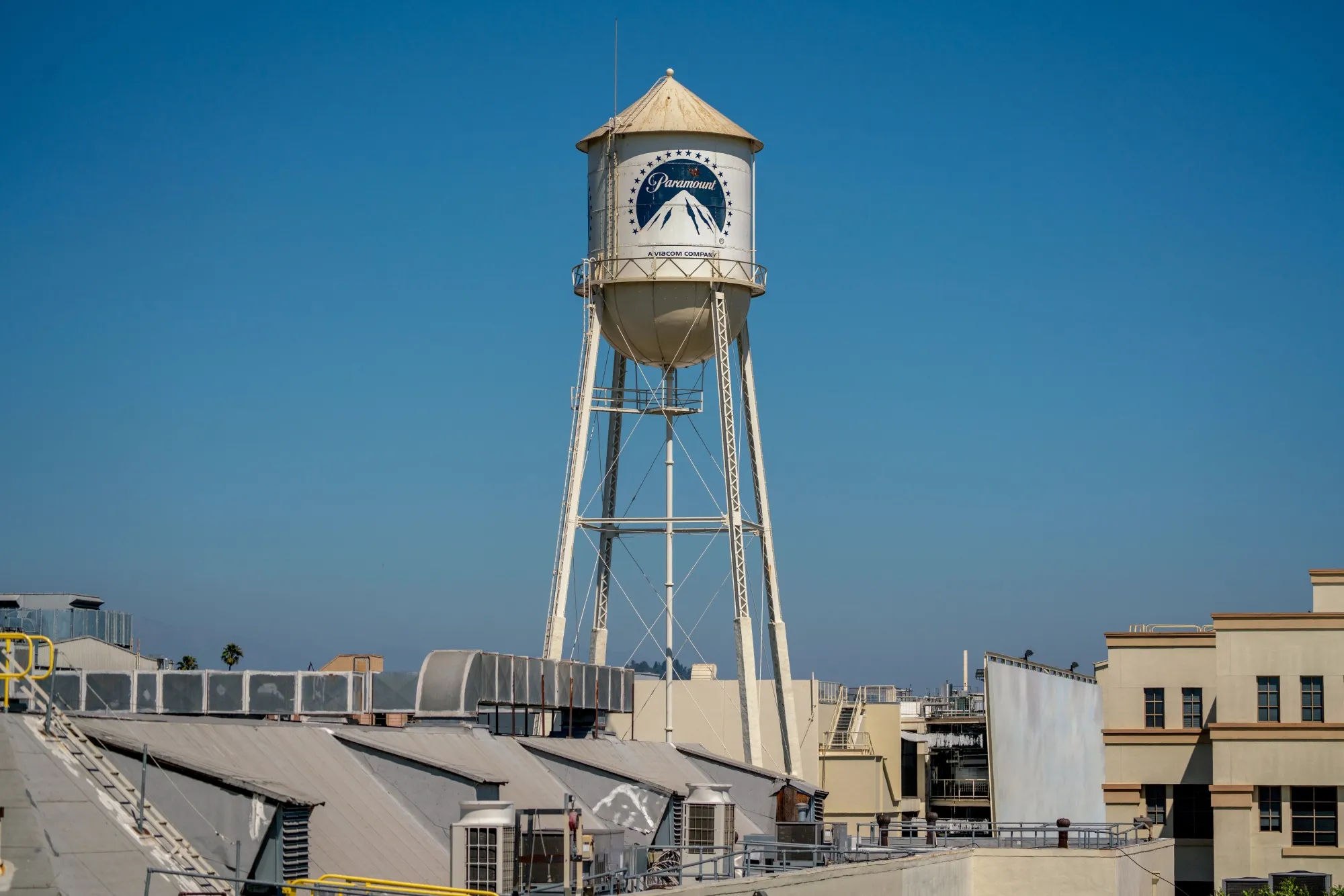
Bloomberg – Paramount Kicks Off High-Grade Bond Sale for Warner Bros. Deal
______
7. Apple CEO John Ternus Considers Overhaul to Accelerate Product Development
Former senior Bank of America Corp. investment banker Jason Satsky was accused by the US Securities and Exchange Commission of providing an insider-trading tip to a friend who allegedly made $18.5 million in illegal profits.
Satsky, who was previously Bank of America’s head of energy and power infrastructure banking, was sued Friday by the SEC along with the friend, Gavin Wolfe. According to the SEC, Satsky tipped Wolfe off on an acquisition offer for South Jersey Industries Inc. during a November 2021 basketball game.
Between November and December 2021, Wolfe bought at least $53 million in stock and the pair continued to converse, the SEC said.
The SEC suit doesn’t name Bank of America as Satsky’s then-employer, but Bloomberg has previously reported that federal prosecutors were probing trades around the deal.

Bloomberg – Apple’s New CEO Seeks to Make Company Run Faster and Leaner
______