
—— Mpower Financing Curtails Operations as Immigration Crackdown Disrupts Funding; US Mortgage Rates Rise for Seventh Straight Week; New Jersey Suburban Cost Advantage for Families Is Shrinking; SpaceX Seeks $40 Billion Financing for Nvidia Chip Purchase; Porsche Plans 20% Increase in Average Price of Top Models; HSBC Plans Sweeping Job Cuts in UK Wealth Management; Google Launches AI Platform for Creating Video Games with Text Prompts
1. Mpower Financing Curtails Operations as Immigration Crackdown Disrupts Funding
A US lender specializing in loans to international students has sharply scaled back its operations after losing access to fresh financing, highlighting the financial fallout that tighter immigration and visa policies can have on lenders serving foreign students.
Mpower Financing had become heavily reliant on borrowers from several African countries, particularly Zimbabwe. The US administration added Zimbabwe to a partial travel-ban list last year, leaving the lender particularly exposed to the policy shift. A person with direct knowledge of Mpower’s lending strategy said the company’s concentration in loans to Zimbabwean students had grown beyond what it originally intended.
The Washington, DC-based company relied heavily on warehouse financing to fund its business. It used credit facilities, including one from Deutsche Bank AG, to originate student loans and then bundled those loans into asset-backed securities that were sold to money managers. The proceeds were used to repay the financing facilities and free up capacity for additional lending.
That funding cycle began to break down earlier this year as demand for Mpower’s ABS dried up following the implementation of the new restrictions. According to an investor letter seen by Bloomberg, the development sharply curtailed the company’s ability to make new loans. An effort to sell the company around the same time also failed.
Mpower subsequently cut most of its workforce, including founder and Chief Executive Officer Manu Smadja. Last month, the company canceled its quarterly shareholder call and warned equity investors that they were likely to be wiped out.

Bloomberg – Student Lender Collapses as Immigrant Crackdown Roils Loan Book
______
2. US Mortgage Rates Rise for Seventh Straight Week
US mortgage rates climbed for a seventh consecutive week, reaching their highest level in nearly three years and adding to the affordability pressures already weighing on the housing market.
The contract rate on a 30-year fixed mortgage rose 19 basis points to 7.49% in the week ended Oct. 2, the highest level since November 2023, according to data released Wednesday by the Mortgage Bankers Association. Rates have climbed about half a percentage point over the past three weeks, marking their fastest increase since early 2023.
The rise in mortgage rates has closely tracked the recent move higher in Treasury yields. Since the start of the Iran war, higher energy costs and broader inflation pressures have pushed up the yield on 10-year US Treasury notes, a key benchmark for mortgage rates. The 10-year yield reached its highest level since 2002 on Monday.
Higher borrowing costs, combined with still-elevated home prices, have made it difficult for both existing-home and new-home sales to sustain momentum. The increase in mortgage rates is also adding to monthly payment burdens for prospective buyers, further limiting demand.
The MBA’s purchase index, which tracks mortgage applications for home purchases, fell 2.1% during the week to its lowest level in more than a year. Its refinancing gauge dropped 7.5%, extending a decline that began in mid-August.
The MBA survey has been conducted weekly since 1990 and draws responses from mortgage bankers, commercial banks and thrifts. The data cover more than 75% of all retail residential mortgage applications in the US, making the survey a closely watched indicator of housing-finance demand.
With inflation and borrowing costs still elevated, the continued rise in mortgage rates is becoming an increasingly significant drag on the US housing market. Higher financing costs are weighing on buyers’ willingness to enter the market and adding to the affordability challenges facing households.
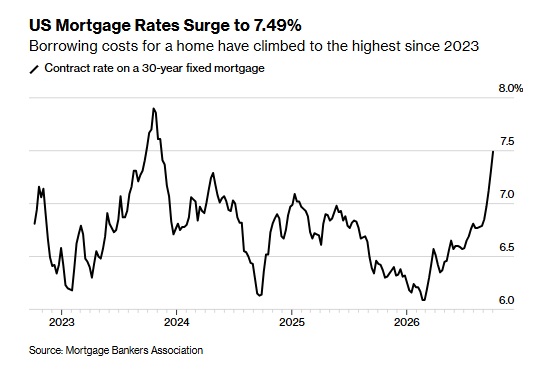
Bloomberg – US Mortgage Rates Jump to 7.49%, Highest Since 2023
______
3. New Jersey Suburban Cost Advantage for Families Is Shrinking
For decades, the formula for many New York families was straightforward: Keep a high-paying job in New York City while living across the Hudson River in New Jersey, where a lower cost of living allowed households to stretch their income further. But that suburban discount is becoming increasingly difficult to maintain.
The annual budget needed to support a dual-income family of four in New Jersey increased by about $40,800 between 2021 and 2026, representing an average annual increase of 6.7%, according to the Living Wage Institute, a nonpartisan public benefit corporation that tracks household costs including housing, child care, food, transportation and healthcare.
Every county in New Jersey has seen family budgets grow faster than the 4.5% national median. Eight of the 20 US counties with at least 100,000 residents that recorded the fastest growth in family budgets since 2021 are located in New Jersey suburbs.
The increase in family costs accelerated during the pandemic, when a surge in housing prices pushed up household expenses across the state. Since 2023, the pace of growth in child-care and healthcare costs has more than tripled, adding further pressure to annual family budgets.
The trend is also narrowing the traditional cost gap between New York City and its New Jersey suburbs. Families that moved across the Hudson to escape the high cost of living in the city are now seeing their budgets increase faster than in Manhattan.
Manhattan household expenses rose at an annual rate of 4.6% over the past five years, compared with a 6.7% annual increase in New Jersey family budgets.
For families relying on two incomes while facing large housing, child-care and healthcare bills, the financial calculation behind suburban life is changing. The New Jersey suburbs may still offer an alternative to New York City, but the cost advantage that once made the move especially attractive is steadily shrinking.

Bloomberg – NYC Families That Fled to Suburbs See Jersey Discount Disappear
______
4. SpaceX Seeks $40 Billion Financing for Nvidia Chip Purchase
SpaceX is seeking to raise about $40 billion to finance a major purchase of Nvidia’s advanced AI chips, underscoring the enormous amounts of capital being deployed to build the infrastructure supporting the AI boom.
The Elon Musk-led space and AI company plans to raise about $10 billion through bank loans and another $30 billion through investment-grade debt, according to people familiar with the matter. Private capital group Apollo is expected to lead the financing and help distribute the debt to a broad base of investors.
Bond manager Pimco is among a small group of lenders that have been in discussions about financing the transaction, the people said. The deal is expected to close in 2027.
The financing plans highlight the vast sums being raised to fund investments in data centers, AI chips and other infrastructure needed to support the rapid expansion of artificial intelligence. SpaceX’s BBB credit rating, the second-lowest investment-grade rating, would allow insurance companies and pension funds to participate in the debt offering. Such investors typically have more limited capacity to hold below-investment-grade bonds.
The deal would deepen the relationship between SpaceX and Nvidia as Musk continues to increase his reliance on Nvidia technology for his AI initiatives. It would also represent a significant win for Nvidia as it faces growing competition from chipmakers seeking to challenge its dominance in advanced AI semiconductors.

Financial Times – SpaceX looks to raise $40bn to buy Nvidia chips
______
5. Porsche Plans 20% Increase in Average Price of Top Models
Porsche plans to raise the average price of its most expensive models by about 20% by 2030, as the German sports-car maker shifts toward selling fewer, more exclusive vehicles in an effort to strengthen profitability.
Chief Executive Officer Michael Leiters outlined the multiyear strategy at an investor day on Wednesday, saying the company wants to further elevate the Porsche brand, preserve its exclusivity and gain greater pricing power.
The average price of Porsche’s top models is expected to rise to more than €330,000 by the end of the decade, from about €270,000 currently. At the same time, the company expects its high-end models to account for about 45% of its portfolio, up from roughly one-third today.
The strategy marks a shift away from relying primarily on sales growth and toward higher-margin sports cars and limited editions. It also echoes Ferrari’s approach of using scarcity and exclusivity to support pricing and profitability. Ferrari has achieved an operating profit margin of about 30%, well above most traditional automakers.
Porsche has historically generated outsized profits for parent Volkswagen Group, helped by rapid growth in China. But that model has come under pressure as sales in the world’s largest car market have fallen sharply. Higher US tariffs have added another challenge.
The company is also dealing with the costs of reversing parts of its earlier electric-vehicle strategy. Porsche previously made a major push toward EVs and reduced its focus on combustion-engine models, but it has since taken substantial writedowns and committed additional investment to gasoline-powered vehicles.
Leiters, who took over as Porsche CEO in January after previously leading McLaren, is now seeking to reposition the company around higher-value vehicles rather than maximizing unit sales.
The strategy could make Porsche more dependent on affluent customers and the strength of demand for its most exclusive models, but it also gives the company greater scope to offset weaker volumes through higher prices and margins.

Financial Times – Porsche to raise top model prices by 20%
______
6. HSBC Plans Sweeping Job Cuts in UK Wealth Management
HSBC is planning sweeping job cuts across its UK wealth management business as the bank seeks to use artificial intelligence and digital tools to serve wealthy clients with a significantly smaller workforce.
About half of the management and specialist roles in the UK wealth business are expected to be eliminated, while the number of financial advisers could fall by close to 70%, according to people familiar with the plans.
One person described the proposed reductions as “deep, wide and brutal,” saying that some teams could be almost entirely eliminated.
HSBC does not disclose the number of employees in its UK wealth business, but the division is believed to have hundreds of relationship managers across the country. The bank is currently in a consultation period over the proposed changes, according to one person familiar with the plans, with affected employees expected to leave at the end of the month.
HSBC said in a statement that its UK business is continuing to evolve by developing more digitally enabled products and customer journeys to support its wealth-management offering and respond to changing client needs.
The cuts come as financial institutions across the industry debate whether AI will primarily make existing employees more productive or allow companies to operate with substantially smaller workforces. HSBC’s planned restructuring appears to point toward the latter model in at least part of its wealth business.
The move also represents a sharp reversal from the bank’s strategy two years ago, when HSBC embarked on a hiring push to expand its UK wealth and private banking operations. At the time, the bank set an ambitious goal of doubling assets under management to £100 billion by the end of the decade.
The business had just over £62 billion in assets under management at the end of last year, leaving it well short of that target.
Financial Times – HSBC plans sweeping job cuts across UK wealth business in AI push
______
7. Google Launches AI Platform for Creating Video Games with Text Prompts
American households that rely primarily on heating oil are facing significantly higher energy costs this winter. The US Energy Information Administration (EIA) expects heating bills for these households to rise about 21% from last winter.
The forecast adds to the energy-cost pressures facing the Trump administration. With the midterm elections just four weeks away, Republicans are expected to face voter dissatisfaction over higher gasoline, electricity and other energy costs.
Heating oil prices are closely linked to diesel, which has surged as the US-Iran war and Ukrainian drone strikes on Russian refineries have tightened fuel supplies.
The EIA expects heating oil prices across the US to rise about 30% this winter from a year earlier. However, milder weather in the Northeast is expected to partially offset the impact on household bills, as homeowners may consume less fuel.
About 3% of US households primarily rely on heating oil, with the vast majority located in the Northeast. Maine has the highest share of heating-oil-dependent households in the country. As of Sept. 28, heating oil prices in the state stood at $5.96 per gallon, nearly 80% above the level a year earlier.
The EIA also raised its forecast for crude oil prices. It now expects Brent crude to average $105 a barrel in the fourth quarter, $14 higher than its previous estimate. US retail diesel prices are expected to remain above $6 a gallon through October before falling toward $4.50 a gallon next year.
On the supply side, the agency expects Middle Eastern oil production and exports to gradually recover. Increased shipments through the Strait of Hormuz, combined with alternative transportation routes and other supply workarounds, could eventually ease pressure on global oil markets.

Financial Times – Google launches platform to create video games from text prompts
______