
—— Paramount Completes $110 Billion Warner Bros. Discovery Deal; Ford Shares Fall 30% From May Peak as Analyst Optimism Persists; US Trade Deficit Widens to Biggest Since Early 2025; S&P 500 Hits Record High on AI Earnings Optimism; McDonald’s Overhaul Plan Raises Concerns Among Franchisees Over Costs; Distressed Leveraged Loans Surge to Pandemic-Era Levels; US Heating Bills for Oil-Dependent Households Could Rise 21% This Winter
1. Paramount Completes $110 Billion Warner Bros. Discovery Deal
Paramount Skydance Corp. completed its $110 billion acquisition of Warner Bros. Discovery Inc. on Tuesday, bringing together two major Hollywood studios after a bruising battle for control with Netflix Inc. and a series of antitrust challenges.
The combined company will be called Skydance and will unite two of Hollywood’s five largest film studios, bringing major franchises including Harry Potter and Mission: Impossible under one roof. It will also control dozens of television networks, from CBS to TNT, as well as two major subscription streaming platforms, Paramount+ and HBO Max.
The deal further cements David Ellison’s growing influence in the media business. Ellison completed the merger of his Skydance Media production company with Paramount in August 2025, and has now completed another major acquisition in just over a year, establishing himself as one of Hollywood’s most powerful media executives.
To help run the enlarged company, Ellison brought in Ynon Kreiz from Mattel Inc. to serve as co-chief executive officer. Kreiz will oversee day-to-day operations, while Ellison will retain responsibility for the company’s creative and long-term vision and relationships with talent.
“Today is a historic day, not just for Skydance but for our entire industry,” Ellison said in a statement.
After pulling off two mega-mergers involving century-old Hollywood companies in little more than a year, Ellison now faces the difficult task of making the combined business work. That includes eliminating overlapping operations and jobs without provoking further backlash in Hollywood, an industry already suffering from a downturn and one that has opposed media consolidation from the outset.
Skydance must also manage nearly $80 billion of debt while adhering to a strict schedule for theatrical releases required under the settlement of the antitrust litigation.

Bloomberg – Paramount Closes Warner Bros. Merger in Historic Hollywood Deal
______
2. Ford Shares Fall 30% From May Peak as Analyst Optimism Persists
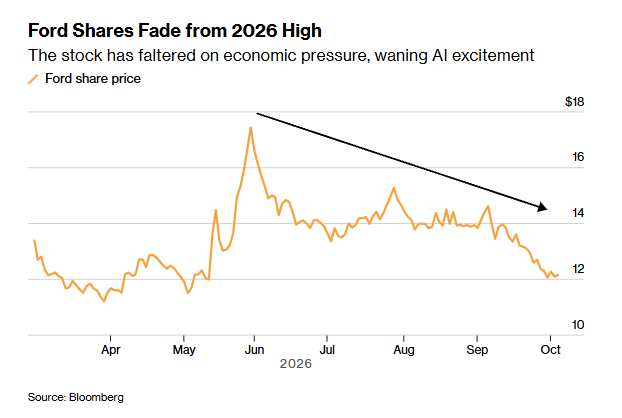
Ford Motor Co. shares have retreated sharply as enthusiasm from an earlier rally fades and a tougher economic backdrop weighs on the auto industry. Analysts, however, remain relatively upbeat, continuing to raise price targets on expectations that the company’s earnings will improve.
The stock has fallen about 30% from its May peak, when investors pushed shares higher on hopes that Ford would benefit from the buildout of artificial-intelligence infrastructure. Since then, analysts have raised their average price target by 16%, leaving the gap between Ford’s stock price and Wall Street’s target at its widest in three years, according to Bloomberg data.
The divergence leaves investors facing two possibilities: The market may have become too pessimistic, or analysts may still be too optimistic about Ford’s prospects.
Such a disconnect between analysts and investors is not unusual, said Eric Diton, president and managing director of The Wealth Alliance. But he said investors should pay attention to what the stock market is signaling.
“I believe the market before the analysts,” Diton said. “I see no reason to rush into the stock — I would rather pay more and see better fundamentals.”
Ford has had a volatile year. The shares surged 44% in May as investors bet the automaker would benefit from the expansion of artificial-intelligence infrastructure. But the rally faded as a lack of updates on customer demand and production capacity made it harder to sustain those gains.
The shift has left Ford with a growing disconnect between its current share price and analysts’ expectations, even as investors wait for clearer evidence that the earlier AI-driven optimism can translate into stronger fundamentals.
Bloomberg – Ford Selloff Tests Wall Street’s Faith in an Earnings Recovery
______
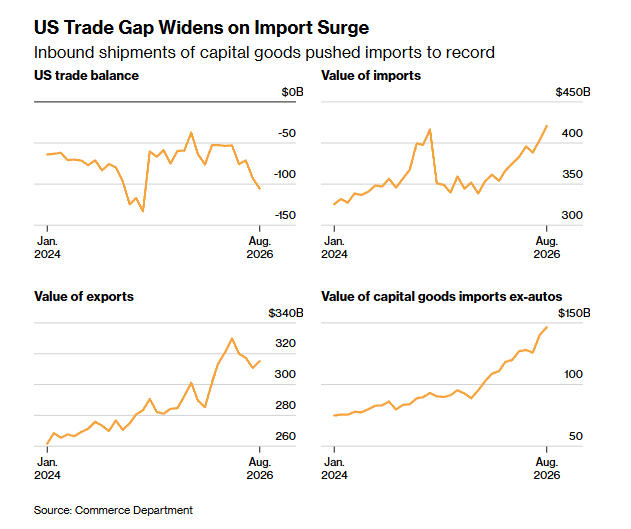
3. US Trade Deficit Widens to Biggest Since Early 2025
Amazon is considering selling about $8 billion of advanced Nvidia chips to outside investors through a new special-purpose vehicle, then leasing the equipment back to support its US data centers, according to people familiar with the matter.
The Seattle-based cloud company has held discussions with investors in recent weeks to gauge demand for the proposed transaction. Under the plan, thousands of Nvidia Grace Blackwell chips deployed across Amazon’s US data centers would be transferred to the special-purpose vehicle, which would raise debt from outside investors to finance the purchase.
Amazon would then lease the chips back, allowing it to use the equipment while shifting ownership of the expensive semiconductors off its balance sheet. The structure would give Amazon a more asset-light way to fund its rapidly expanding AI infrastructure.
Amazon declined to comment.
The proposal comes as major technology companies look for new ways to finance the huge capital outlays required to build AI data centers. Chips used to train increasingly sophisticated AI models account for a significant portion of those costs.
Tech companies have been exploring structures that move debt or financing obligations away from their balance sheets as they seek to preserve their credit profiles. Some have used residual-value guarantees, giving lenders assurances about the future value of chips or data centers without directly borrowing to fund the projects. Such arrangements can make it harder for investors to assess the full amount of risk being assumed by the technology companies.
Investors expect the new entity could receive an investment-grade rating, supported by Amazon’s current double-A credit rating. That could broaden the pool of potential buyers to include insurance companies and pension funds.
Amazon also plans to sell as much as 10% of the equity in the vehicle to investors, meaning it would not retain an ownership stake in the entity.
Discussions between Amazon and investors are ongoing and the structure could change, the people said. The chips included in the proposed transaction were bought or leased by Amazon and have already been deployed at more than a dozen data centers across five US states, including Nevada and Virginia.
Bloomberg – US Trade Gap Widens to $105.6 Billion as Imports Hit Record
______
4. S&P 500 Hits Record High on AI Earnings Optimism
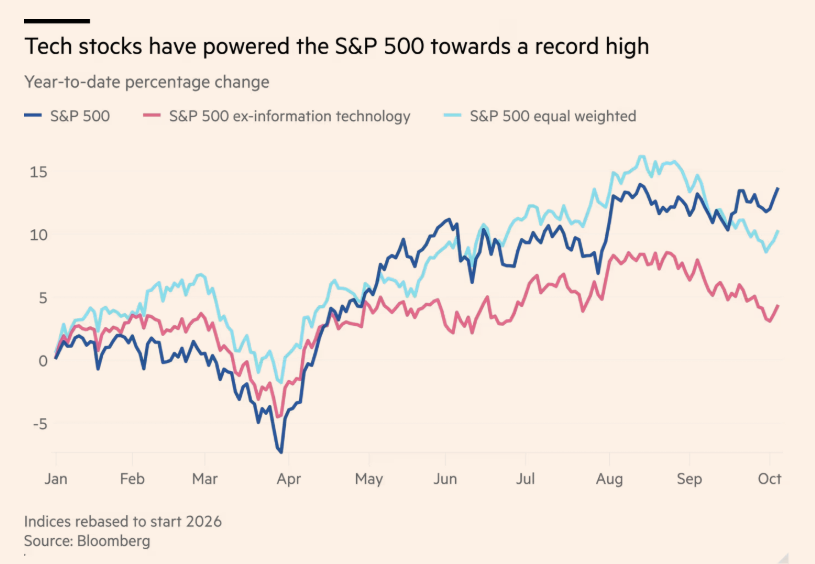
The S&P 500 touched a record high on Tuesday for the first time since August as expectations for strong earnings from AI-related companies helped stocks shrug off a sharp selloff in government bonds.
The blue-chip index rose 0.7%, reaching a new all-time high after a downturn in September. At the time, elevated oil prices and US Treasury yields at multi-decade highs had raised concerns that tighter financial conditions could weigh on risk assets.
Investors and analysts said the latest rally is being driven largely by expectations for a strong third-quarter earnings season, with trillions of dollars flowing into artificial-intelligence infrastructure and supporting growth among technology companies tied to the AI boom.
The gains have not been broad-based, however. Many sectors have lagged behind, leaving the market increasingly dependent on a small group of technology stocks and raising concerns about the concentration of the rally.
“We are in an earnings upswing,” said Arun Sai, senior multi-asset strategist at Pictet Asset Management. “In the short term, I just don’t see any evidence of that cracking.”
Sai acknowledged that there is “no dearth of excuses to be bearish,” including high oil prices, rising bond yields and concerns over potentially circular spending among AI companies. But he said macroeconomic, fundamental and technical factors still support holding equities.
Financial Times – Saudi Aramco chief warns world’s oil stockpiles are ‘scarily thin’
______
5. McDonald’s Overhaul Plan Raises Concerns Among Franchisees Over Costs
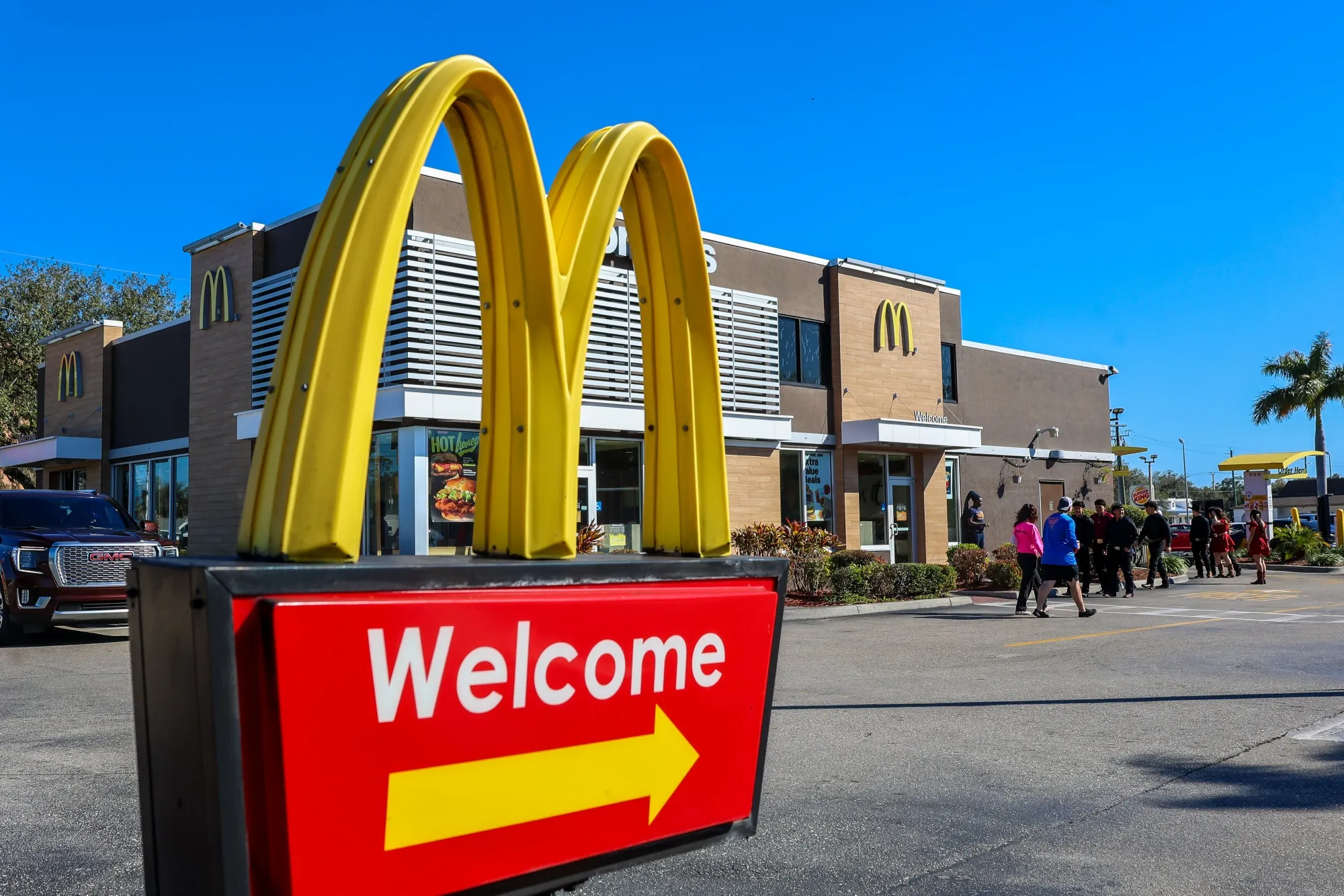
McDonald’s ambitious effort to overhaul its US restaurants and menu is facing resistance from franchisees who are being asked to shoulder hundreds of thousands of dollars in additional costs per location.
The company estimates that the latest multiyear initiative, aimed at improving food quality, service and efficiency, will cost US franchisees about $800,000 per restaurant to implement. Some franchise owners said they were surprised by the price tag disclosed two weeks ago and have raised concerns about the cost and the lack of details surrounding the plan.
Franchisees have discussed the initiative in a series of recent meetings, including gatherings organized by an elected association representing US operators, according to people familiar with the matter.
The support of franchisees is particularly important for McDonald’s as the company works to restore investor confidence after a difficult year for its stock.
From its peak in late February through the end of September, around the time Chief Executive Officer Chris Kempczinski unveiled his “Next” business plan, McDonald’s shares fell about 32%. The decline erased nearly $80 billion in market value over roughly seven months and has put the stock on track for its worst annual performance since 2002.
The $800,000 cost of the new upgrades would come on top of existing remodeling requirements. Franchisees are already expected to spend at least $400,000 per restaurant on scheduled renovations, bringing the potential total investment to roughly $1.2 million per location over the coming years.
McDonald’s has pledged about $8.5 billion in cash and rent relief to help offset some of those expenses, although the level of support will vary by franchisee.
Bloomberg – McDonald’s Franchisees Balk at Costly Bill to Upgrade Stores
______
6. Distressed Leveraged Loans Surge to Pandemic-Era Levels
Stress in the riskiest corners of the leveraged-loan market is intensifying, with the amount of deeply distressed debt reaching levels not seen since the beginning of the pandemic and technology emerging as the single largest sector under pressure.
Strategists at JPMorgan Chase & Co. said Tuesday that the value of leveraged loans trading below 60 cents on the dollar — a level considered deeply distressed — has climbed to $65 billion, up from $40 billion a year ago. That is the highest level since March 2020.
The broader pool of distressed leveraged loans, defined as those trading at or below 80 cents on the dollar, has also expanded sharply. The total has reached $139.8 billion, an increase of nearly 90% over the past 12 months and just $4 billion below the peak reached in May 2020, according to strategists including Nelson Jantzen.
There are now about 141 leveraged-loan issuers trading below 80 cents on the dollar, 35 more than a year ago. Software providers including CDK Global, QLIK Technologies Inc. and Quest Software are among the largest contributors to the distressed pool.
Technology accounts for the largest concentration of distressed loans, representing 39% of the total, or about $54.4 billion.
The pressure is particularly acute for software companies, which face a difficult refinancing environment as more than $100 billion of debt approaches maturity. The sector has also come under pressure from growing concerns that advances in artificial intelligence could disrupt traditional software businesses and weaken some companies’ revenue models.
At the riskiest end of the leveraged-loan market, CCC-rated loans have performed particularly poorly. Returns on CCC loans are down 1.97% so far this year, while every other junk-rated category has posted gains, according to JPMorgan.
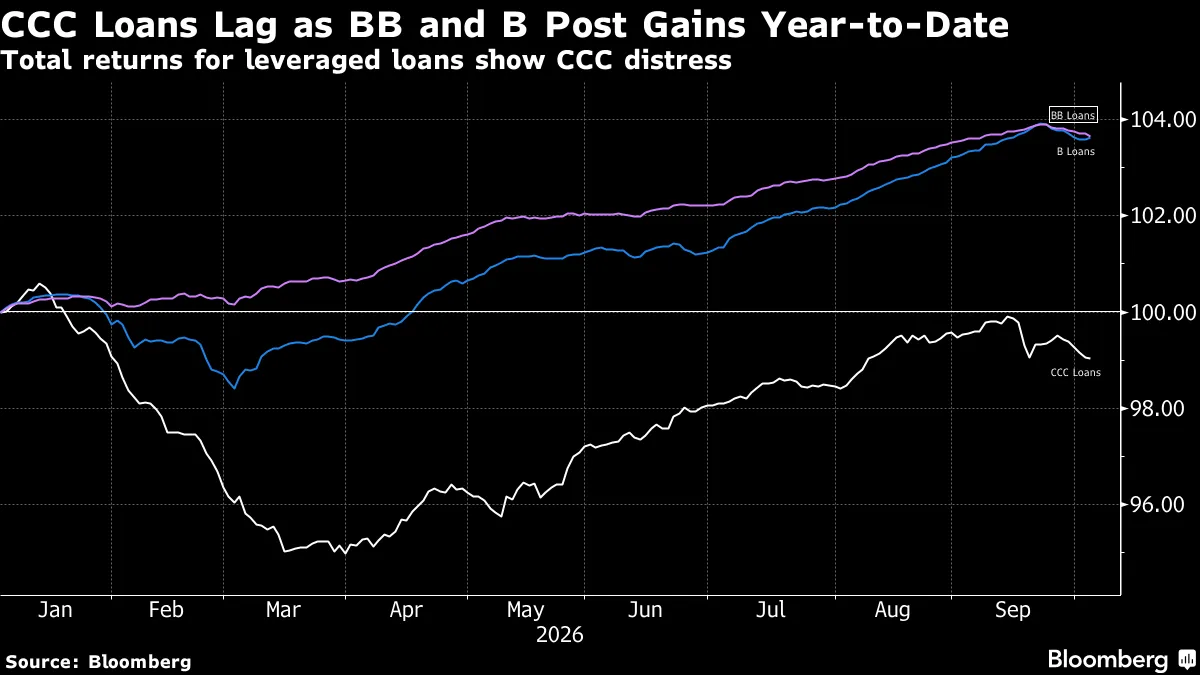
Bloomberg – Deeply Distressed US Loans Rise to Highest Level Since Pandemic, JPMorgan Says
______
7. US Heating Bills for Oil-Dependent Households Could Rise 21% This Winter
American households that rely primarily on heating oil are facing significantly higher energy costs this winter. The US Energy Information Administration (EIA) expects heating bills for these households to rise about 21% from last winter.
The forecast adds to the energy-cost pressures facing the Trump administration. With the midterm elections just four weeks away, Republicans are expected to face voter dissatisfaction over higher gasoline, electricity and other energy costs.
Heating oil prices are closely linked to diesel, which has surged as the US-Iran war and Ukrainian drone strikes on Russian refineries have tightened fuel supplies.
The EIA expects heating oil prices across the US to rise about 30% this winter from a year earlier. However, milder weather in the Northeast is expected to partially offset the impact on household bills, as homeowners may consume less fuel.
About 3% of US households primarily rely on heating oil, with the vast majority located in the Northeast. Maine has the highest share of heating-oil-dependent households in the country. As of Sept. 28, heating oil prices in the state stood at $5.96 per gallon, nearly 80% above the level a year earlier.
The EIA also raised its forecast for crude oil prices. It now expects Brent crude to average $105 a barrel in the fourth quarter, $14 higher than its previous estimate. US retail diesel prices are expected to remain above $6 a gallon through October before falling toward $4.50 a gallon next year.
On the supply side, the agency expects Middle Eastern oil production and exports to gradually recover. Increased shipments through the Strait of Hormuz, combined with alternative transportation routes and other supply workarounds, could eventually ease pressure on global oil markets.

Bloomberg – US Heating-Oil Bills Expected to Rise 21% This Winter, EIA Says
______