—— Nvidia Invests $3.5 Billion in MediaTek; US 10-Year Yield Tops 4.75% as Rising Oil Prices Fuel Fed Rate Hike Bets; SEC Plans to Scrap Shareholder Proxy Rules to Return Power to States; California Utility Stocks Plunge as Wildfire Liability Relief Effort Fails; LIV Golf May File for Bankruptcy as Early as Next Week; Cash-Strapped Colleges Drain Endowments to Survive Deficits; US and Iran Exchange Strikes as Strait of Hormuz Tensions Escalate
1. Nvidia Invests $3.5 Billion in MediaTek
Nvidia Corp. is investing $3.5 billion in MediaTek Inc., deepening collaboration with the Taiwanese chipmaker at a time when it’s working to persuade more companies to build chips that plug into its dominant data center ecosystem.
Nvidia will buy bonds convertible into MediaTek shares, the companies said in a joint statement on Monday.
The investment broadens a partnership between the two chip designers under which MediaTek will use NVLink Fusion and the newly announced NVHBM technology as part of an Nvidia tech suite to help components communicate more seamlessly in data centers. The smaller company is trying to challenge Broadcom Inc. and Marvell Technology Inc. by helping owners of data centers create their own components. For Nvidia, the new agreement is the latest effort to ensure the future of artificial intelligence is built around its hardware platform and standards.
The company has been building data center interconnect systems like NVLink Fusion and partnering with the likes of MediaTek to ensure it maintains a central role in the entire hardware chain, not just with its class-leading AI accelerators. The MediaTek agreement follows a similar agreement with Amazon.com Inc., which agreed to deploy an additional 2 million Nvidia components. Critically, Amazon also pledged to use Nvidia’s connection technology with its in-house chips.
Nvidia Chief Executive Officer Jensen Huang, who was born in Taiwan, is tightening ties with a company working to reduce its reliance on the smartphone market. MediaTek earlier this year secured a partnership with Alphabet Inc.’s Google, and is gaining credibility as a design partner to major tech firms that are seeking to build their own AI chips. That momentum has led the chipmaker’s market value to roughly triple in recent months.

Bloomberg – Nvidia to Invest $3.5 Billion in Chipmaker MediaTek
______
2. US 10-Year Yield Tops 4.75% as Rising Oil Prices Fuel Fed Rate Hike Bets
The US 10-year yield topped 4.75% on Monday for the first time since January 2025 as rising oil prices bolstered expectations that the Federal Reserve will hike interest rates.
The selloff extended to other tenors, with five-year yields also hitting their highest level since early last year. Key oil benchmarks rose more than 3%, reaching session highs during US morning hours after President Donald Trump threatened Iran with additional attacks. Monday’s moves extend a selloff that has gripped Treasuries in recent days, as investors grapple with percolating worries over government debt while gauging how aggressively the Fed will need to raise rates in order to fight inflation. Short-dated yields soared on Friday after Fed Chairman Kevin Warsh, speaking at the central bank’s Jackson Hole Symposium, signaled an increased likelihood of rate hikes aimed at curbing price pressures. While 30-year yields also climbed Monday, rising five basis points to near 5.26%, they remained well below their mid-August multiyear highs, having retreated after the Treasury Department said earlier this month it would increase its buybacks of debt in the sector to bolster its market value.
The longest-maturity Treasuries may also benefit from anticipation of buying tied to the month-end rebalancing of bond indexes at 4 p.m. New York time, in which the larger-than-average amount of 10- to 30-year debt sold during the month will be added to benchmarks.
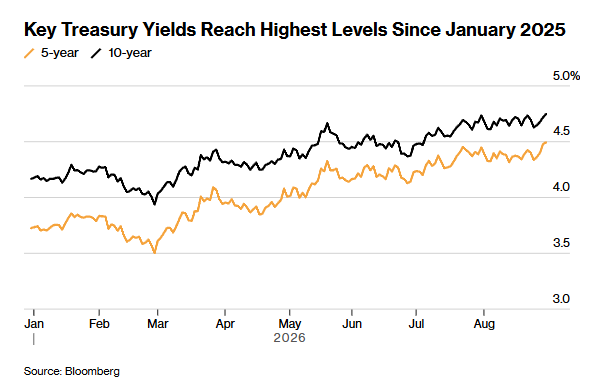
Bloomberg – Treasury 10-Year Yield Tops 4.75%, Highest Since January 2025
______
3. SEC Plans to Scrap Shareholder Proxy Rules to Return Power to States
The Securities and Exchange Commission is planning to scrap rules governing how and when public company shareholders can bring proxy proposals, according to a new post by the Office of Management and Budget.
The agency sent the proposal to the White House’s OMB for review last week, according to a notice published Monday. It marks the latest step in SEC Chairman Paul Atkins’ push to change the dynamics of the shareholder and corporate management relationship for publicly-traded companies.
“Since his time as a commissioner, Chairman Atkins has highlighted concerns that the SEC’s Rule 14a-8 on shareholder proposals exceeds the commission’s authority and infringes upon state laws,” an SEC spokesperson said in an email. The agency is looking to “return the role of regulating shareholder proposals to the States,” the spokesperson said.
Atkins has long criticized existing proxy rules for allowing for “the tyranny of the minority” of shareholders to seek changes in corporate governance, management or other business operations. His remarks have been most pointed toward to shareholders seeking changes in corporate environmental or social practices.
An analysis of the 2025 proxy season by law firm Freshfields found that social issues were by far the most prevalent topic of shareholder proposals, comprising 43% of the overall filings examined.
Bloomberg – SEC Tees Up Plan to Scrap Shareholder Proxy Proposal Rules
______
4. California Utility Stocks Plunge as Wildfire Liability Relief Effort Fails
Shares of PG&E Corp., Edison International and Sempra plunged Monday after an effort by California Governor Gavin Newsom to shift wildfire liabilities from the state’s utilities failed.
On Saturday, California lawmakers introduced a bill that would update the state’s wildfire response, but would not move liability away from publicly traded utilities, leading to at least three analysts cutting their recommendations on utilities stocks. Newsom and investors had advocated for the utilities to be shielded from wildfire-related lawsuits.
PG&E fell as much as 21%, its biggest intraday decline since 2020. Edison plunged 23% in its biggest drop since 2018. Shares of Sempra fell 5.6%, the biggest intraday decline since April 2025. BMO Capital Markets James Thalacker, who downgraded PG&E to market perform from outperform, sees the introduced legislation falling short of ensuring the California wildfire fund’s solvency and protecting the utilities from bankruptcy from wildfire risk. For PG&E, it will be “incrementally harder to attract capital relative not only to its utility peers given investors’ preference for accelerating, large-load-driven growth and aversion to significant wildfire-related liabilities, but also for generalist investors given the challenge of open-ended wildfire-related tail risk despite the company’s low absolute valuation,” he wrote in a note to clients. This risk is especially pronounced for PG&E which filed for Chapter 11 bankruptcy in 2019 after the company faced billions of dollars in wildfire liabilities.
PG&E “management has been clear over the last few quarters that absent a meaningful improvement in the state’s wildfire fund framework that both ensures the sanctity of the wildfire fund and protects the state’s investor-owned utilities from another bankruptcy, the company would have to explore alternative capital allocation strategy,” Thalacker wrote.
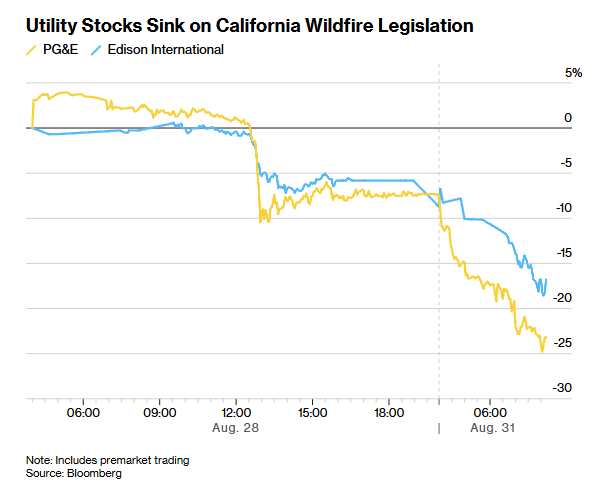
Bloomberg – PG&E, Edison Fall on California Wildfire Liability Worries
______
5. LIV Golf May File for Bankruptcy as Early as Next Week
LIV Golf may file for bankruptcy protection as soon as next week, as the challenger golf league races to find funding for a slimmed-down version slated for 2027, according to people briefed on the negotiations.
The league in recent days has sent settlement offers to the current LIV players who are owed millions in guaranteed payouts past 2026, with those initial offers at just a few cents on the dollar.
People with knowledge of the situation said the reluctance of Saudi Arabia’s sovereign wealth fund, which launched the league in 2022, to provide more funding had played into the meagre offer to the players. The LIV management, meanwhile, remains dependent on the Saudi Public Investment Fund for financial support needed to facilitate the transition.
LIV has for several weeks been negotiating a funding package with the credit division of private capital firm BC Partners, and BC executives have attended recent LIV tournaments in Indiana and New Jersey to make their pitch to players.
The FT previously reported on LIV’s attempt to strike a “grand bargain” whereby its golfers would simultaneously settle claims with the current LIV regime and agree to equity awards and other financial terms for “LIV 2.0”. Such a deal could be clinched in a pre-packaged bankruptcy.
However, securing commitments from enough top players to entice BC Partners and other funders has proved challenging. The DP World Tour, which runs events in Europe and the Middle East, has said that players on a future LIV circuit may face fines or bans for playing in league events scheduled in the same weeks as the DP World Tour.
The new LIV circuit envisions a global, 10-tournament slate that would probably require other tours to accommodate its players for the remainder of the season.
Financial Times – LIV Golf prepares for imminent bankruptcy filing
______
6. Cash-Strapped Colleges Drain Endowments to Survive Deficits
A college endowment is supposed to last forever, supporting students, professors and research in perpetuity.
Instead, many cash-strapped schools are draining their nest eggs just to stay alive.
Faced with multi-million dollar deficits, Hiram College in rural Ohio borrowed from its $56 million endowment. The 1,000-student liberal arts school — which boasts a statue of US President James Garfield, who worked as a janitor there to pay his tuition — eventually pulled more than $47 million from the fund. It even tapped money that donors had explicitly set aside for specific purposes, not for balancing the budget. Hiram is now working with the state attorney general’s office and is hashing out a repayment plan, a spokesperson said. The school is also notifying its donors about the draw from the endowment, both in writing and through in-person conversations.
David Haney, Hiram’s president from 2020 to 2023, said he was surprised to learn about the loans when he took office. He considers them a risky bet that many smaller schools feel forced to take in an era when US student enrollment has started to decline. Colleges need to focus on cutting expenses instead, he said.
“What a lot of these small colleges do is they think that things are going to turn around,” Haney said. “‘If we just invest in new athletic facilities, everything is going to be fine.’ In most cases, that doesn’t happen. To me, that’s why borrowing from the endowment and taking out debt is not the way to go about it.”
Hiram is far from alone. Nearly 200 private colleges borrowed from restricted endowment funds in 2025, up from about 130 in 2021, according to estimates from higher-ed consulting firm Perspective Data Science. Other colleges have avoided loans but are drawing more from their endowments each year than advisors consider sustainable.
Analysts liken both strategies to borrowing from a 401(k) — it may help in the short-term but carries long-term risks, such as downgrading a school’s credit rating.
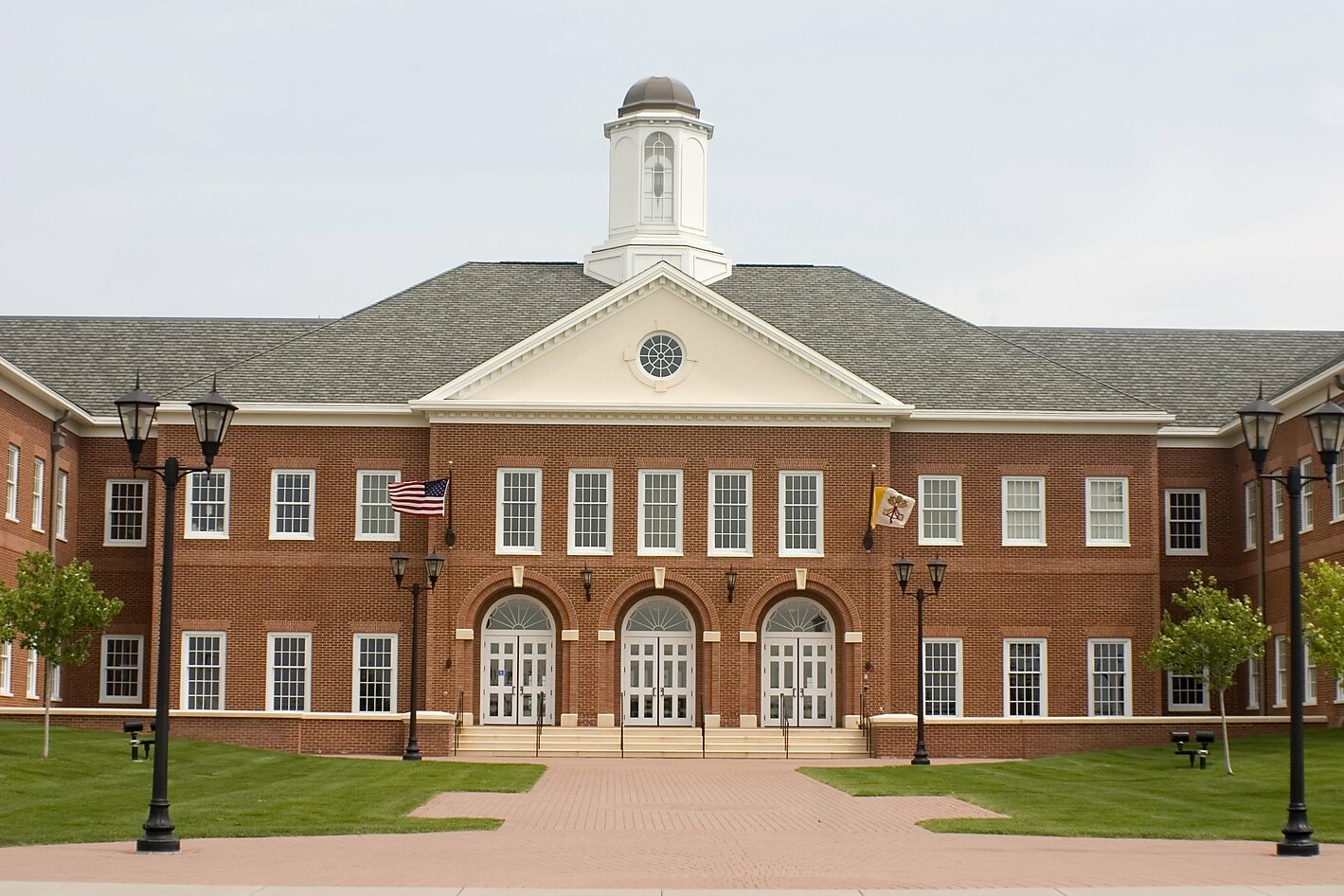
Bloomberg – Cash-Strapped Colleges Are Draining Their Endowments to Survive
______
7. US and Iran Exchange Strikes as Strait of Hormuz Tensions Escalate
Former senior Bank of America Corp. investment banker Jason Satsky was accused by the US Securities and Exchange Commission of providing an insider-trading tip to a friend who allegedly made $18.5 million in illegal profits.
Satsky, who was previously Bank of America’s head of energy and power infrastructure banking, was sued Friday by the SEC along with the friend, Gavin Wolfe. According to the SEC, Satsky tipped Wolfe off on an acquisition offer for South Jersey Industries Inc. during a November 2021 basketball game.
Between November and December 2021, Wolfe bought at least $53 million in stock and the pair continued to converse, the SEC said.
The SEC suit doesn’t name Bank of America as Satsky’s then-employer, but Bloomberg has previously reported that federal prosecutors were probing trades around the deal.

Bloomberg – US and Iran Exchange Attacks as Middle East Hostilities Reignite
______