—— US Retail Sales Rose 1.2% in August, Showing Consumer Resilience; US 30-Year Mortgage Rates Rise to 6.97%; Novo Nordisk Partners with Anthropic to Speed Up AI-Driven Drug Discovery; Federal Reserve Raises Rates for First Time Since 2023; PwC UK Revenues Fall for First Time in Two Decades; OpenAI Seeks $1.2tn Valuation in Private Funding Ahead of Planned IPO; US House Panel Votes to Hold Apollo Co-Founder Leon Black in Contempt Over Epstein Subpoenas
1. US Retail Sales Rose 1.2% in August, Showing Consumer Resilience
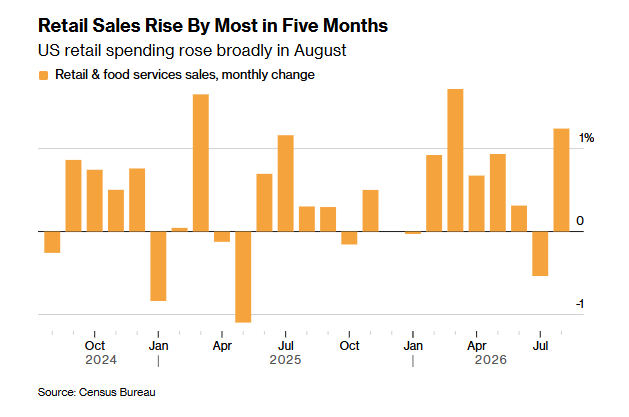
US retail sales rose by the most in five months in a broad advance, showing consumers continued to spend despite rising gas prices.
The value of retail purchases increased 1.2% in August after a revised 0.5% decline in July, according to Census Bureau data released Wednesday. The median estimate in a Bloomberg survey of economists called for a 0.8% advance. The figures are not adjusted for inflation. Consumer spending has been resilient this year, helping power overall economic growth. While the boost from tax refunds has faded, low unemployment and stock market gains are supporting households. Twelve of 13 retail categories in the report posted increases, including gasoline stations and online retailers. Back-to-school shopping likely supported outlays at general merchandise stores as well as spending on clothing, electronics, sporting goods and other hobbies.
So-called control-group sales — which feed into the government’s calculation of goods spending for gross domestic product — increased 1.4%, the most in nearly two years. The measure excludes food services, auto dealers, building materials stores and gas stations.
Sales at nonstore retailers, primarily online shopping, climbed 2.6% in August — the most since February 2025 — after falling the prior month. Amazon.com Inc. moved its Prime Day sales event to June this year from July the year before, a shift that likely distorted data and dragged down July’s headline retail sales numbers.
The value of gasoline station sales rose 3.1%. The nationwide average price of a gallon of gasoline held above $4 a gallon through August, according to American Automobile Association data. Prices have since climbed above $4.30 this month as wars in the Middle East and Ukraine limit fuel supplies.
The retail data showed sales at motor vehicles and parts dealers rose 0.6%. Industry data earlier this month showed auto sales climbed in August to the strongest pace since April 2025. Excluding autos and gasoline, sales also rose 1.2%.
Bloomberg – US Retail Sales Rebound More Than Expected in Broad Advance
______
2. US 30-Year Mortgage Rates Rise to 6.97%
US mortgage rates last week climbed to the highest level in more than a year, marking the latest setback for an already sluggish housing market.
The contract rate on a 30-year mortgage rose 12 basis points to 6.97% in the week ended Sept. 11, according to Mortgage Bankers Association data released Wednesday. That was the highest since May 2025.
Rates had dipped to their lowest level since 2022 in February, just before the start of the Iran war. Since then, they’ve moved significantly higher, in part because rising energy prices are stoking inflation concerns. Escalating borrowing costs have tamped down demand for loans. The MBA purchase index, a measure of loan applications, edged down 0.8% from the prior week. The group’s refinance index fell 8.8% to its lowest level since May 2025.
On Wednesday, the Federal Reserve is expected to raise interest rates for the first time since 2023 in an effort to tamp down inflation.
The Fed’s decision won’t directly impact mortgage rates but could reverberate across bond markets. Mortgage rates closely track the 10-year US Treasury yield, which climbed this week to the highest level in almost two decades.
The MBA survey, which has been conducted weekly since 1990, uses responses from mortgage bankers, commercial banks and thrifts. The data cover more than 75% of all retail residential mortgage applications in the US.

Bloomberg – US Mortgage Rates Rise to 6.97%, Highest In More Than a Year
______
3. Novo Nordisk Partners with Anthropic to Speed Up AI-Driven Drug Discovery
Novo Nordisk A/S and Anthropic PBC will work together to speed up drug development using artificial intelligence, a key goal as Novo tries to catch up in the cutthroat obesity market.
“Joining forces with Anthropic will supercharge our R&D organization,” Novo Chief Executive Officer Mike Doustdar said in a statement Wednesday, adding that the drugmaker has the ambition to “become the world’s most AI-driven healthcare company.”
Initially, Novo’s R&D department will use Anthropic’s Claude Science to tackle scientific problems identified by researchers where the companies’ joint capabilities are seen as having the greatest impact. The goal is to compress the path from research to marketed product, and ultimately to use AI to find “completely new scientific opportunities,” according to Doustdar. Novo needs next-generation medicines to plug a looming revenue gap, with its Ozempic and Wegovy diabetes and obesity medicines set to face generic competitors in the US and Europe early in the next decade. In the shorter term, the Danish company is also trying to claw back market share from Eli Lilly & Co.
The Anthropic partnership comes months after Novo agreed to integrate OpenAI’s artificial intelligence across the company.
Novo shares were little changed at 3:30 p.m. in Copenhagen. The stock has declined 15% this year.
Bloomberg – OpenAI Says It’s Working With Anthropic, Google on AI Safety
______
4. Federal Reserve Raises Rates for First Time Since 2023
The Federal Reserve has raised rates for the first time since 2023 as chair Kevin Warsh defies Donald Trump’s calls for lower borrowing costs and tries to curb the jolt of inflation sparked by the Iran war.
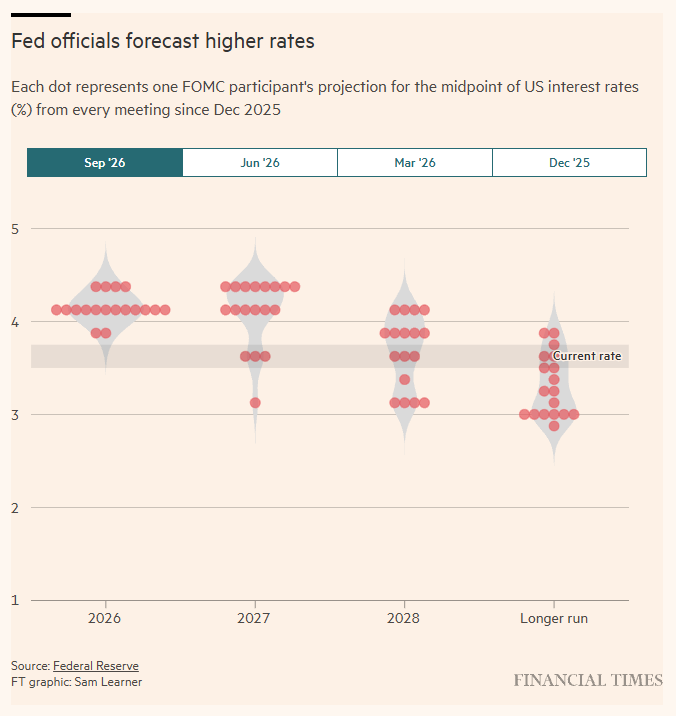
The Federal Open Market Committee voted unanimously to increase the benchmark federal funds rate by a quarter point to a 3.75-4 per cent range, in line with Wall Street’s expectations.
The FOMC said the rise “will support a timelier return” of inflation to the Fed’s 2 per cent target — a goal it has missed for five and a half years. “The committee will deliver price stability,” it added.
The decision comes as Warsh and other rate-setters attempt to stop the boom in energy prices ignited by Middle East conflict from morphing into a wider inflation crisis. It comes just months before midterm elections in which affordability will be a major issue among voters.
Ahead of the meeting, investors had priced in a more than 90 per cent chance of a rate increase after the closely watched consumer price index reading for August signalled progress on returning inflation back to the Fed’s goal had stalled.
A fresh set of interest rate projections, also published Wednesday, indicated most of the committee anticipated another quarter-point rate rise before the end of the year.
Financial Times – Federal Reserve decision live: US central bank raises rates for first time since 2023
______
5. PwC UK Revenues Fall for First Time in Two Decades
PwC UK’s revenues fell last year for the first time in more than two decades as it was hit by a prolonged slump in its Middle East consulting business.
PwC said on Wednesday that total revenue for the UK group, which includes operations in the Middle East, fell by 3 per cent to £6.2bn in the 12 months to June.
Revenues in the Big Four firm’s Middle East business contracted 15 per cent to £1.7bn, with the fall outweighing a 2 per cent increase in sales by its larger UK-based operations.
Despite the fall in revenues, average pay for the firm’s near-1,000 partners rose to a record £935,000 as it reduced staff numbers and cut costs. PwC UK’s senior partner, Marco Amitrano, was paid £4.8mn, up from £4.3mn a year earlier.
The record payouts came as the firm cut back on hiring, slashing staff numbers across the UK and Middle East by 4,000 or almost 12 per cent.
It is the second year of falling sales in PwC’s Middle East business, which has been hit by a wider slowdown in lucrative Saudi Arabian consulting projects, previously the engine for rapid growth at the firm.
PwC said it had been a “challenging year” for its Middle East business, citing “the impact of regional conflict, wider market disruption and currency movements”.
The firm had last year cut the jobs of about 60 partners and 1,500 staff in the region after being hit with a year-long ban on winning work from Saudi Arabia’s sovereign wealth fund.
Financial Times – PwC revenues fall for first time in two decades
______
6. OpenAI Seeks $1.2tn Valuation in Private Funding Ahead of Planned IPO
OpenAI has held early conversations with investors about raising another private funding round at a $1.2tn valuation before its planned IPO, as it seeks to capitalise on the success of its latest AI model.
The ChatGPT maker, which in March raised $122bn at an $852bn valuation, including the new money, has recently held discussions with large backers about a fresh capital raise that would increase its value to about $1.2tn, according to people familiar with the matter.
The conversations with investors are at an early stage and the figure could change over the coming months, the people added.
Whether to go ahead with the private round, and its timing, would depend on when OpenAI opts to go public, according to one of the people, who added that the conversations had been initiated by investors rather than the company.
Chief executive Sam Altman on Saturday said a listing is unlikely to come before 2027. He has said it would be an “ill-advised moment” to go public amid rising concerns about the existential risks posed by AI.
Altman’s company is looking to capitalise on renewed demand for its products following the release of its latest models, GPT-5.6 in July and Astra earlier this month.
Those models have boosted the company’s revenue growth after a relatively slow start to the year, during which rival Anthropic leapfrogged OpenAI to a $965bn post-money valuation and investors questioned OpenAI’s direction and price tag.

Financial Times – OpenAI weighs funding round at $1.2tn valuation before IPO
______
7. US House Panel Votes to Hold Apollo Co-Founder Leon Black in Contempt Over Epstein Subpoenas
Former senior Bank of America Corp. investment banker Jason Satsky was accused by the US Securities and Exchange Commission of providing an insider-trading tip to a friend who allegedly made $18.5 million in illegal profits.
Satsky, who was previously Bank of America’s head of energy and power infrastructure banking, was sued Friday by the SEC along with the friend, Gavin Wolfe. According to the SEC, Satsky tipped Wolfe off on an acquisition offer for South Jersey Industries Inc. during a November 2021 basketball game.
Between November and December 2021, Wolfe bought at least $53 million in stock and the pair continued to converse, the SEC said.
The SEC suit doesn’t name Bank of America as Satsky’s then-employer, but Bloomberg has previously reported that federal prosecutors were probing trades around the deal.

Financial Times – US House panel votes to hold Leon Black in contempt over Epstein subpoena
______