—— Citigroup Shares Slide as New Long-Term Guidance Trails Wall Street Peers; BlackRock Cuts Value of Private Credit Fund by 5%; US Jobless Claims Edge Higher but Remain Near Decades-Low Levels; Google Launches $100 Screenless Fitbit Air to Challenge Whoop; US Stocks Enter “Manic” Territory: Overheated Sentiment Signals Slower Rally Ahead; Hochul Announces $268 Billion State Budget Deal; Kalshi Hits $22 Billion Valuation After Raising $1 Billion in Series F Funding
1. Citigroup Shares Slide as New Long-Term Guidance Trails Wall Street Peers
Citigroup Inc. shares dropped in pre-market trading Thursday after the bank’s new strategic guidance suggested it will take longer than expected to close the performance gap with its Wall Street rivals. Despite a multi-year effort to address regulatory concerns and shed its image as a laggard, the bank’s long-term targets failed to impress investors.
The lender announced it aims to reach a return on tangible common equity (ROTCE) of approximately 14% to 15% by 2031. This target remains well below the 20% return posted by JPMorgan Chase & Co. in 2025. Analysts noted that investors were looking for a more “aspirational” medium-term goal. Citigroup shares fell 4% to $122.50 following the news.
While CEO Jane Fraser’s turnaround plan previously gained momentum, the bank’s history of revising downward its estimates—including lowering its 2026 ROTCE goal—continues to weigh on market sentiment as it pitches its next phase of growth at its New York headquarters today.
Bloomberg – Citi Shares Decline as Return Target Falls Short of Expectations
______
2. BlackRock Cuts Value of Private Credit Fund by 5%
BlackRock Inc. reduced the net asset value (NAV) of its publicly-traded private credit fund, BlackRock TCP Capital Corp. (TCPC), by approximately 5% in the first quarter. According to a statement released Thursday, the $1.5 billion fund recorded $35 million in net markdowns for the period ending March 31, bringing its NAV per share down to $6.72.
Despite the writedowns, the fund pointed to “improving credit quality,” noting that loans on non-accrual status—a key indicator of borrower distress—fell to 7.6% on a cost basis, down from 9.7% in the prior quarter. BlackRock, the world’s largest asset manager, is aggressively expanding into the private credit space, highlighted by its $12 billion acquisition of HPS Investment Partners last year. However, TCPC has faced headwinds due to its exposure to struggling e-commerce aggregators and the bankruptcy of home improvement firm Renovo Home Partners. As the $1.8 trillion private credit market grows, lenders are facing increased scrutiny over their exposure to sectors like software, where rapid advancements in AI are beginning to shift risk profiles.
AMD currently holds the position of the second-largest maker of AI accelerators—the chips essential for training and running AI services—and while it still trails Nvidia by a wide margin, its accelerating growth highlights its rising competitive threat.
Bloomberg – BlackRock Private Debt Fund Cuts Asset Value on Loan Markdowns
______
3. US Jobless Claims Edge Higher but Remain Near Decades-Low Levels
Applications for U.S. unemployment benefits rebounded slightly last week after hovering near decades-lows, signaling that the broader labor market remains tight despite a recent flurry of job-cut announcements. Initial claims rose by 10,000 to 200,000 in the week ended May 2, according to Labor Department data released Thursday, coming in below the median economist forecast of 205,000.
Continuing claims, a proxy for the total number of people receiving benefits, fell to 1.77 million—a fresh two-year low. The data suggests the U.S. labor market remains in a “low-hire, low-fire” state, even as high-profile firms like Meta Platforms Inc. and Nike Inc. reduce headcounts. While a separate report noted that tech-sector job-cut announcements reached a three-year high year-to-date, overall private-sector layoff announcements have receded.
All eyes are now on Friday’s April jobs report, which is expected to show the first back-to-back monthly increase in payrolls in nearly a year.
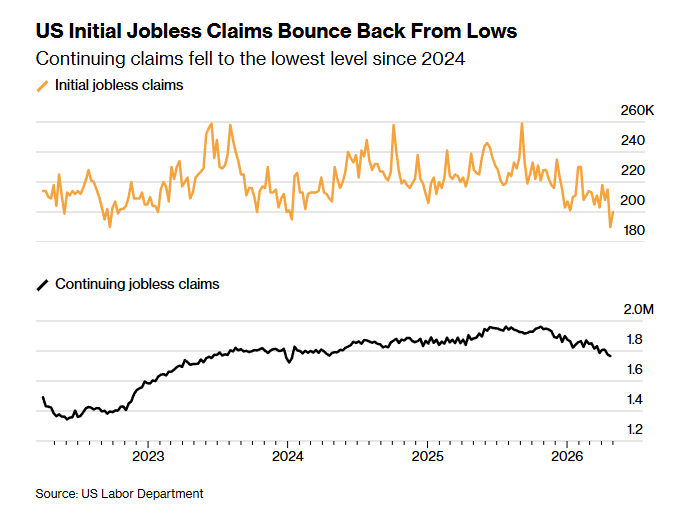
Bloomberg – US Initial Jobless Claims Tick Up After Falling Near Decades Low
______
4. Google Launches $100 Screenless Fitbit Air to Challenge Whoop
Alphabet Inc.’s Google unveiled the Fitbit Air on Thursday, a $100 screenless fitness band designed to compete directly with Whoop and other display-free health wearables.
The new device mirrors the minimalist aesthetic of Whoop, featuring a sensor pack tucked under a soft fabric band. Unlike Whoop’s subscription-only model ($200+ annually with free hardware), Google is charging an upfront cost for the device with an optional $10 monthly Google Health subscription. The Fitbit Air tracks essential metrics including heart rate, sleep, blood oxygen, and heart rate variability, and can detect signs of atrial fibrillation. Lacking a screen or buttons, it utilizes haptic feedback and a small status light for interaction, boasting a one-week battery life.
Available in four colors, the device positions itself as a distraction-free, budget-friendly alternative to the Apple Watch ($249+) and the Oura Ring ($349).

Bloomberg – Google Launches $100 Fitbit Air Without a Screen to Rival Whoop
______
5. US Stocks Enter “Manic” Territory: Overheated Sentiment Signals Slower Rally Ahead
A historic surge has propelled U.S. equities to fresh record highs, but signs of overheated sentiment suggest the rally may be shifting into a lower gear. Fueled by easing geopolitical tensions and robust corporate earnings, investor sentiment has reached what Bloomberg Intelligence (BI) strategists describe as “manic” territory. According to BI’s Market Pulse model, three key drivers—tight high-yield spreads, low volatility, and pairwise correlations—have pushed the gauge to these elevated levels.
While “manic” sentiment doesn’t historically predict a crash, it often signals more modest gains. Between 2012 and 2023, the Russell 3000 Index averaged a 2.9% return in the three months following similar sentiment peaks, with large-cap stocks typically outperforming small-caps. Strategists Christopher Cain and Nathaniel Welnhofer noted that unlike the rebounds of 2009 or 2020 which followed deep sell-offs, this rally started from an already high base, potentially capping future upside.
After a blockbuster April where the S&P 500 soared over 10%, the benchmark has already added another 2.2% in the first week of May.
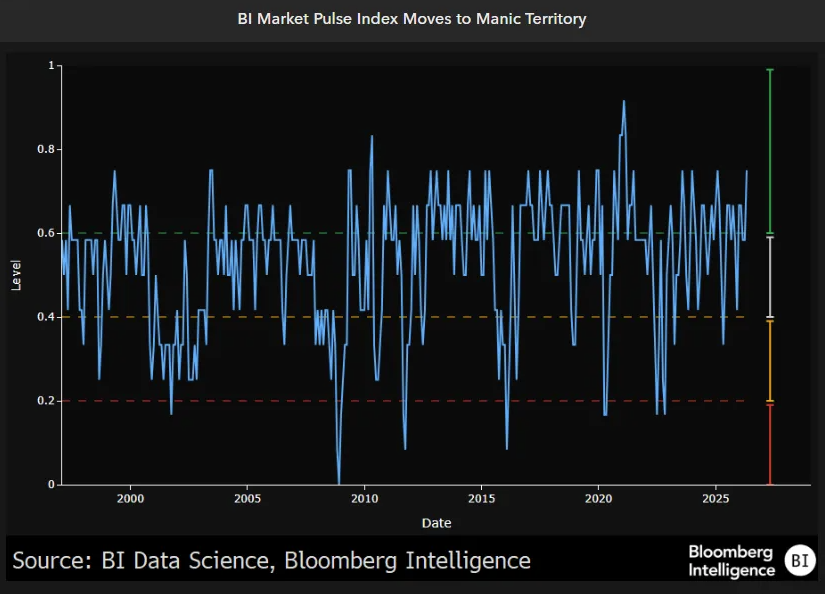
Bloomberg – Quant Model Shows Rally in Stocks Is Approaching ‘Manic’ Level
______
6. Hochul Announces $268 Billion State Budget Deal
New York Governor Kathy Hochul reached a “general agreement” with Assembly Speaker Carl Heastie and Senate Majority Leader Andrea Stewart-Cousins on a $268 billion spending plan.
Election Year Stakes: With primary races approaching in June and a general election this fall, Hochul’s budget balances progressive demands for NYC aid with conservative-leaning efforts to limit corporate tax hikes and reform insurance liability.
Pied-à-terre Levy: To fill NYC’s $5.4 billion deficit without raising income taxes on millionaires—a move Hochul resisted—the state will tax second homes in the city, targeting high earners who do not reside there full-time.
Climate & Development: In a move that rattled environmentalists, the deal weakens state climate emissions targets. Simultaneously, it streamlines housing development by creating carveouts in the environmental review process.
Insurance & Liability: The budget includes measures to cap insurance payouts in certain accident cases, a pillar of Hochul’s plan to lower premiums by curbing fraudulent claims.
The deal reflects a series of strategic compromises aimed at stabilizing New York City’s finances while addressing statewide affordability.
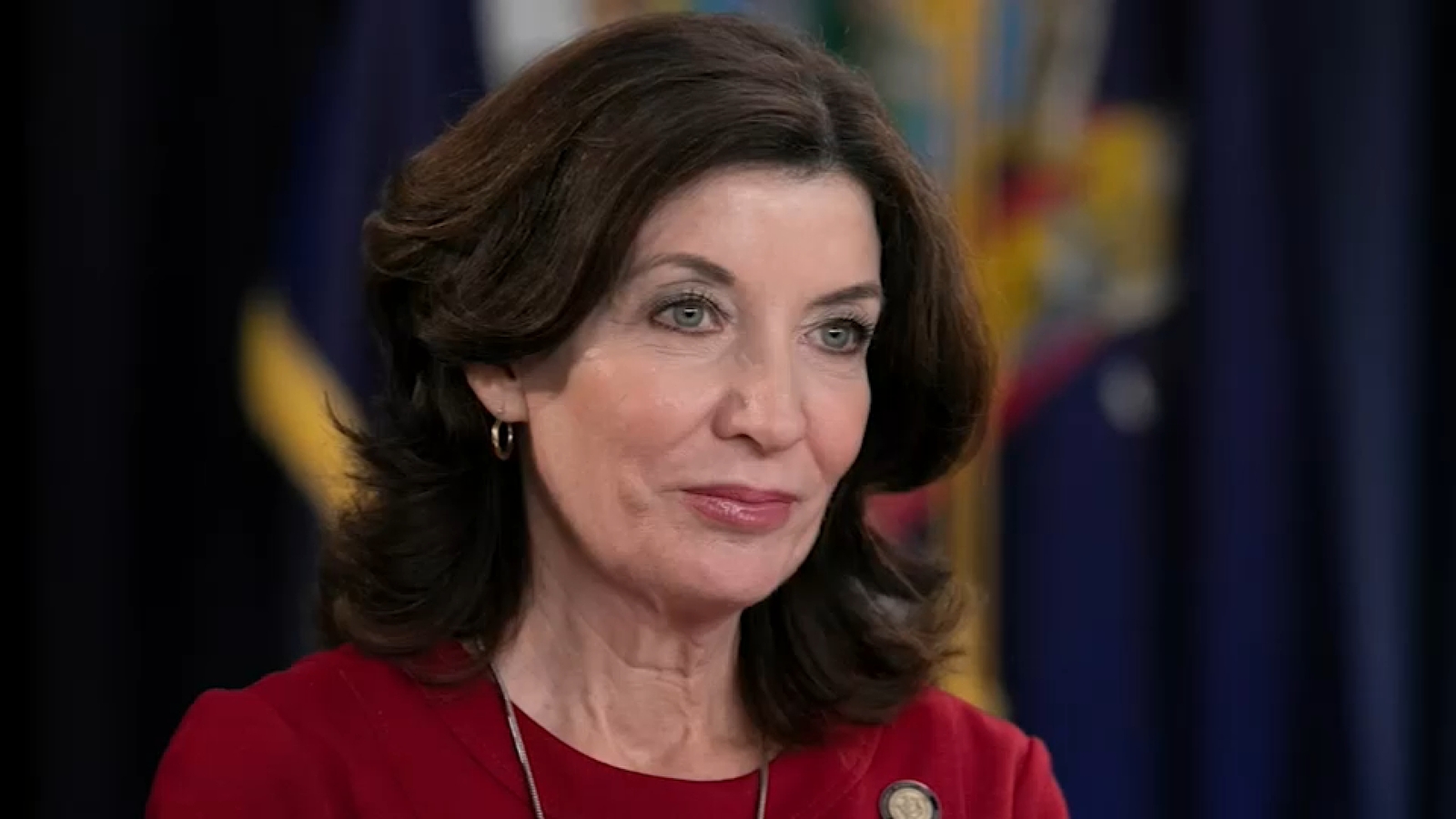
Bloomberg – NY Announces $268 Billion Budget Deal Including Second-Home Tax
______
7. Kalshi Hits $22 Billion Valuation After Raising $1 Billion in Series F Funding
Kalshi Inc., the New York-based prediction market platform, announced on Thursday that it has completed a $1 billion Series F funding round led by Coatue Management. The latest infusion of capital values the firm at $22 billion, doubling its $11 billion valuation secured just five months ago.
The round saw participation from a powerhouse lineup of investors, including Sequoia Capital, Andreessen Horowitz, IVP, Paradigm, Morgan Stanley, and ARK Invest. The valuation surge comes as prediction markets go mainstream among retail investors trading on political and economic outcomes. According to a company blog post, Kalshi’s annualized trading volume has tripled over the last six months, skyrocketing from $52 billion to $178 billion.
A spokesperson confirmed that Kalshi’s annual revenue run rate has now surpassed $1.5 billion. The funding highlight’s the intense competition in the sector; its chief rival, Polymarket, was reported last month to be seeking fresh funding at a $15 billion valuation.

Bloomberg – Kalshi Secures $22 Billion Valuation in Coatue-Led Round
______