
—— Wall Street Pros See Buying Opportunity in Software Sell-off; Shopify Revenue Jumps 31% Beating Estimates; Zelle Transaction Volume Hits $1.2 Trillion in 2025; Direct Shopping Hits Gemini as Universal Protocol Breaks Barriers; Altruist Unveils Hazel AI Tax Tool Triggering Brutal Sell-off; US Payrolls Surpass Estimates with 130,000 Gain in January; Silicon Valley Shatters VC Taboos
1. Wall Street Pros See Buying Opportunity in Software Sell-off
Market professionals are increasingly vocal that the severe punishment of software stocks over the past few weeks has gone too far, creating significant bargains following a panic-driven exit. The rout was fueled by fears that new AI automation tools, such as those recently unveiled by Anthropic, would cannibalize the business models of established Software-as-a-Service (SaaS) providers. Last week, the S&P North American Software Index traded below 20 times forward earnings for the first time in history. Even with a modest rebound to roughly 23 times this week, the sector remains priced well below its long-term historical average multiple of 34.
JPMorgan strategists wrote on Tuesday (Feb 10, 2026) that the “overly bearish outlook on AI disruption” has ignored solid fundamentals, creating a skew toward a potential rebound. Goldman Sachs CEO David Solomon echoed this sentiment at a conference on Tuesday, calling the sell-off “too broad” and predicting that many incumbents will pivot successfully. Furthermore, a Sunday note from Jefferies analysts led by Brent Thill revealed that 42% of the 64 software stocks they cover are currently trading at or near historical valuation floors.
Strategists at Janney Montgomery Scott suggested that with software stocks having moved in a “straight line toward zero,” the market is now ripe for a counter-trend rally as investors realize not all incumbents will be displaced by AI.
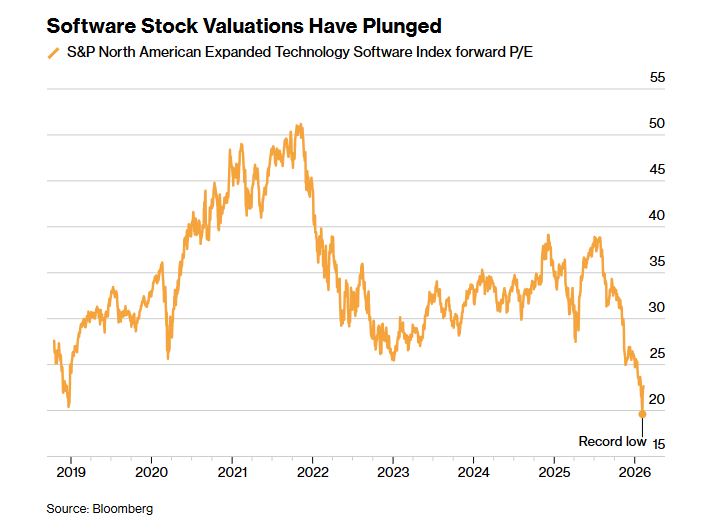
Bloomberg – Software Stocks Trade at Bargain Bin Prices After AI-Fueled Drop
______
2. Shopify Revenue Jumps 31% Beating Estimates
Shopify Inc. reported fourth-quarter results on Wednesday (Feb 11, 2026) that beat analyst revenue estimates, driven by a blockbuster holiday shopping season. Revenue grew 31% to $3.67 billion, surpassing the $3.6 billion expected by analysts. Gross Merchandise Volume (GMV), a key metric for platform business activity, climbed 31% to $123.8 billion, also ahead of forecasts. However, adjusted diluted earnings per share came in at $0.48, slightly missing the $0.51 consensus. Buoyed by the top-line growth, Shopify’s US-listed shares surged as much as 14% in premarket trading before settling 11% higher at $109.48 by 7:41 a.m. in New York.
Merchants on the platform hit record sales of $14.6 billion during the Black Friday-Cyber Monday weekend, a 27% increase year-over-year. For the first quarter of 2026, the Ottawa-based company expects revenue to continue growing at a low-thirties percentage rate. Additionally, Shopify announced a $2 billion share repurchase program set to begin on Feb 17.
CFO Jeff Hoffmeister highlighted that the move signals financial strength as the company invests heavily in its “agentic commerce” strategy, including AI tools like Sidekick and Catalog designed to automate marketing and inventory for its global merchant base.

Bloomberg – Shopify Shares Soar in Premarket After Revenue Beat
______
3. Zelle Transaction Volume Hits $1.2 Trillion in 2025
Zelle, the bank-owned payment network backed by giants including JPMorgan Chase, Bank of America, and Wells Fargo, reported on Wednesday (Feb 11, 2026) that its platform moved over $1.2 trillion in 2025, a 20% increase year-over-year. The network averaged $3.4 billion in daily transactions, with December marking its busiest month ever as the number of active bank and credit union accounts topped 100 million for the first time. A key driver of this momentum was the small business sector; nearly 30% of all funds sent on Zelle last year—approximately $360 billion—involved small enterprises, making it the platform’s fastest-growing segment.
The network’s reach continued to scale in 2025, adding 337 new financial institutions to bring its total to over 2,300, covering roughly 80% of all U.S. bank accounts. Denise Leonhard, General Manager of Zelle, noted that the platform is moving beyond domestic borders, having launched a cross-border initiative late last year that incorporates stablecoin technology to simplify international money movement. Amid ongoing scrutiny over security, Zelle highlighted its improved fraud detection capabilities, noting that 99.98% of transactions are now completed without reports of fraud or scams.
The company is also deepening its commitment to financial inclusion through new partnerships aimed at providing real-time payment solutions to Minority Deposit Institutions (MDIs) and rural credit unions.

Bloomberg – Zelle Says Payments Sent Last Year Surged 20% to $1.2 Trillion
______
4. Direct Shopping Hits Gemini as Universal Protocol Breaks Barriers
Alphabet Inc. announced a landmark shift in its commercial strategy on Wednesday (Feb 11, 2026), deeply integrating shopping capabilities into the Gemini chatbot and Google Search’s “AI Mode.” Powered by the newly launched Universal Commerce Protocol (UCP), users can now purchase items from major retailers including Etsy, Wayfair, Target, and Walmart directly within their conversational flow, eliminating the need to visit third-party sites. Vidhya Srinivasan, Google’s VP of Ads and Commerce, stated in a letter to the industry that UCP provides the foundation for “agentic commerce,” where AI agents can eventually plan, reason, and execute entire shopping journeys on a user’s behalf.
Key features of the rollout include “Direct Offers,” a new ad format that allows brands to serve personalized, real-time discounts within AI-generated responses. Google has also partnered with giants like Shopify and Visa to streamline checkout via Google Pay and Google Wallet. However, the move has drawn scrutiny from Washington. Senator Elizabeth Warren sent a letter to CEO Sundar Pichai expressing deep concerns over consumer privacy, potential price manipulation, and the risk of “exploitative pricing” driven by AI data merging.
While Google maintains that it prohibits merchants from displaying inflated prices in AI Mode, Warren warned that the protocol could facilitate tacit collusion among retailers and push vulnerable consumers toward higher spending.

Bloomberg – Google Pushes AI Shopping Features in Search and Gemini Chatbot
______
5. Altruist Unveils Hazel AI Tax Tool Triggering Brutal Sell-off
Fear of AI-driven disruption spread to the financial services sector on Tuesday (Feb 10, 2026), as a new automated tax strategy tool sparked a massive sell-off in wealth management stocks. The catalyst was Altruist Corp.’s launch of AI-powered tax planning within its Hazel platform. The new feature can read and interpret 1040 forms, pay stubs, and account statements to generate personalized tax strategies and “what-if” scenario models in minutes—tasks that previously justified high advisory fees. In response, Raymond James Financial plunged 8.8%, its worst day since 2020, while Charles Schwab and LPL Financial dropped 7.4% and 8.3% respectively as investors scrambled to price in the threat of automated advice.
The market reaction reflects deep anxiety over fee compression and the erosion of competitive moats. Altruist CEO Jason Wenk stated that the tool “makes average advice a lot harder to justify,” directly challenging the value proposition of human-led firms. UBS analyst Michael Brown noted that the high level of uncertainty surrounding “Agentic AI”—systems capable of independent complex maneuvers—has made it difficult for legacy institutions to reassure shareholders.
While industry veterans like Morgan Stanley’s Jed Finn argue that AI cannot yet replicate the “trust and credibility” required in highly regulated wealth management, the indiscriminate selling suggests that investors now view high-touch advisory services as the next casualty in the AI efficiency race.

Bloomberg – Wealth Manager Stocks Sink as Traders Flee Next AI Casualty
______
6. US Payrolls Surpass Estimates with 130,000 Gain in January
U.S. employers added 130,000 jobs in January 2026, significantly exceeding the 75,000 forecast and marking the strongest monthly gain in over a year, according to Bureau of Labor Statistics data released Wednesday (Feb 11). The unemployment rate unexpectedly ticked down to 4.3% from 4.4% in December. While the January print suggests the labor market is finding its footing, sweeping annual benchmark revisions revealed that 2025 was far weaker than previously thought. Total job growth for last year was slashed from an initially reported 584,000 to just 181,000, bringing the monthly average down to a mere 15,000—the lowest level for a non-recession year since 2003. Heather Long, chief economist at Navy Federal Credit Union, labeled 2025 a “hiring recession,” noting that the broader economy essentially shed jobs last year when excluding the resilient healthcare sector.
Industry data showed that healthcare once again led hiring in January with 82,000 new roles, while construction added 33,000 positions. Manufacturing snapped a 13-month losing streak by adding 5,000 jobs. Conversely, the federal government shed 34,000 positions amid ongoing workforce reductions, and financial activities lost 22,000 jobs. The surprisingly robust January headline prompted traders to recalibrate Federal Reserve expectations, pushing the timeline for the next potential rate cut from June to July.
With the labor market showing signs of stabilization rather than a sharp deterioration, the Fed is widely expected to keep interest rates steady at 3.50%–3.75% during its March meeting as policymakers await further clarity on inflation and fiscal policy impacts.
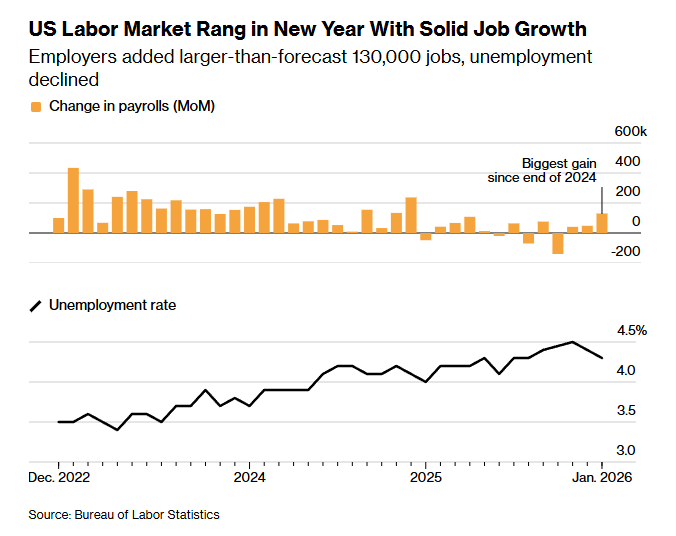
Bloomberg – US Adds 130,000 Jobs and Unemployment Falls After Tepid 2025
______
7. Silicon Valley Shatters VC Taboos
In a dramatic departure from decades of venture capital orthodoxy, top-tier firms are increasingly backing direct rivals as the race to fund frontier AI models reaches a fever pitch. According to February 2026 reports, Anthropic is finalizing a massive $25 billion funding round at a staggering $350 billion valuation. The deal is notable for including Sequoia Capital and Altimeter Capital—two firms that are already major stakeholders in OpenAI. Historically, Silicon Valley VCs strictly avoided betting on competing startups to prevent conflicts of interest and protect sensitive information. However, the immense capital requirements of generative AI are transforming these frontier labs into infrastructure-like bets, prompting firms to hedge their positions across multiple leaders.
The strategic pivot at Sequoia follows a recent leadership shift where partners Alfred Lin and Pat Grady have taken a more aggressive stance on AI exposure. This comes as OpenAI itself prepares for a monumental $100 billion raise, with Masayoshi Son’s SoftBank reportedly discussing an additional $30 billion commitment on top of its existing stake. While OpenAI CEO Sam Altman has previously warned that investors making “non-passive” bets on competitors could lose access to confidential information, the allure of a potential 2026 IPO surge appears to have outweighed those risks.
As compute costs escalate, the industry’s “winner-take-all” mentality is evolving into a “back-the-entire-sector” approach, marking a fundamental realignment of how venture capital operates in the age of artificial intelligence.

Bloomberg – VCs Break Taboo by Backing Both Anthropic, OpenAI in AI Battle
______