
—— 3 US Companies Eclipse Whole Chinese Stock Market; Trafigura Profit Drops 73%; ECB Cuts Interest Rates by 25 Basis Points; US Unit Labor Costs Rose Less Than Forecast; Chanel Creative Director to Step Down; SpaceX Completes Fourth Test Flight; Hungary Buys Budapest Airport
1. 3 US Companies Eclipse Whole Chinese Stock Market
Microsoft Corp., Nvidia Corp., and Apple Inc. now have a combined market value exceeding that of China’s entire stock market.
According to Bloomberg data, the total market capitalization of these three leading tech companies is approximately $9.2 trillion. This surpasses the nearly $9 trillion value of stocks actively traded on Chinese exchanges, excluding Hong Kong. The soaring demand for artificial intelligence has driven many shares in the tech sector to record highs.
Nvidia, in particular, has greatly benefited from a significant surge in AI spending over the past year. This week, Nvidia became the first computer-chip company to reach a market capitalization of $3 trillion.
Based in Santa Clara, California, Nvidia has become a market leader with its in-demand products that power data centers handling complex AI computations. At the same time, Microsoft has invested in OpenAI and is incorporating AI features into its products and services.
Apple has faced challenges this year, with its shares impacted by concerns over slowing iPhone demand in China and a $2 billion fine from the European Union. Despite these setbacks, investor sentiment toward the iPhone maker is gradually improving, and its shares have recently turned positive for 2024.

______
2. Trafigura Profit Drops 73%
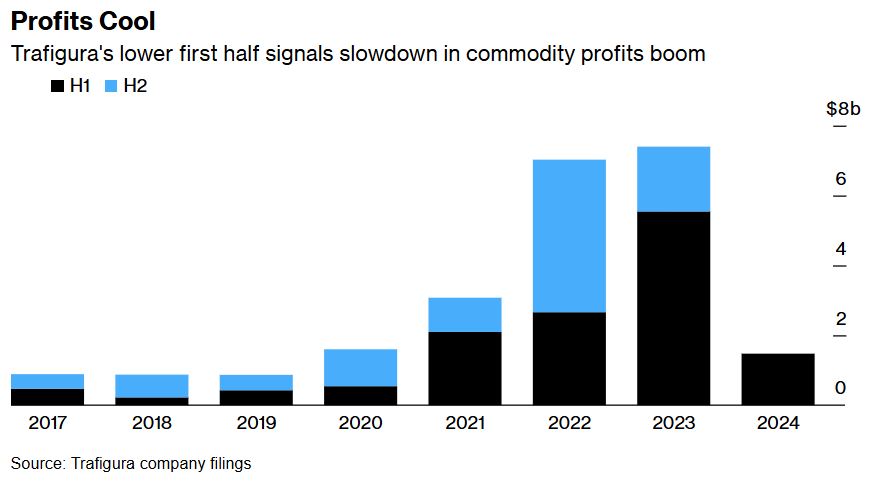
Trafigura Group reported its smallest first-half profit since 2020, with earnings down 73% from a year ago as the commodity giant adjusts to more stable conditions in its key energy and metals markets.
This decline indicates the end of the commodity trading industry’s most profitable period, initially triggered by the Covid-19 pandemic and later intensified by the fallout from Russia’s invasion of Ukraine. The dramatic price fluctuations that previously benefited traders have diminished, and regional supply shortages are now largely resolved.
Trafigura’s net profit for the six months ending in March dropped to $1.47 billion, a significant decrease from the record $5.5 billion a year earlier. Revenue fell by 5.4% to $124.2 billion, while group equity increased to $17.3 billion.
The company and its competitors have been cautioning that the exceptional profit levels of recent years are unlikely to persist, though the industry consensus is that the baseline for profits is now higher than before. Despite the drop, Trafigura’s first-half earnings remain higher than most of its annual profits prior to 2020.
______
3. ECB Cuts Interest Rates by 25 Basis Points
The European Central Bank (ECB) has reduced interest rates for the first time in nearly five years, acting more quickly than its counterparts in the US and UK in response to the largest price surge in a generation.
Following a meeting in Frankfurt on Thursday, the ECB lowered its benchmark deposit rate by a quarter percentage point to 3.75%. The euro remained steady, rising 0.1% to $1.0865 after the announcement.
Interest rate-sensitive two-year German Bund yields, a benchmark for the Eurozone, increased to 3.02%, up 0.05 percentage points for the day. Meanwhile, traders in swaps markets slightly reduced their expectations for a second rate cut by September to 65%, down from 70% before the announcement.
The ECB stated that future policy decisions would be “data-dependent and meeting-by-meeting,” and it did not commit to a specific rate path.

______
4. US Unit Labor Costs Rose Less Than Forecast
US labor costs in the first quarter increased by less than previously reported, due to downward revisions in economic output and hours worked, aligning with other indicators of moderating economic activity.
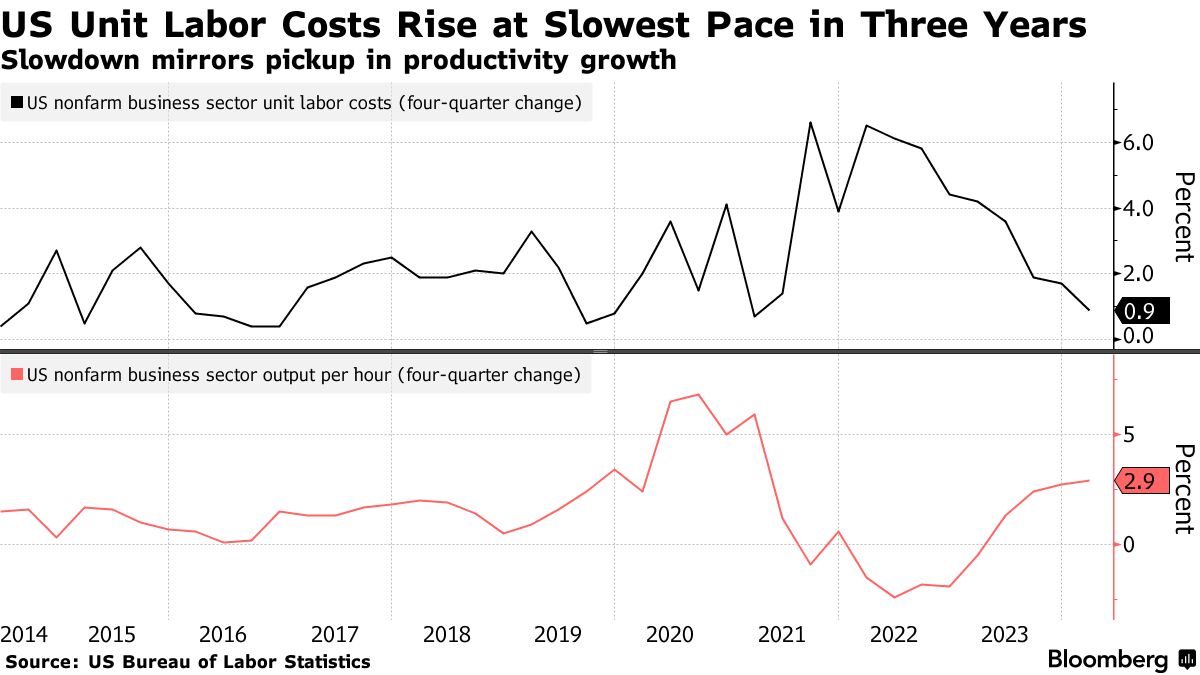
According to the Bureau of Labor Statistics figures published on Thursday, unit labor costs—what a business pays employees to produce one unit of output, accounting for changes in productivity—rose at a revised annual rate of 4%, down from the initially reported 4.7%.
Compared to a year earlier, unit labor costs were up only 0.9%, marking the slowest growth rate in three years.
Productivity, measured as output per hour of nonfarm employees, barely increased in the first three months of the year, with a slight revision down to a 0.2% growth rate.
While quarterly productivity figures are typically volatile, a prolonged slowdown could present an additional challenge for the Federal Reserve’s efforts to control inflation.
______
5. Chanel Creative Director to Step Down
Chanel’s creative director, Virginie Viard, is leaving the luxury fashion house after nearly three decades with the group. Viard, who became creative director in 2019 following the death of Karl Lagerfeld, will be stepping down, though Chanel has not yet named a replacement.
In a statement on Thursday, Chanel confirmed Viard’s departure after five years as artistic director of fashion collections, noting that a new creative team would be announced “in due course.” The exact timing of her departure was not specified.
The brand, founded by legendary French designer Coco Chanel, has more than doubled in size since 2018. It is now one of the top-selling names in the industry, following closely behind LVMH-owned Louis Vuitton.

______
6. SpaceX Completes Fourth Test Flight
SpaceX’s giant Starship rocket successfully completed its fourth test mission on Thursday, achieving speeds five times the speed of sound to reach space and return to Earth in a controlled re-entry.
Eight minutes after launch, the rocket’s super heavy booster splashed down in the Gulf of Mexico. Just under an hour later, the upper stage, known as “Ship,” splashed down in the Indian Ocean.
The goal of this fourth test flight was to demonstrate the safe return of both stages to Earth, following a previous mission that failed during re-entry.
Despite some challenges, including a control flap beginning to break apart as Ship descended, the mission successfully achieved its primary objectives.

______
7. Hungary Buys Budapest Airport
Hungary and French construction giant Vinci SA are acquiring Budapest Airport Zrt. in a deal valuing the Central European hub at €4.3 billion ($4.7 billion), according to sources familiar with the matter.
The new owners paid €3.1 billion for the airport’s equity and took on a net debt of €1.2 billion, one source with direct knowledge of the transaction said. Hungarian Prime Minister Viktor Orban has championed the acquisition as part of a broader initiative to increase local ownership of strategic assets.
Hungary secured an 80% stake in the airport, while Vinci acquired the remaining 20%, according to other sources. The deal, which received clearance from the European Union, was finalized upon signing.
AviAlliance GmbH, the German operator and largest shareholder of the Hungarian hub, confirmed the sale in a statement without disclosing the transaction’s value. The other sellers were Singapore’s sovereign wealth fund GIC Pte and Canada-based Caisse de Dépôt et Placement du Québec.
Ranked as the 39th busiest airport in Europe, Budapest Airport is considered the crown jewel of Hungary’s tourism and logistics industries. According to Eurocontrol data, Budapest has averaged 307 daily flights year-to-date, matching the average daily flights of Prague.

______
本文内容来自《Financial Times》、《Bloomberg》,以及《The Real Deal》等多家财经新闻媒体。