—— McDonald’s US Sales Hit Two-Year High; Nuveen to Acquire Schroders for £9.9 Billion; China-EU Trade Ties Thaw as Beijing Slashes Final Tariffs on EU Dairy Imports; US Weekly Jobless Claims Edge Down to 227,000; Four EY Partners Depart Following Shell Audit Breach; Microsoft AI Chief Declares “Self-Sufficiency” Mission; Real Estate Stocks Sink on AI Fears
1. McDonald’s US Sales Hit Two-Year High
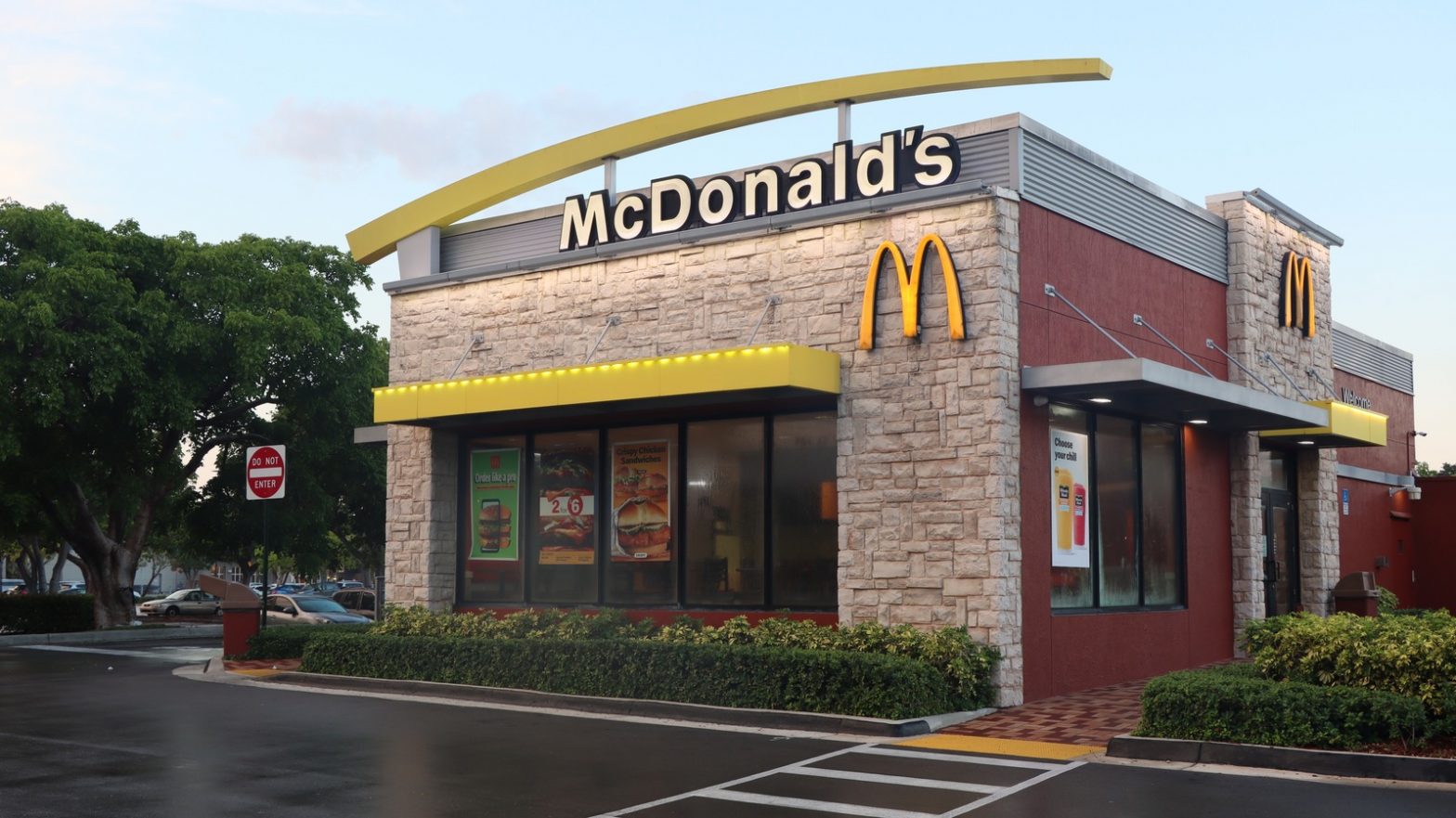
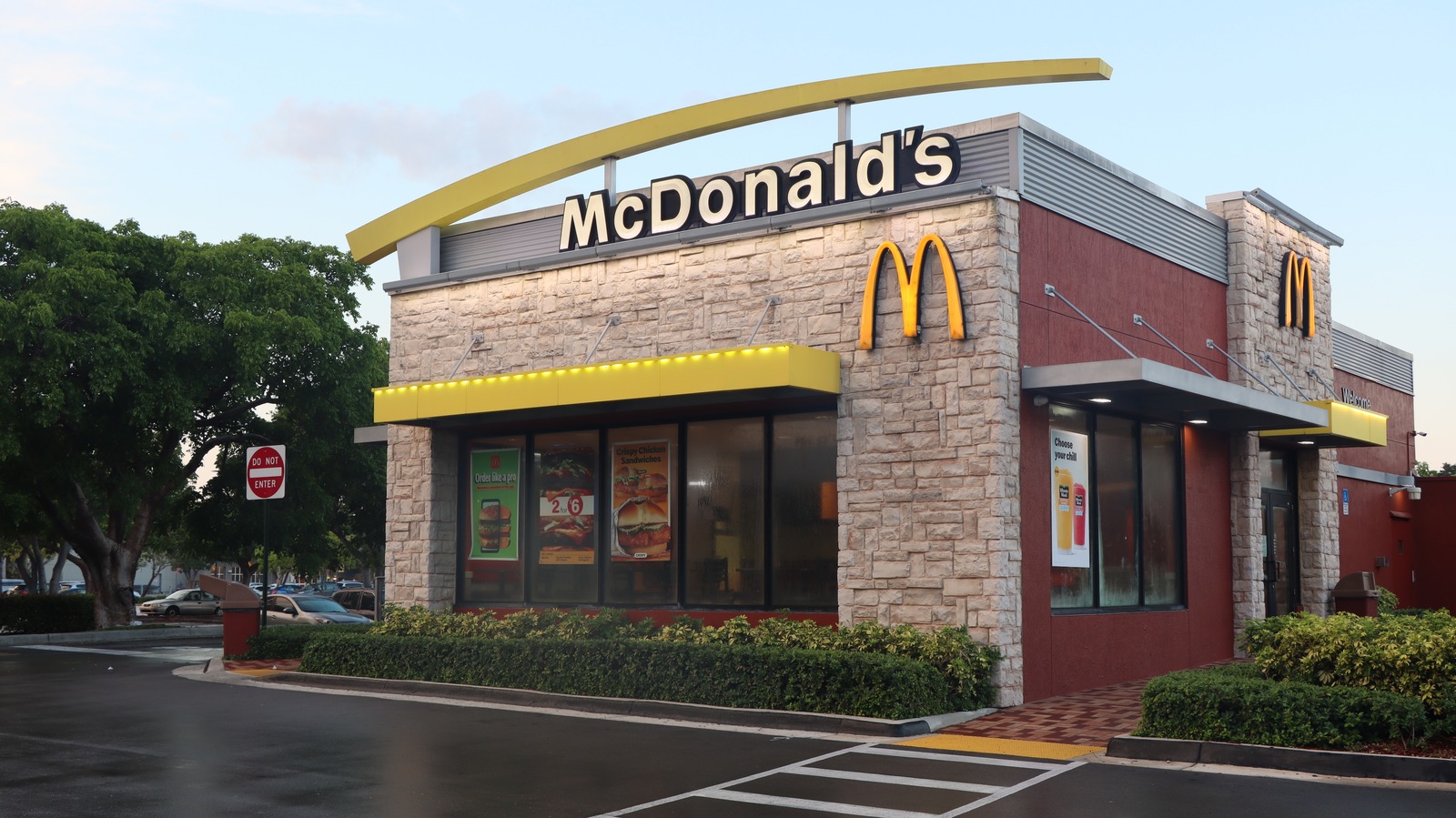
McDonald’s Corp. reported on Wednesday (Feb 11, 2026) that US same-store sales jumped 6.8% in the fourth quarter of 2025, the fastest growth pace since 2023. The results handily beat the 5.4% analyst estimate and represent a full recovery from the traffic slump caused by an E. coli outbreak in October 2024. Despite a challenging consumer environment throughout last year, the burger giant successfully reclaimed market share among low-income diners—those with household incomes under $45,000—by relaunching Extra Value Meals and reintroducing popular $2.99 Snack Wraps. CEO Chris Kempczinski told investors during the earnings call, “McDonald’s is not going to get beat on value and affordability.”
The quarter was also bolstered by viral marketing campaigns, most notably the December launch of the Grinch-themed meal. The promotion became a global cultural phenomenon, with McDonald’s selling 50 million pairs of collectible socks in the first few days, briefly making the company the world’s largest sock retailer. For the fourth quarter, revenue rose 10% to $7.01 billion, with adjusted earnings per share of $3.12 topping Wall Street forecasts. However, CFO Ian Borden cautioned that momentum would likely slow in the first quarter of 2026 due to severe winter weather impacting January traffic.
Looking ahead, McDonald’s plans to expand its McCafé lineup later this year with energy drinks and fruit-based refreshers, directly challenging Starbucks in the fast-growing functional beverage category.
Bloomberg – McDonald’s Sales Surge Most in Two Years on $5 Value Meal Push
______
2. Nuveen to Acquire Schroders for £9.9 Billion
US asset management titan Nuveen, a subsidiary of TIAA, announced on Thursday a definitive agreement to acquire Schroders Plc, the UK’s largest standalone asset manager, in a cash deal valued at £9.9 billion (approximately $13.5 billion). The transaction marks the end of 222 years of independence for the historic City of London firm, creating a combined powerhouse with nearly $2.5 trillion in assets under management—ranking it as the world’s ninth-largest asset manager. Under the terms, Schroders shareholders will receive 590 pence in cash plus 22 pence in dividends per share, totaling 612 pence—a 29% premium over Wednesday’s closing price. Schroders’ London-listed shares surged as much as 31% on Thursday following the announcement.
While the ownership changes, the Schroders brand will be retained, and London will serve as the combined group’s non-US headquarters and largest global office, housing 3,100 staff. Schroders CEO Richard Oldfield will remain in his role and join Nuveen’s executive management team. The acquisition comes amid a wave of consolidation in the asset management industry as firms seek the scale necessary to compete with passive giants. Nuveen aims to leverage Schroders’ deep presence in Europe and Asia to accelerate its global “public-to-private” investment platform.
Despite the Schroder family controlling roughly 42% of shares and previously rebuffing sale speculation, the board has unanimously recommended the deal. The transaction is expected to close in the fourth quarter of 2026.
Bloomberg – Nuveen to Buy UK Asset Manager Schroders in £10 Billion Deal
______
3. China-EU Trade Ties Thaw as Beijing Slashes Final Tariffs on EU Dairy Imports
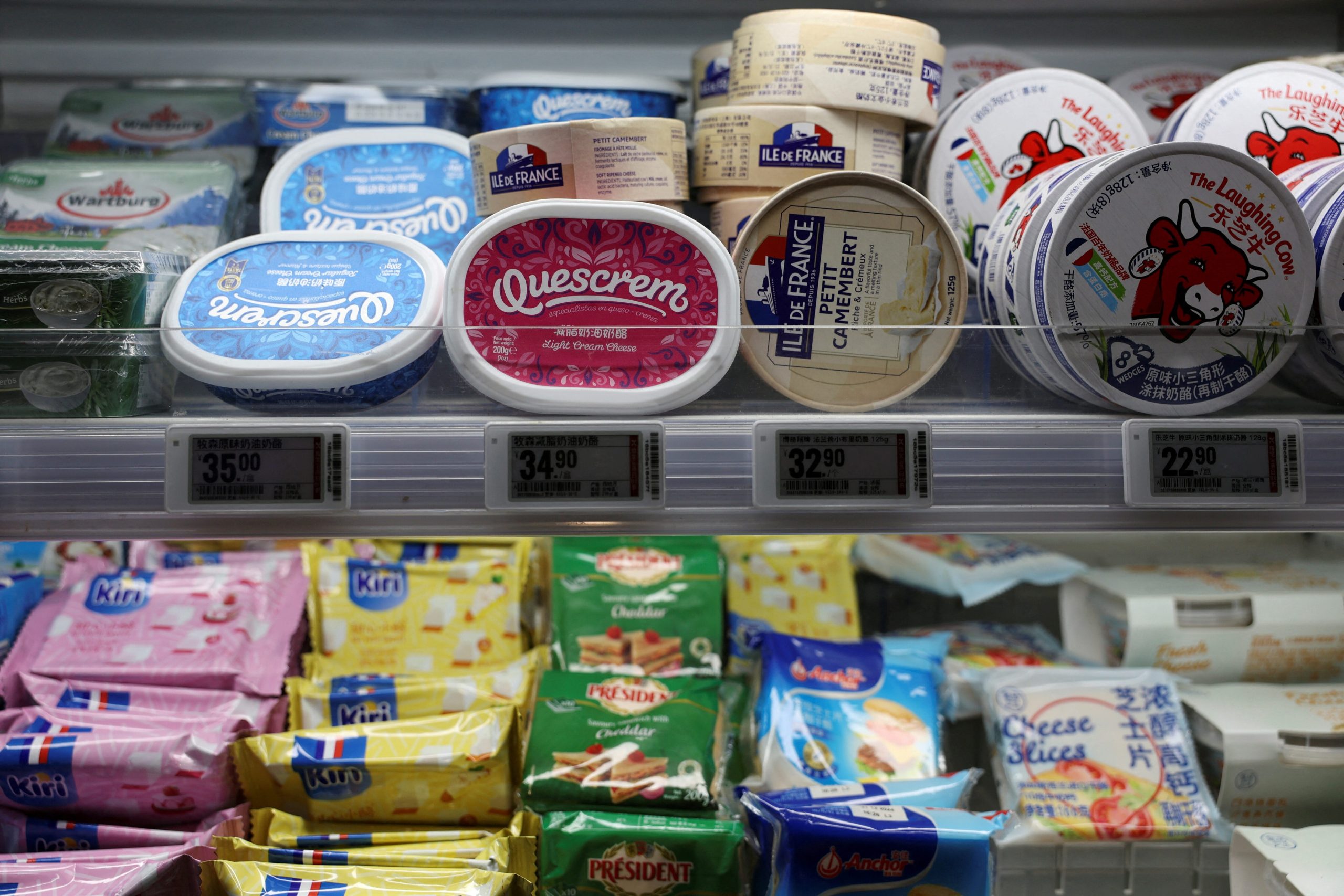
China’s Ministry of Commerce finalized import tariffs on select dairy products from the European Union on Thursday, setting rates significantly lower than the preliminary figures outlined late last year. The final duties, reaching a maximum of 11.7%, will apply to goods including fresh milk, cream, and processed cheeses effective Friday for a five-year period. This marks a sharp reduction from the provisional rates of up to 42.7% announced in December, which were widely viewed as a retaliatory measure against the bloc’s tariffs on Chinese-made electric vehicles. The move is seen as the latest signal that Beijing and Brussels are moving toward a tactical de-escalation of their trade dispute.
The adjustment follows a series of diplomatic efforts to stabilize economic cooperation, including a leaders’ summit in July and recent high-level visits from European officials. This week, the EU reciprocated by exempting a China-built Volkswagen EV from heavy duties under a new price-commitment mechanism, further easing tensions. Beijing has followed a similar pattern of moderation with its final rulings on EU pork and brandy, opting for lower levies than initially threatened.
While the European Commission maintained on Thursday that the dairy probe was “unjustified” and hinted at potential WTO proceedings, analysts suggest that both sides are prioritizing stability as they navigate a volatile global trade landscape weighed down by shifting US trade policies.
Bloomberg – China Eases Duties on EU Dairy in Latest Sign of Trade Thaw
______
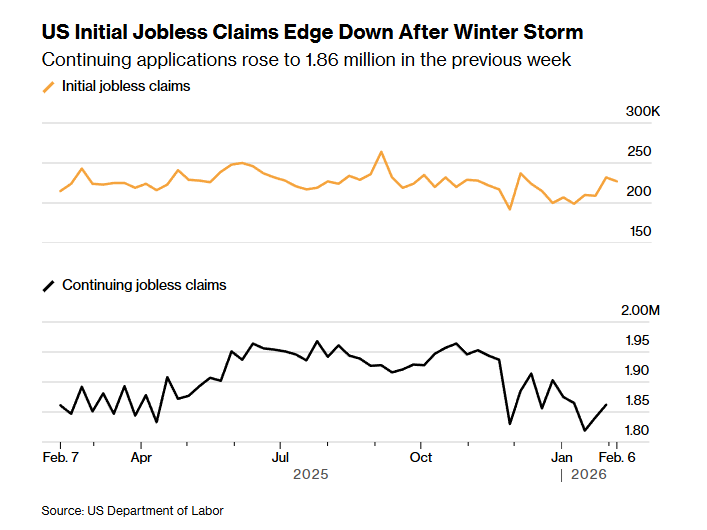
4. US Weekly Jobless Claims Edge Down to 227,000
The number of Americans filing new applications for unemployment benefits decreased by 5,000 to 227,000 in the week ended Feb 7, according to Labor Department data released Thursday. While the figure was slightly higher than the 224,000 median forecast, it signals a stabilization of the labor market following a storm-induced surge in the previous period, which was revised upward to 232,000. States like Pennsylvania, Ohio, and Missouri—which had seen spikes in layoffs within the construction and education sectors due to severe winter weather—posted some of the largest declines in the latest week as businesses and schools resumed normal operations.
Continuing claims, a proxy for the pace of hiring, rose by 21,000 to 1.862 million for the week ended Jan 31, reflecting lingering seasonal volatility and a slightly longer search period for displaced workers. Despite high-profile job-cut announcements from major firms like Amazon and UPS, the weekly claims data suggests these plans have not yet translated into a broad-based wave of layoffs. Analysts characterized the early 2026 labor market as remaining in a “low-hire, low-fire” state.
Coupled with Wednesday’s surprisingly strong January payrolls report showing 130,000 jobs added, the steady level of claims reinforces expectations that the Federal Reserve will maintain interest rates at their current levels during the March policy meeting.
Bloomberg – US Jobless Claims Settle Back After Severe Winter Weather
______
5. Four EY Partners Depart Following Shell Audit Breach
Four partners at EY have left the firm following breaches of independence rules during its audit of Shell, which resulted in the oil major stripping the Big Four firm of a lucrative $66 million-a-year contract. The departures occurred in December as EY scrambled to contain the fallout from what is considered one of its worst compliance failures in recent history. According to public records and sources familiar with the internal review, the group includes Gary Donald, who led the Shell audit, as well as oil and gas experts Mark Woodward and Hee Yu Lee, and Alistair Denton from the national office overseeing compliance and independence.
The debacle stemmed from a breach of US regulatory rules on auditor rotation, after Donald remained as the lead auditor for Shell’s 2023 and 2024 accounts beyond the permitted term. In July, Shell flagged the breach, prompting the UK’s accounting regulator to launch a formal probe in October. Following the scandal, Shell announced on Friday its decision to switch to PwC starting next year.
The loss of such a high-profile mandate underscores the significant commercial and reputational damage to EY, as the firm faces heightened scrutiny over its internal oversight and adherence to strict regulatory standards.
Financial Times – Four partners leave EY after independence rule breach on Shell audit
______
6. Microsoft AI Chief Declares “Self-Sufficiency” Mission
Microsoft’s AI CEO Mustafa Suleyman told the Financial Times that the tech giant is pursuing “true self-sufficiency” in artificial intelligence by building its own powerful frontier models. This strategic pivot follows a major restructuring of Microsoft’s partnership with OpenAI in October 2025, which saw OpenAI transition into a for-profit Public Benefit Corporation (Group PBC) with Microsoft retaining a 27% stake and IP rights through 2032. Suleyman emphasized that as a $3 trillion corporation, Microsoft cannot remain dependent on a third party for its core intellectual property and must develop foundational models at the “absolute frontier” independently.
To fuel this mission, Microsoft is investing heavily in “gigawatt-scale” compute infrastructure and organizing world-class AI training teams to manage vast datasets. Suleyman revealed that Microsoft’s own advanced foundation models are slated for release sometime in 2026, aiming to capture a larger share of the enterprise market through “professional-grade AGI.” He boldly predicted that most white-collar tasks performed on computers—including roles for lawyers, accountants, and marketers—could be fully automated within the next 12 to 18 months. Beyond enterprise tools, Microsoft is also developing “medical superintelligence” to address healthcare challenges.
While Microsoft remains OpenAI’s primary partner, Suleyman’s comments signal an aggressive acceleration toward technological sovereignty as the company competes directly with Google and Amazon in the race for AI dominance.

Financial Times – Mustafa Suleyman plots AI ‘self-sufficiency’ as Microsoft loosens OpenAI ties
______
7. Real Estate Stocks Sink on AI Fears
Real estate services stocks tumbled on Wednesday as investors weighed the industry’s vulnerability to a new generation of artificial intelligence tools threatening to disrupt traditional business models. Shares of CBRE Group Inc. and Jones Lang LaSalle Inc. plunged 12%, while Cushman & Wakefield Ltd. dropped 14%. For CBRE and Cushman & Wakefield, the declines marked their steepest one-day sell-off since the pandemic-driven volatility of 2020. The broad retreat reflects growing anxiety that AI agents could eventually automate market research, contract review, and deal matching, challenging the industry’s reliance on human labor.
In a note to clients on Wednesday, Keefe, Bruyette & Woods analyst Jade Rahmani wrote that investors are rotating out of “high-fee, labor-intensive” businesses viewed as vulnerable to AI-driven disruption. While the AI boom has previously supported sectors like data centers and premium office leasing, the focus has shifted to whether automation will erode the pricing power of traditional brokerages. However, Rahmani also cautioned that the sell-off might overstate the immediate threat to complex deal-making which still requires human negotiation.
This latest jolt comes as the commercial real estate sector continues to struggle with high interest rates and shifting office demand, highlighting a new era of uncertainty where AI is seen as both a catalyst and a competitor.

Bloomberg – Real Estate Services Stocks Sink in Latest ‘AI Scare Trade’
______