—— Epstein Estate Agrees to $35 Million Settlement to Resolve Remaining Victim Claims; US Stocks Hit 5-Year Low in Relative Popularity; US GDP Growth Slows to 1.4% in Q4; US Egg Prices Plunge 59% from 2025 Peak; Zuckerberg’s AI Pivot Squeezes Employee Perks; Supreme Court Strikes Down Trump’s Emergency Tariffs; Paramount’s 108 billion dollar WBD Bid Clears US Antitrust Hurdle
1. Epstein Estate Agrees to $35 Million Settlement to Resolve Remaining Victim Claims
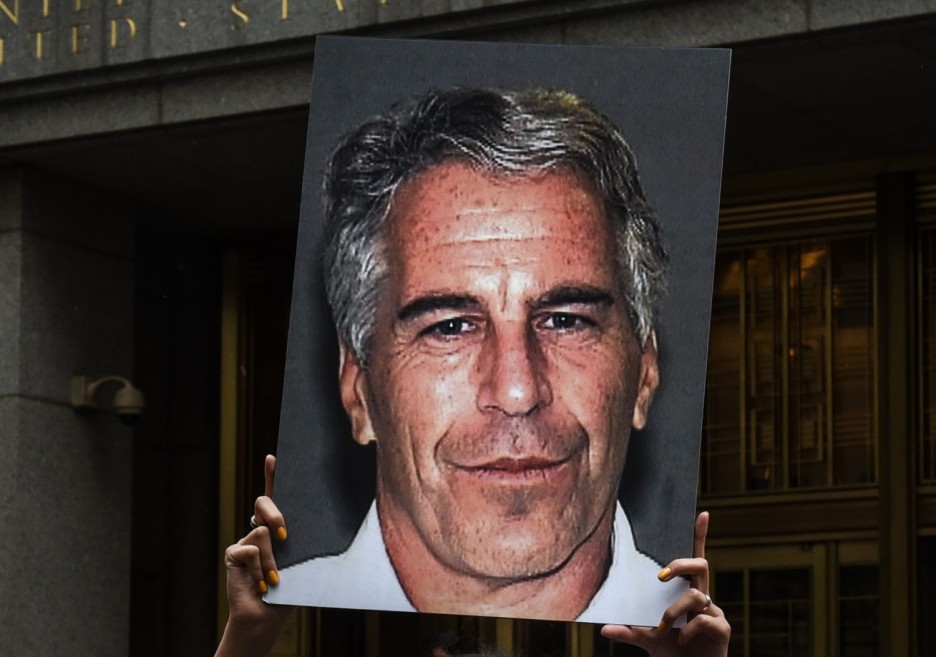
The estate of Jeffrey Epstein and its co-executors have agreed to pay up to $35 million to settle outstanding legal claims from a class of victims who have not yet reached prior settlements. According to a federal court filing in Manhattan on Thursday, the agreement seeks to “finally and forever resolve” claims from women who allege they were sexually abused or trafficked by Epstein between January 1, 1995, and August 10, 2019. The proposed plan stipulates that the estate will pay $35 million if 40 or more eligible victims are identified, or $25 million if the class size is smaller. The settlement currently awaits final approval from a federal judge in New York.
The deal concludes a 2024 lawsuit filed against Darren Indyke and Richard Kahn, Epstein’s longtime legal and accounting advisors who serve as co-executors of his estate. While the plaintiffs accused the pair of facilitating Epstein’s trafficking network through financial and legal structures, both men have consistently denied any wrongdoing or knowledge of the abuse. Their legal counsel stated that the settlement was reached to achieve “finality” and avoid protracted litigation without any admission of liability.
This latest payout follows $121 million previously distributed to 136 claimants via a restitution fund and another $48 million paid to 59 victims in separate agreements, potentially bringing the estate’s total direct compensation past the $200 million mark.
Bloomberg – Epstein Estate Agrees to $35 Million Settlement in Victim Claims
______
2. US Stocks Hit 5-Year Low in Relative Popularity
US equities are currently at their least favored level relative to international peers in more than five years, according to a “Flow Show” report by Bank of America strategist Michael Hartnett on Friday. American stocks have captured just $26 of every $100 entering global equity funds so far this year, the smallest share since 2020 and a sharp decline from the $92 peak seen in 2022. Hartnett noted that the era of “US exceptionalism” is ending not through massive outflows, but through a significant reduction in relative capital allocation to American assets.
While the S&P 500 Index has remained virtually flat in 2026, the MSCI World Index excluding the US has surged nearly 8%. Investor appetite for US shares has been dampened by concerns over excessive AI spending by Big Tech, a weaker US dollar influenced by Trump administration trade policies, and a growing rotation toward cyclical stocks that thrive on broader global growth. According to EPFR Global data cited by BofA, stock funds in Europe, Japan, and other developed markets have attracted a combined $125 billion this year, compared to just $35 billion for the US.
Hartnett suggests that a major leadership shift is taking place as the market pivots from “Wall Street” growth plays to “Main Street” value, positioning international equities and emerging markets as the primary beneficiaries of this global rebalancing.

Bloomberg – BofA Says US Stocks Draw Lowest Share of Global Flows Since 2020
______
3. US GDP Growth Slows to 1.4% in Q4
The US economy grew at an annualized rate of 1.4% in the fourth quarter of 2025, a sharp deceleration from the 4.4% expansion in the previous period and well below economist forecasts of 3%. According to the Bureau of Economic Analysis (BEA) advance estimate released Friday, the record-breaking 43-day government shutdown between October and November subtracted approximately 1 percentage point from the quarterly growth. For the full year, the US economy expanded 2.2%. President Donald Trump preempted the data on social media, claiming the shutdown cost the nation “at least two points in GDP” while renewing his calls for the Federal Reserve to lower interest rates.
Inflationary pressures also showed unexpected persistence at year-end. Separate BEA data revealed that the Fed’s preferred inflation gauge—the core Personal Consumption Expenditures (PCE) price index—rose 0.4% in December, its largest monthly increase in nearly a year. On an annual basis, core PCE (excluding food and energy) climbed to 3% in December from 2.8% the previous month, likely reflecting the pass-through effect of 2025 tariff policies on consumer goods. Despite the administration’s promise of a “golden age” and lower cost of living, sticky inflation remains a central challenge heading into the 2026 midterm elections.
With a brief secondary shutdown occurring in January 2026, economists warn that the world’s largest economy faces a fragile start to the new year.

Bloomberg – US GDP Rose at Slower-Than-Forecast 1.4% Pace Last Quarter
______
4. US Egg Prices Plunge 59% from 2025 Peak
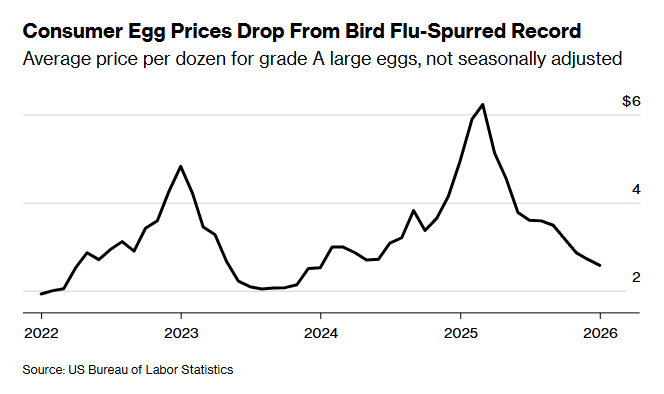
The US egg market, which became a symbol of stubborn food inflation in 2025, has undergone a dramatic reversal in early 2026. According to the latest data from the Bureau of Labor Statistics and industry reports, consumers paid an average of $2.58 for a dozen Grade A large eggs in January, representing a 59% drop from the record high of $6.23 seen in March 2025. Last year’s shortage, fueled by highly pathogenic avian influenza (HPAI) outbreaks that decimated flocks, has been replaced by a supply glut. Driven by aggressive flock repopulation and a fourfold increase in imports encouraged by the Trump administration to tame grocery costs, the US layer hen population hit 309 million in early January, the highest level in 14 months.
While the price drop is a relief for shoppers, producers are feeling the sting of the “whiplash” effect. Wholesale prices have plummeted faster than retail costs, hitting levels in January not seen since 2017. Emily Metz, president of the American Egg Board, noted that many farmers are currently operating below breakeven as production costs remain elevated despite the falling market price. The USDA’s February forecast now pegs the average 2026 egg price at just $1.25 per dozen, a 67% decrease from the prior year’s average.
Analysts warn that while low prices may help ease political pressure ahead of the midterm elections, prolonged losses could force smaller family farms out of business, potentially leading to increased industry consolidation and future price volatility.
Bloomberg – Egg Prices Collapse as Once-Empty Shop Shelves Now Overstuffed
______
5. Zuckerberg’s AI Pivot Squeezes Employee Perks
Meta CEO Mark Zuckerberg is aggressively reallocating financial resources toward artificial intelligence and data center infrastructure, leading to a second consecutive year of reduced equity-based awards for most employees. According to people familiar with the matter, the social media giant has trimmed annual stock option distributions by approximately 5% for the bulk of its staff. This follows a more substantial 10% cut last year, signaling a sustained shift in Meta’s compensation strategy. The $1.6 trillion company estimates its 2026 capital expenditures could reach as high as $130 billion as it races to build the hardware fleet necessary for developing frontier AI models.
While general stock refreshers are being tightened, Meta is engaging in an unprecedented talent war, offering signing bonuses as high as $100 million to poach elite researchers from rivals like OpenAI. To manage ballooning costs, Zuckerberg has enforced strict efficiency measures elsewhere, including the layoff of 1,500 employees from the loss-making Reality Labs division in January 2026. To maintain morale among high-performers, Meta recently overhauled its review process with a new system called “Checkpoint,” which offers significantly higher bonus multipliers for top-tier staff.
These moves highlight Meta’s delicate balancing act: funding a massive AI arms race while restructuring its workforce and maintaining investor confidence in its long-term profitability.

Financial Times – Meta cuts staff stock awards for a second straight year
______
6. Supreme Court Strikes Down Trump’s Emergency Tariffs
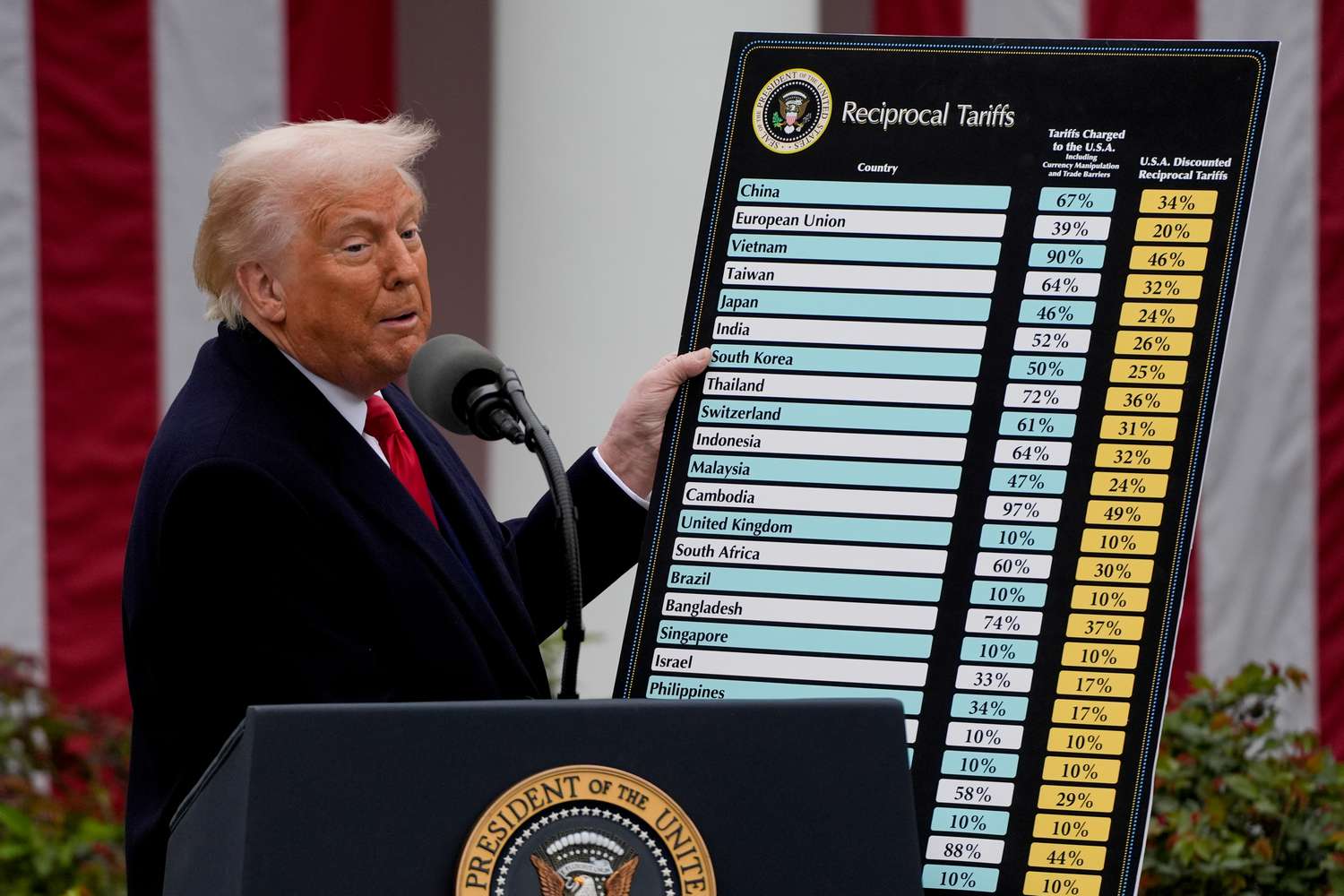
The U.S. Supreme Court delivered a landmark rebuke to President Donald Trump on Friday, ruling 6-3 that his administration’s use of the International Emergency Economic Powers Act (IEEPA) to impose sweeping global tariffs was an unconstitutional overreach. Chief Justice John Roberts, writing for the majority, stated that the authority to “regulate” importation under a national emergency does not encompass the power to levy taxes—a power the Constitution vests exclusively in Congress. The decision effectively invalidates the majority of the “reciprocal” and drug-trafficking-related tariffs implemented since April 2025’s “Liberation Day,” which had pushed effective U.S. tariff rates to their highest levels since World War II.
President Trump reacted sharply at a White House press conference, calling the ruling a “disgrace” and expressing disappointment in certain conservative justices for failing to “do what’s right for the country.” Despite the loss, the administration pledged to activate a “backup plan,” exploring alternative legal justifications under Section 232 or Section 301 to preserve the existing tariff regime. While the Court did not immediately order the refund of the estimated $133 billion in duties collected during 2025, the ruling opens the door for thousands of importers to seek reimbursement through the Court of International Trade.
Analysts suggest that while broad emergency tariffs have been struck down, sector-specific duties on steel, aluminum, and autos remain in place, leaving global markets in a state of cautious suspense as the White House recalibrates its trade offensive.
Financial Times – US Supreme Court rules Trump’s sweeping tariffs are illegal
______
7. Paramount’s 108 billion dollar WBD Bid Clears US Antitrust Hurdle
Paramount Skydance announced Friday that its 108 billion dollar hostile bid to acquire Warner Bros. Discovery (WBD) has cleared a critical US antitrust milestone. The company confirmed that the statutory waiting period under the Hart-Scott-Rodino Act expired without intervention from the Department of Justice (DOJ), removing a major legal impediment to the deal. This regulatory progress comes even as WBD remains officially committed to a rival 83 billion dollar agreement with Netflix. Paramount’s bid is notably bankrolled by Oracle founder and prominent Donald Trump donor Larry Ellison, who has provided a personal guarantee for over 40 billion dollars in equity financing.
The swift clearance is widely interpreted as a signal of favor from the White House, especially as allies of the President expand their influence across the media landscape. Unlike Netflix’s offer, which seeks only WBD’s studios and HBO, Paramount’s 30 dollar per-share all-cash proposal aims to acquire the entire company, including CNN and Discovery. Paramount argues its plan poses less regulatory risk than a Netflix merger, which would create a dominant streaming monopoly. Backed by additional funding from Jared Kushner’s Affinity Partners and Middle Eastern sovereign wealth funds, the Paramount deal is moving into a decisive phase.
WBD has been granted a seven-day waiver by Netflix to engage in final negotiations with Paramount before a scheduled March 20 shareholder vote to decide the future of the Hollywood giant.

Bloomberg – Paramount’s 108 billion dollar WBD Bid Clears US Antitrust Hurdle
______