—— Big Tech Projects $650 Billion Capex Surge for 2026; Westbrook Sells Ritz-Carlton Hotels in NY and DC; Bitcoin’s Drop Below $65,000 Triggers $12.4 Billion Loss for Strategy Inc.; KPMG Demands Lower Audit Fees Citing AI Efficiency Gains; Trump Administration Weighs Antitrust Probe into US Homebuilders; Nvidia CEO Jensen Huang Defends AI Spending; US Tech Stocks and Bitcoin Rally on Friday
1. Big Tech Projects $650 Billion Capex Surge for 2026
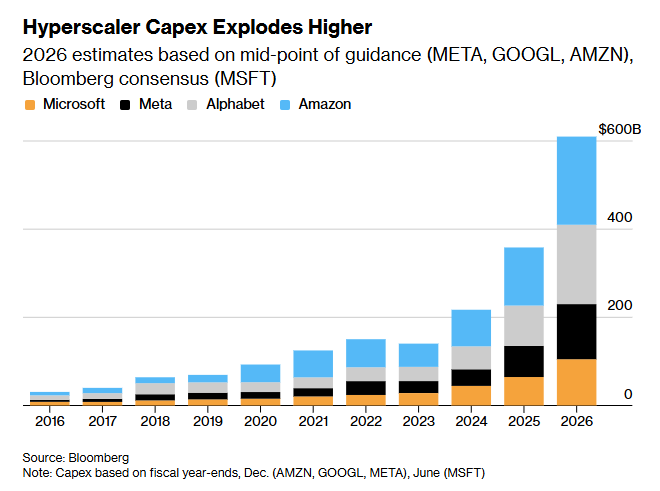
Alphabet, Amazon, Meta, and Microsoft have collectively forecast capital expenditures reaching approximately $650 billion for 2026, a staggering tide of cash earmarked for new data centers and high-end computing infrastructure. This planned spending marks an estimated 60% increase from a year ago—a boom without parallel in this century. Bloomberg data shows that each company’s budget for 2026 is expected to either approach or exceed its total capital spending for the past three years combined, setting a decade-high water mark for corporate investment.
Analysts have compared the scale of this build-out to the 19th-century US railroad expansion, the post-war interstate highway project, or the telecommunications bubble of the 1990s. The sprint to construct massive facilities powered by expensive AI processors has triggered unprecedented borrowing and strained global energy supplies, leading to conflicts with local communities over rising power and water costs. Gil Luria, an analyst at DA Davidson, noted that these companies view the race for AI compute as a “winner-take-all” market, with none willing to fall behind.
However, the concentration of such massive spending by a narrow set of affluent firms raises risks that it may increasingly distort big-picture US economic data.
Bloomberg – Big Tech to Spend $650 Billion This Year as AI Race Intensifies
______
2. Westbrook Sells Ritz-Carlton Hotels in NY and DC
Westbrook Partners is offloading its Ritz-Carlton hotels in New York and Washington, D.C., capitalizing on the continued resilience of affluent consumers in the luxury travel sector. According to sources familiar with the transactions, the firm has finalized a deal to sell the Ritz-Carlton New York, Central Park, to lodging investor Gencom. Westbrook is also nearing an agreement to sell the Ritz-Carlton Washington D.C., located in the city’s West End, to Honolulu-based Trinity Investments. While the financial details of the sales have not been disclosed, Gencom founder Karim Alibhai noted that the firm sees enduring global appeal in New York’s luxury real estate assets.
The move comes as high-end hospitality remains a significant outlier in a cooling broader market. Data from CoStar reveals that revenue per available room (RevPAR) for luxury chains grew 5.1% in 2025, while the metric for the overall U.S. hotel industry saw a marginal decline of less than 1%. The 253-key New York property, which Westbrook acquired in 2012 for roughly $105 million, and the 300-key Washington hotel represent prime assets in high-barrier markets.
Analysts suggest the deals highlight a strategic rotation of capital by institutional investors toward specialized luxury portfolios amidst a robust outlook for premium international travel.

Bloomberg – Ritz-Carlton Owner to Sell Hotels in New York and Washington
______
3. KPMG Demands Lower Audit Fees Citing AI Efficiency Gains
Shares of Novo Nordisk A/S fell 7.5% on Thursday following a report that telehealth firm Hims & Hers Health Inc. will begin offering a significantly cheaper version of its new weight-loss pill. According to Reuters, Hims & Hers plans to provide a compounded copycat version of the drug—which uses the same active ingredient, semaglutide—starting at just $49 a month through a subscription-based program.
The move directly challenges Novo Nordisk’s pricing strategy, as the Danish drugmaker sells its brand-name Wegovy pill starting at $149 a month for cash-paying customers. This intensifying competition comes at a vulnerable time for Novo Nordisk, which recently warned of “unprecedented” pricing pressures and a potential revenue decline in 2026. Hims & Hers CEO Andrew Dudum noted that the initiative aims to increase accessibility and provide more choices for the millions of Americans seeking obesity treatments.
Analysts suggest that the availability of low-cost alternatives in the telehealth sector could further erode the market share of premium brand-name GLP-1 medications.
Bloomberg – Novo Shares Fall As Hims & Hers Offers $49 Wegovy Copycat
______
4. Bitcoin’s Drop Below $65,000 Triggers $12.4 Billion Loss for Strategy Inc.
KPMG, one of the world’s largest accounting firms, negotiated a reduction in fees from its own auditor, Grant Thornton UK, by arguing that the rollout of artificial intelligence (AI) should make the work cheaper. According to people familiar with the matter, the Big Four firm pressured Grant Thornton to pass on the cost savings generated by AI-driven efficiencies and threatened to switch accountants if a significant discount was not granted. Grant Thornton serves as the auditor for KPMG International, the UK-based entity that coordinates the firm’s global network of independent partnerships.
The negotiations were led by Michaela Peisger, who took over as KPMG International’s CFO in early 2025. KPMG argued that the auditor should leverage new technology to speed up processes and that their longstanding relationship allowed Grant Thornton to complete the work more quickly. The talks highlight an intensifying debate within the professional services sector over whether the financial benefits of AI investments should be retained by the firms or passed on to clients.
While many audit firms have invested heavily in automation for routine tasks, KPMG’s aggressive stance represents a high-profile challenge to traditional hourly-based or fixed-fee pricing models.

Bloomberg – Saylor’s Crypto Project Pounded After $12.4 Billion Loss
______
5. Trump Administration Weighs Antitrust Probe into US Homebuilders
Trump administration officials are exploring an antitrust investigation into US homebuilders as part of a sharpened focus on tackling the nation’s housing affordability crisis. According to people familiar with the matter, the Department of Justice could open a probe in the coming weeks, potentially targeting the industry trade group Leading Builders of America. Officials are concerned that the group—whose members include giants like Lennar Corp. and DR Horton Inc.—may be serving as a platform to restrict housing supply or coordinate pricing strategies.
The potential probe emerges during a complex period of negotiation between the industry and the White House. Only days ago, builders pitched a “Trump Homes” initiative aimed at boosting supply through regulatory easing. President Trump has previously compared major builders to “the OPEC of housing,” accusing them of land hoarding to keep prices artificially high. Following the report, homebuilder stocks slumped on Friday, with shares of Lennar and DR Horton both dropping nearly 2% in mid-day trading.
While the DOJ and the White House have declined to comment, officials noted that the administration may still abandon the effort before a formal launch.

Bloomberg – White House Explores Opening Antitrust Probe on Homebuilders
______
6. Nvidia CEO Jensen Huang Defends AI Spending
Nvidia Corp. CEO Jensen Huang dismissed concerns on Friday that tech giants are overspending on AI data centers, calling the current level of capital expenditure “appropriate and sustainable.” Speaking to CNBC, Huang predicted that the expansion of artificial intelligence infrastructure is set to continue for the next seven to eight years, driven by “incredibly high” demand. His comments follow a turbulent week where Alphabet, Amazon, Meta, and Microsoft saw a collective $1 trillion wiped from their market valuations as investors grew wary of the massive $650 billion projected spending on AI hardware and facilities.
Huang argued that unlike the initial internet boom, today’s AI infrastructure is not sitting idle; rather, it is actively generating returns for adopters. He pointed to companies like Anthropic and OpenAI, which are already seeing profitable revenue from AI applications. Huang also highlighted the upcoming Vera Rubin architecture, set for release in the second half of 2026, which aims to further slash energy costs and increase computing density.
He maintained that if customers had access to even more data centers, they would be performing even better, asserting that the current pace of investment is a necessary “generational” shift that remains in its early innings.
Bloomberg – Nvidia CEO Says AI Capital Spending Is Appropriate, Sustainable
______
7. US Tech Stocks and Bitcoin Rally on Friday
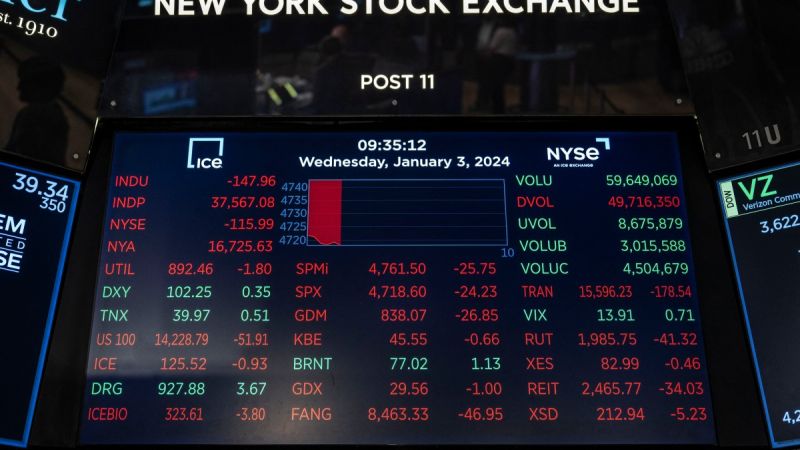
US technology stocks and bitcoin rallied strongly on Friday, following a three-day rout driven by investor anxiety over massive AI infrastructure spending. The tech-heavy Nasdaq Composite rose 2.1% on Friday, narrowing its weekly loss to approximately 2%. Chipmaking giant Nvidia led the recovery with a 7.7% jump, while Broadcom and Intel also posted significant gains. Bitcoin bounced back from its lowest levels since 2024, trading up 10.5% to around $69,884, while Michael Saylor’s Strategy Inc. saw its shares surge by 23%.
Amazon remained a notable outlier, falling 6% on Friday after disclosing that its capital expenditure would hit $200 billion this year. The broader market volatility earlier this week stemmed from fears regarding the vast scale of tech investment and potential disruption to business models in the data analytics and software sectors. Fabiana Fedeli, CIO for equities at M&G, noted that the market is rethinking its AI approach and becoming far more selective.
Arun Sai at Pictet Asset Management added that the pullback in the AI ecosystem appeared tactically overstretched, prompting dip buying as valuations became more attractive to some investors.
Bloomberg – US tech stocks rally strongly after three days of heavy selling
______