—— US Jobless Claims Jump by Most Since Pandemic Began; US Trade Deficit Narrows to Smallest Since 2020; Lilly Weight-Loss Shot Cuts Body Weight by 23%; Disney Invests $1 Billion in OpenAI; Oracle Shares Plunge as AI Data Center Spending Surges; Two Chinese AI Startups Plan Hong Kong IPOs Within Weeks
1. US Jobless Claims Jump by Most Since Pandemic Began
Applications for US unemployment benefits rose last week by the most since the onset of the pandemic, highlighting the volatility of claims during the holiday season.
Initial jobless claims increased by 44,000 to 236,000 in the week ended Dec. 6, Labor Department data showed Thursday. That was the largest weekly rise since March 2020 and followed the lowest level of claims in more than three years during the previous week, which included the Thanksgiving holiday. The figure exceeded all but one estimate in a Bloomberg survey of economists. Claims tend to be choppy around holidays and will likely continue fluctuating through year-end, but this reading is at the upper range of 2025 levels.
Companies such as PepsiCo and HP have recently announced job cuts, and nationwide layoffs in October surged to the highest since early 2023. The four-week moving average of initial claims edged up to 216,750.
Federal Reserve officials cut interest rates for a third straight meeting on Wednesday to support what Chair Jerome Powell described as a “gradually cooling” labor market. While policymakers did not project higher unemployment for next year compared with their September forecasts, Powell noted “significant” downside risks.
Before seasonal adjustment, initial claims soared by nearly 115,000 — also the most since March 2020 — led by large increases in states such as California, Illinois, New York and Texas.
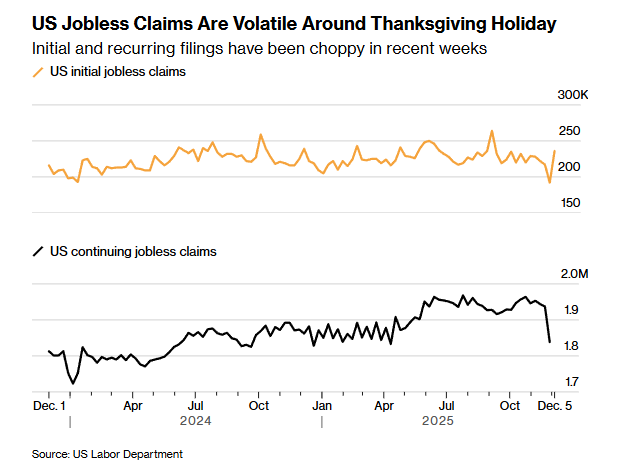
Bloomberg – US Jobless Claims Jump by Most Since 2020 After Holiday Drop
______
2. US Trade Deficit Narrows to Smallest Since 2020
The US trade deficit unexpectedly narrowed in September to the smallest level since mid-2020 as exports surged.
The goods and services trade gap shrank nearly 11% from the prior month to $52.8 billion, Commerce Department data showed Thursday. Economists surveyed by Bloomberg had expected a deficit of $63.1 billion.
Exports rose 3% to the second-highest level on record, driven by nonmonetary gold and pharmaceutical products. Imports increased a more modest 0.6%. The figures are not adjusted for inflation. Large monthly swings in trade this year related to US tariff implementation have added volatility to the government’s GDP calculations. The September trade numbers will help economists refine their third-quarter GDP estimates.
Before the report, the Federal Reserve Bank of Atlanta’s GDPNow model projected that net exports would contribute 0.86 percentage point to third-quarter growth.
On an inflation-adjusted basis, the merchandise trade deficit fell to $79 billion, the smallest in nearly five years. Real consumer-goods exports reached a record high.
The data also showed a sizable pickup in pharmaceutical imports. Imports of capital equipment and autos declined, as did shipments of most consumer goods, including cell phones, appliances, toys and furniture.
Meanwhile, nonmonetary gold exports hit a record in September, largely reversing a recent surge in gold imports tied to tariff concerns. A month earlier, gold imports had slumped after a sharp tariff increase on Switzerland, a major exporter of the precious metal.

Bloomberg – US Trade Deficit Unexpectedly Shrinks to Smallest Since 2020
______
3. Lilly Weight-Loss Shot Cuts Body Weight by 23%
Eli Lilly & Co.’s next-generation obesity shot helped patients lose nearly a quarter of their body weight, potentially making the experimental drug the most potent weight-loss treatment to date.
The late-stage study was designed to evaluate weight loss and knee osteoarthritis pain, a condition closely linked to obesity. Patients on the highest dose of the drug — retatrutide — lost more than 23% of their body weight over 68 weeks, Lilly said Thursday. Participants also saw a more than 62% reduction in knee pain based on a self-reported questionnaire. Wall Street had expected weight loss of roughly 20% to 23% and at least a 50% reduction in knee pain. The results exceeded expectations, and some patients lost so much weight that they dropped out of the trial. Lilly’s shares rose 3% in premarket trading.
“We believe retatrutide could become an important option for patients with significant weight loss needs and complications such as knee osteoarthritis,” said Kenneth Custer, president of Lilly Cardiometabolic Health.
The results further strengthen Lilly’s dominance in the obesity market, which is expected to reach $100 billion by 2030. Lilly’s existing drug, Zepbound, is already the most widely used weight-loss medication, but the company is racing to develop next-generation treatments that are more effective, easier to administer or offer benefits like fewer side effects.
Competition is intense. Shares of rival Novo Nordisk A/S plunged a record amount last year after its experimental shot failed to meet expectations. That drug, CagriSema, produced average weight loss of 20.4%, below the 25% the company projected. Novo shares trimmed gains to 2.2% on Thursday in Copenhagen.
Bloomberg – Lilly’s Experimental Shot Cuts Body Weight by 23% in Study
______
4. Disney Invests $1 Billion in OpenAI
Walt Disney Co. agreed to invest $1 billion in OpenAI and license iconic characters such as Mickey Mouse and Cinderella to Sora, OpenAI’s short-form AI video platform.
Under the three-year licensing deal, Sora will be able to generate short, user-prompted social videos based on a library of more than 200 animated and creature characters from Disney, Marvel, Pixar and Star Wars, according to a Thursday statement. The deal excludes any talent likenesses or voices. At the same time, Disney will become a major OpenAI customer, using its AI tools to build new products and deploy ChatGPT internally.
“The rapid advancement of artificial intelligence marks an important moment for our industry,” CEO Bob Iger said. “Through this collaboration with OpenAI, we will thoughtfully and responsibly extend the reach of our storytelling through generative AI, while respecting and protecting creators and their works.”
Hollywood studios have been cautious about partnering with AI companies due to concerns about data usage and potential backlash from labor unions. But OpenAI has been in discussions with major studios including Disney, Universal Pictures and Warner Bros. Discovery about Sora’s creative and commercial potential.
OpenAI introduced an updated version of Sora in September as a standalone, invite-only social app. As with the original Sora released last December, users can generate short clips from text prompts, but the new app also allows viewing others’ creations. Users can additionally create realistic AI avatars and voices of themselves, which—with permission—can be inserted into videos made by themselves or friends.

Bloomberg – Disney Invests $1 Billion in OpenAI, Strikes Licensing Deal
______
5. Oracle Shares Plunge as AI Data Center Spending Surges
Oracle Corp. shares fell the most in more than 24 years after the company reported soaring spending on AI data centers and other equipment — investments that are taking longer to convert into cloud revenue than investors would like.
Capital expenditures reached about $12 billion in the quarter, up from $8.5 billion previously and well above the $8.25 billion analysts expected. Fiscal second-quarter cloud revenue rose 34% to $7.98 billion, while infrastructure revenue increased 68% to $4.08 billion. Both figures came in just short of estimates.
The stock plunged as much as 16% after markets opened Thursday in New York, the steepest intraday drop since March 2001, erasing roughly $102 billion in market value. Oracle shares have already fallen about one-third since their record high on Sept. 10. A measure of the company’s credit risk, meanwhile, hit a fresh 16-year high.
Although long known for database software, Oracle has recently gained traction in the competitive cloud market. The company is undertaking a massive data center build-out to support AI workloads for OpenAI and counts companies including TikTok parent ByteDance and Meta Platforms as major cloud clients.
Remaining performance obligation — a key bookings metric — surged more than fivefold to $523 billion, topping the $519 billion average analyst estimate.

Bloomberg – Oracle Shares Drop the Most Since 2001 on Mounting AI Spending
______
6. Two Chinese AI Startups Plan Hong Kong IPOs Within Weeks
Two Chinese artificial-intelligence startups seen as potential rivals to OpenAI are aiming to complete Hong Kong initial public offerings in the coming weeks.
MiniMax, a Shanghai-based company backed by Alibaba, Tencent and others, plans to hold its IPO as early as January and could raise hundreds of millions of dollars, according to people familiar with the matter. Zhipu — also backed by major tech firms — is targeting a listing around the same time. Bloomberg previously reported that Zhipu was considering shifting its planned IPO from mainland China to Hong Kong.
Details of both offerings remain under discussion and may change, and both companies still need approval from the China Securities Regulatory Commission. Representatives for MiniMax and Zhipu declined to comment.
The race to go public highlights intensifying competition in China’s AI sector, where MiniMax and Zhipu are vying against larger tech players to challenge US leaders such as OpenAI. While funding is critical for growth, there are concerns about heavy investment in AI infrastructure without clear profitability.
Hong Kong’s stock market has been strong, with IPOs surging. About $35 billion has been raised in 2025 — on track for a four-year high, according to Bloomberg data. The emergence of DeepSeek in January helped revive interest in Chinese equities and set the stage for a rebound in share sales.

Bloomberg – Chinese AI Unicorns MiniMax and Zhipu Said to Target Hong Kong IPOs Soon
______
7. Fed Cuts Rates to Three-Year Low in Divisive Decision
OpenAI has hired Slack Chief Executive Officer Denise Dresser to be its chief revenue officer as the ChatGPT maker pushes to expand business adoption of its artificial intelligence products.
Dresser was named CEO at Slack in late 2023, after the workplace communication provider was acquired by Salesforce Inc. Dresser previously served as a longtime executive at Salesforce.
OpenAI now has more than 1 million businesses paying to use its enterprise AI products, but it faces growing competition from Anthropic PBC and Alphabet Inc.’s Google. The company is under pressure to grow revenue fast enough to justify its immense investments in AI development. OpenAI has said it’s committed to spend $1.4 trillion on infrastructure to support AI.
“I’ve spent my career helping scale category-defining platforms,” Dresser said in a statement. “I’m looking forward to bringing that experience to OpenAI as it enters its next phase of enterprise transformation.”

Financial Times – Federal Reserve cuts rates to lowest level in three years
______