—— US Companies Cut Payrolls Sharply in November; State Farm Faces Fraud, Unjust Enrichment Lawsuit; Trump-Linked Crypto Projects Plunge; Meta Poaches Apple’s Top Design Executive; Morgan Stanley Weighs Offloading Data-Center Exposure; Blackstone Agrees to Sell Flushing’s Skyview Shopping Center; Two Sigma Launches Tax-Aware Long-Short Fund
1. US Companies Cut Payrolls Sharply in November
In an unprecedented philanthropic move, Michael and Susan Dell will give 25 million American children $250 each to jump-start an investment account for their futures — a total gift of $6.25 billion.
The donation expands the Invest America initiative — commonly known as “Trump accounts” — created earlier this year under President Donald Trump’s One Big Beautiful Bill Act. Under the federal program, the government seeds an account with $1,000 for each child born between 2025 and 2028.
The Dells’ contribution will go to the US Treasury Department and fund accounts for an additional 25 million children, ages 10 and under, who are not eligible for the government-funded portion. Dell said he is initially targeting zip codes with median household incomes below $150,000 and expects to reach 80% of US children in that age range.
“We believe that if every child can see a future worth saving for, we will build something far greater than an account,” Dell said in an interview. “We will build hope, opportunity, and prosperity for generations to come.”
Dell, 60, is the world’s 11th-richest person with a net worth of $148 billion, according to the Bloomberg Billionaires Index, and has been a vocal supporter of the Trump accounts.
In June, the Dell Technologies founder and chief executive joined other major CEOs — including Goldman Sachs’ David Solomon and Uber’s Dara Khosrowshahi — at an “Invest in America” roundtable.
At the event, Trump praised the investment-account initiative and credited Dell with bringing the idea to him. Dell announced that his company would match the government’s $1,000 contribution for employees’ children.
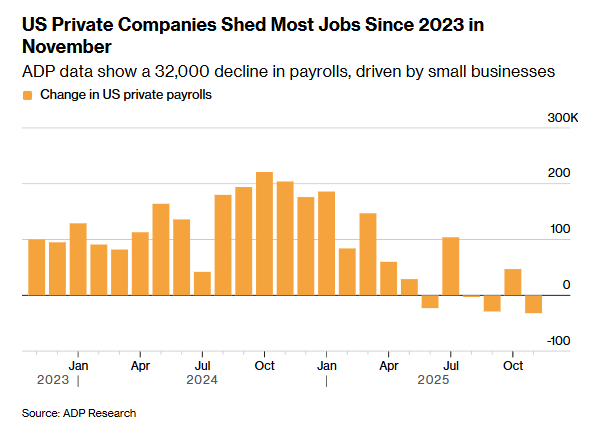
Bloomberg – Payrolls at US Companies Fall by Most Since 2023, ADP Says
______
2. State Farm Faces Fraud, Unjust Enrichment Lawsuit
State Farm Mutual Automobile Insurance Co. is facing a lawsuit accusing it of fraud and unjust enrichment for selling products from PHL Variable Insurance Co., which authorities say has a $2.2 billion capital shortfall that left policyholders with far smaller payouts than promised.
Three individuals who bought PHL life insurance and annuity contracts from State Farm agents filed a proposed class action on Nov. 26 in Chicago federal court. They allege that State Farm knew about PHL’s deteriorating finances and concealed information about the potential impact on policy payouts.
One plaintiff, Jenny Nappo, said she received only $300,000 from a $2 million life insurance policy after her husband died of cancer last year. Patrick McLaughlin, who bought a $1.5 million policy, and Gordon Jason, who purchased a $500,000 policy, now say their payouts are also capped at $300,000.
Connecticut-based PHL has faced multiple challenges over the past decade, including outdated actuarial assumptions and poor investment performance. Even after private equity owner Golden Gate Capital used complex risk-shifting transactions to shore up PHL’s finances, the company continued to deteriorate, leaving thousands of policyholders in limbo.
Golden Gate didn’t respond to a request for comment. State Farm said it’s aware of the complaint but hasn’t been served and therefore can’t comment on the specifics. The lawsuit claims State Farm failed to tell clients that it stopped selling products issued by Phoenix Cos.—PHL’s former parent—after its 2009 downgrade to junk. State Farm continued servicing existing Phoenix customers and received millions in compensation after the downgrade.
The plaintiffs seek unspecified damages, including the difference between the original value of their policies and what they’re worth now, as well as disgorgement of any ill-gotten gains by State Farm.
Bloomberg – State Farm Sued Over Policies Backed by Distressed Insurer PHL
______
3. Trump-Linked Crypto Projects Plunge
The nation’s top securities regulator is preparing to make it easier for small companies to go public by cutting mandatory disclosures and scaling back requirements based on firm size.
Such changes could expand the initial public offering pipeline and help revive the shrinking pool of listed companies, Securities and Exchange Commission Chairman Paul Atkins said in prepared remarks for a Tuesday event at the New York Stock Exchange. Atkins has long lamented that the number of publicly traded firms has fallen to about half of what it was three decades ago.
The revisions include providing companies with an “on-ramp” of at least two years — instead of the current one — to gradually comply with IPO rules, such as phasing in disclosures and investor reports. The agency is also reexamining what qualifies as a small company to reduce regulatory burden.
Atkins noted that the last major update to these definitions was roughly 20 years ago and said compliance costs “may have a disproportionate impact on some companies.”
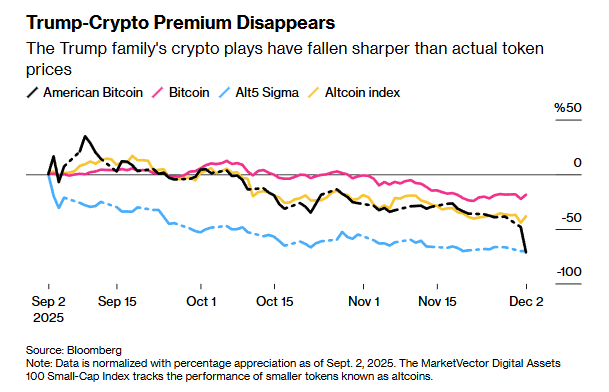
Bloomberg – The 26-Minute, 51% Wipeout That Deepened Trumps’ Crypto Woes
______
4. Meta Poaches Apple’s Top Design Executive
Meta Platforms Inc. has hired Alan Dye, Apple’s most prominent design executive, in a major coup that signals the social media giant’s ambitions to become a major maker of AI-powered consumer devices. Dye has led Apple’s user interface design team since 2015. Apple will replace him with longtime designer Stephen Lemay, a shift confirmed by the company.
“Steve Lemay has played a key role in the design of every major Apple interface since 1999,” CEO Tim Cook said. “He sets an extraordinarily high bar for excellence and embodies Apple’s culture of collaboration and creativity.”
The move marks a significant shift in Silicon Valley and shows Meta’s commitment to hardware. For Apple, Dye’s departure continues the talent exodus that began after Jony Ive left in 2019.
After Ive’s exit, Dye became a central figure shaping Apple’s operating systems, apps, and device aesthetics. He informed Apple this week of his decision to leave, though top management had been anticipating his departure.
At Meta, Dye will lead a new design studio overseeing hardware, software, and AI-integrated interfaces. He will report to CTO Andrew Bosworth, who runs Reality Labs, the division behind Meta’s wearable devices such as smart glasses and VR headsets.
Dye will focus on revamping Meta’s consumer hardware with AI features and will begin as chief design officer on Dec. 31. He most recently oversaw the Vision Pro interface and the sweeping redesign of Apple’s operating systems, and previously worked on Apple Watch, the iPhone X, and a range of Apple apps. His team has also been developing upcoming smart-home devices.

Bloomberg – Apple Design Official Alan Dye Poached by Meta in Major Coup
______
5. Morgan Stanley Weighs Offloading Data-Center Exposure
Morgan Stanley, one of the major financiers of the artificial-intelligence build-out, is exploring a significant risk transfer tied to a portfolio of loans supporting AI-infrastructure companies, according to people familiar with the matter.
The bank has held early discussions with potential investors about an SRT referencing loans to businesses tied to data-center development. SRTs backed by data-center exposure remain a nascent segment of the credit-risk transfer market, where banks hedge credit exposure, optimize capital ratios and free up balance sheet capacity by selling credit-linked notes to institutional investors.
The firm is also evaluating other ways to hedge or syndicate portions of its data-center risk, and there is no guarantee the exploratory discussions will produce a deal.
In October, Morgan Stanley arranged more than $27 billion of debt and roughly $2.5 billion of equity financing for a special-purpose vehicle developing Meta Platforms’ Hyperion data-center site in Louisiana. It also led three recent junk-bond sales from TeraWulf, Cipher Mining and Applied Digital, all tied partly to funding new data-center facilities.
Morgan Stanley expects major cloud providers to spend about $3 trillion on data-center infrastructure through 2028, with cash flow covering only about half. The remainder will rely heavily on debt markets — raising concerns that banks may become overexposed to a small group of borrowers. Oracle, a major beneficiary of the AI boom, has seen a sharp rise in the cost of insuring its debt amid heavy borrowing.
Earlier this year, Morgan Stanley pitched an SRT linked to loans to private-market funds. Global SRT issuance is expected to grow about 11% annually over the next two years, Bloomberg Intelligence estimates.
Bloomberg – Morgan Stanley Considers Offloading Some of Its Data-Center Exposure
______
6. Blackstone Agrees to Sell Flushing’s Skyview Shopping Center
Blackstone Inc. has agreed to sell The Shops at Skyview in Queens to a venture formed between TPG Inc. and Acadia Realty Trust.
The property is under contract for about $425 million, according to a person familiar with the deal. The complex sits less than a mile from Citi Field and the adjacent site where New York Mets owner Steve Cohen recently won approval to operate a casino.
A Newmark Group team led by Adam Spies, Adam Doneger and Ben Lushing is representing Blackstone. The sellers and buyers declined to comment, and Acadia and Newmark didn’t immediately respond to requests.
The Shops at Skyview spans 555,000 square feet and anchors a larger mixed-use development with over 1,000 apartments and medical office space. It is nearly fully leased with tenants such as BJ’s Wholesale Club, Round1 and Marshalls.
Blackstone has been active in commercial property transactions, recently selling an office tower in Boston’s Back Bay and acquiring stakes in office properties in Bellevue, Washington, and Midtown Manhattan.

Bloomberg – Blackstone to Sell NYC Mall to TPG Venture for $425 Million
______
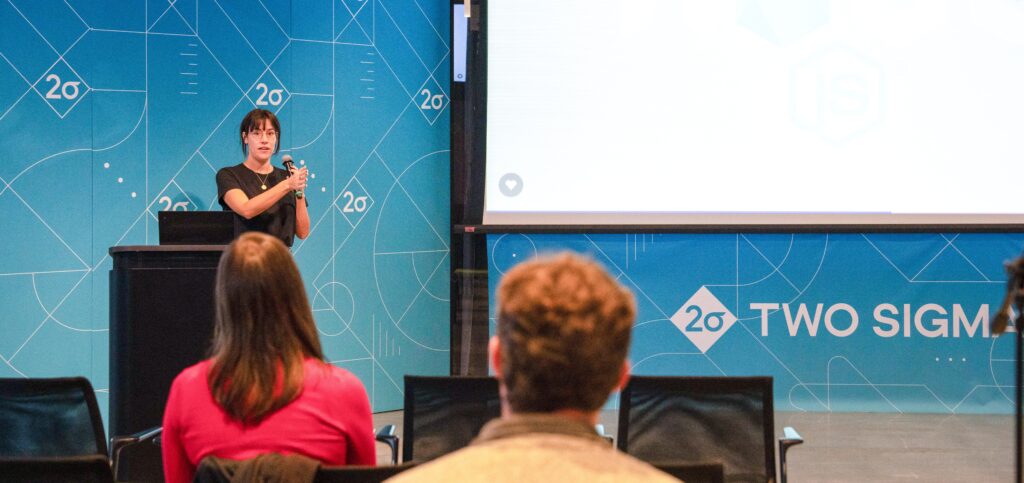
7. Two Sigma Launches Tax-Aware Long-Short Fund
Two Sigma Investments has launched a hedge fund designed to capitalize on one of the hottest trends in wealth management: minimizing taxes.
The firm introduced the Two Sigma Beacon Fund this year, a “tax-aware long-short fund,” according to people familiar with the matter. These strategies aim to reduce tax liabilities by holding outperforming positions longer while systematically harvesting losses.
Two Sigma, which manages more than $70 billion, declined to comment.
Competitor AQR Capital Management has found strong demand for similar strategies, pulling in about $32 billion into its tax-aware long-short private funds and SMAs in the first nine months of the year. That brings AQR’s total assets in this strategy to $45.3 billion — roughly a quarter of the firm’s total AUM.
Two Sigma raised $54 million for its tax-aware fund as of August, filings show. A Goldman Sachs fund offering access to Two Sigma’s Beacon strategy raised nearly $11 million as of October.
Bloomberg – Two Sigma Debuts Hedge Fund to Capitalize on ‘Tax Aware’ Boom
______