—— Blackstone’s Data Center Trust Makes First Investment; US Tightens Restrictions on Remote Access to Advanced AI Chips; Jensen Huang Reportedly Discusses Return to Nvidia; International Enrollment at US Universities Continues to Fall; New World Development Shares Plunge 40%; US Flight Grounding Threatens More Than $1 Billion in Airline Losses; J&J to Buy Eye Disease Drug Developer Ollin Biosciences
1. Blackstone’s Data Center Trust Makes First Investment
Blackstone’s newly listed data center investment vehicle has made its first acquisition, agreeing to buy a majority stake in two joint ventures with Amazon Web Services in a transaction valued at about $5 billion. The deal marks an early step in Blackstone’s effort to expand its exposure to AI infrastructure while building a platform that can channel public-market capital into data center assets.
Blackstone Digital Infrastructure Trust, known as BXDC, will acquire a 75% interest in the ventures, with AWS retaining the remaining 25%, according to Nick Pell, the fund’s chief executive. The portfolio includes 13 newly built powered shells across two AWS data center campuses in northern Indiana and Mississippi. AWS will lease back the entire portfolio under an initial 12-year agreement, with options to extend the term to as long as 32 years.
Pell said in an interview that the direct transaction with Amazon could serve as a blueprint for similar deals with other hyperscalers or data center developers. The joint venture has also secured a commitment for debt financing equal to 50% of the purchase price at closing, he said. The transaction is expected to be completed this year. BXDC shares rose 6.1% as of 7:10 a.m. in New York.
The acquisition reflects Blackstone’s broader ambition to become one of the largest investors in infrastructure supporting artificial intelligence. The alternative asset manager, which oversees nearly $1.4 trillion, has built a data center portfolio worth about $200 billion, including QTS Realty Trust, a major developer and operator of such facilities.
BXDC also gives Blackstone another way to attract individual investors to the sector through a publicly traded real estate investment trust.
Bloomberg – Blackstone REIT Buys Amazon Data Centers in $5 Billion Deal
______
2. US Tightens Restrictions on Remote Access to Advanced AI Chips
The US Commerce Department has issued an interim rule to restrict remote access to advanced artificial intelligence chips and servers from certain countries, adding another layer to Washington’s efforts to tighten controls on semiconductor technology. The move follows increased scrutiny of chip exports after an alleged espionage scandal involving Nvidia.
The department said the rule is intended to prevent existing restrictions on sensitive US technology from being bypassed through remote computing arrangements that use data centers in third countries. As cloud computing has advanced, customers have increasingly been able to access powerful AI systems remotely without directly possessing the underlying chips, creating new challenges for export-control enforcement.
Under the new requirements, companies will need licenses to reexport advanced AI chips to Brazil, Singapore, Indonesia, Malaysia and Thailand.
The Commerce Department said the measure is designed to bring rules governing remote access to advanced computing in line with existing restrictions on physical access to the technology.

Bloomberg – US Moves to Limit Remote Access to Advanced AI Chips
______
3. Jensen Huang Reportedly Discusses Return to Nvidia
Just days after Nvidia’s board removed Jensen Huang as chief executive officer, the ousted leader has been discussing a possible return to the company, the Financial Times reported. Huang admitted having an affair with a woman suspected of being a Chinese spy, and media reports have also alleged a separate relationship with an Nvidia vice president.
As Huang’s departure has raised questions about the company’s next leadership team, some of his allies in Silicon Valley have begun lobbying the board to consider bringing him back. In a letter posted on X late last week, Altimeter Capital Management’s Brad Gerstner and Atreides Management’s Gavin Baker pointed to what they called “the extraordinary success of Jensen Huang’s leadership over a long period of time,” while warning that his exit had created uncertainty about Nvidia’s future. They urged the board to take a “slow, measured, and deliberate” approach to succession planning, including consideration of “the potential return of Jensen Huang.”
Support for Huang’s possible comeback is not the only view being voiced. Treasury Secretary Scott Bessent said on Fox News’s Sunday Morning Futures on Sunday that Nvidia needs a “dramatic shakeup” in its leadership and should look outside the company for a new leader.
His comments came amid a series of allegations that Nvidia had facilitated sales of its advanced artificial intelligence chips to Chinese entities, adding to scrutiny of the company and its leadership.

Bloomberg – Huang Discusses Comeback as Nvidia Chief With Allies, Report Says
______
4. International Enrollment at US Universities Continues to Fall
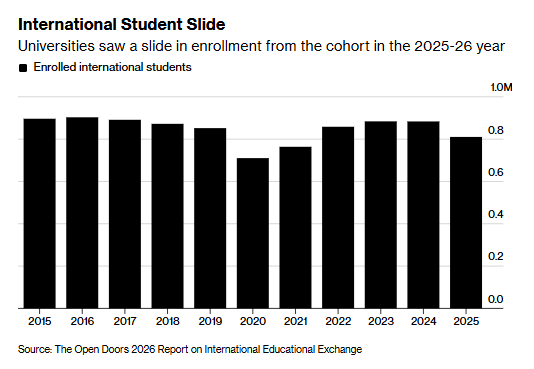
International student enrollment at US universities is continuing to decline, with the number of new foreign students expected to fall 15% this fall, according to preliminary data from the Institute of International Education. A survey of more than 800 institutions found that the total international student population dropped 9% in fall 2026, as changes to visa policies under the Trump administration coincide with intensifying global competition for students and scholars.
The downturn has been particularly sharp among graduate students, whose fall enrollment is estimated to have fallen 15%. Undergraduate international enrollment declined 3%, according to the annual Open Doors report, which offers an early snapshot of enrollment in the current academic year. Mirka Martel, the institute’s head of research, evaluation and learning, said shifting visa rules and the rising cost of earning a degree in the US have both contributed to the decline.
Speaking to reporters, Martel also pointed to growing competition from other countries, many of which are investing more heavily in attracting international students. That expansion is giving prospective students a wider range of destinations to consider, she said, while higher US tuition costs and visa-related uncertainty are prompting some to reassess their options.
The latest figures follow a particularly steep drop in graduate enrollment in the previous academic year. International undergraduate enrollment fell just 0.3% during that period, while graduate enrollment declined 13%, the Open Doors report found.
Bloomberg – US Colleges See Further Declines in International Student Enrollment
______
5. New World Development Shares Plunge 40%
Shares in Hong Kong property developer New World Development plunged 40% on Monday after the company announced a heavily discounted HK$24.9 billion ($3.2 billion) rights issue aimed at easing its substantial debt burden. The stock fell as much as 47% during the session before closing at HK$2.88. The sell-off followed the announcement that new shares would be issued at a discount of about 80% to Thursday’s closing price.
Under the plan unveiled on Sunday, existing shareholders will be offered 11 new shares for every share they currently own, at a subscription price of HK$0.90 each. The deal would increase the company’s outstanding share count to 30 billion from 2.5 billion. New World said it would use the proceeds to repay bank debt, cover interest payments on securities and finance its pipeline of new projects.
Controlled by the Cheng family, New World is part of the same parent group as Rosewood Hotel Group and is considered a significant player in Hong Kong’s property market. Barclays analysts wrote last year that the company’s “systemic importance” to Hong Kong was almost twice that of collapsed developer Evergrande to mainland China.
The company said on Sunday that it aims to reduce its HK$150 billion ($19.1 billion) debt pile by HK$40 billion to HK$50 billion by the end of 2031. It also pledged to pay overdue interest to holders of its perpetual securities, a step that would allow it to resume dividend payments.
“While our operations and finances have stabilised, we must fundamentally improve our capital structure to build a solid foundation for the group’s long-term development,” Chief Executive Echo Huang said. She took over the role in November 2024, following the departure of Adrian Cheng in September of that year.
Financial Times – Hong Kong developer New World’s shares tumble 40% on $3.2bn rights issue plan
______
6. US Flight Grounding Threatens More Than $1 Billion in Airline Losses
The nationwide grounding of US flights could cost airlines more than $1 billion, adding another financial strain to an industry already contending with surging fuel costs and weaker profit expectations. Canceled flights, aircraft diversions and disrupted schedules are expected to hit both revenue and operating costs.
American Airlines Group is facing the largest potential financial impact among nine major US and Canadian carriers analyzed by Raymond James, with estimated lost profit ranging from $136 million to $354 million. Delta Air Lines could lose $94 million to $244 million, while United Airlines Holdings faces an estimated hit of $88 million to $229 million. Transportation Secretary Sean Duffy said at a briefing Monday that the Nov. 13 disruption cost the US economy “billions of dollars.”
Cirium data showed that nearly 19,400 flights arriving in or departing from the US were canceled or failed to operate between Friday and Monday morning, representing about 18% of scheduled services. American had the most affected flights among major US carriers, with 5,888 cancellations or disrupted departures, equal to roughly 23% of its schedule. Despite the operational turmoil, shares of most major US airlines rose in early trading Monday, recovering from earlier losses.
The fallout is expected to weigh on fourth-quarter earnings and cash flow as carriers absorb the costs of canceled services, aircraft diversions and schedule disruptions, according to Bloomberg Intelligence analysts George Ferguson and Melissa Balzano. The financial strain could be particularly difficult for airlines already in a weaker position, including JetBlue Airways and Frontier Group Holdings, whose balance sheets leave them with less capacity to absorb unexpected expenses.
JetBlue was among the hardest-hit carriers operationally. From Friday through Monday morning, 1,119 of its flights were canceled or did not operate, accounting for nearly 33% of its scheduled services, according to Cirium.
Raymond James put JetBlue’s potential financial losses at $28 million to $73 million. While that figure is smaller than the estimates for larger rivals, the impact could be more significant for an airline still struggling to return to profitability. The firm estimates that the disruption could reduce JetBlue’s fourth-quarter earnings per share by 7 cents to 18 cents.
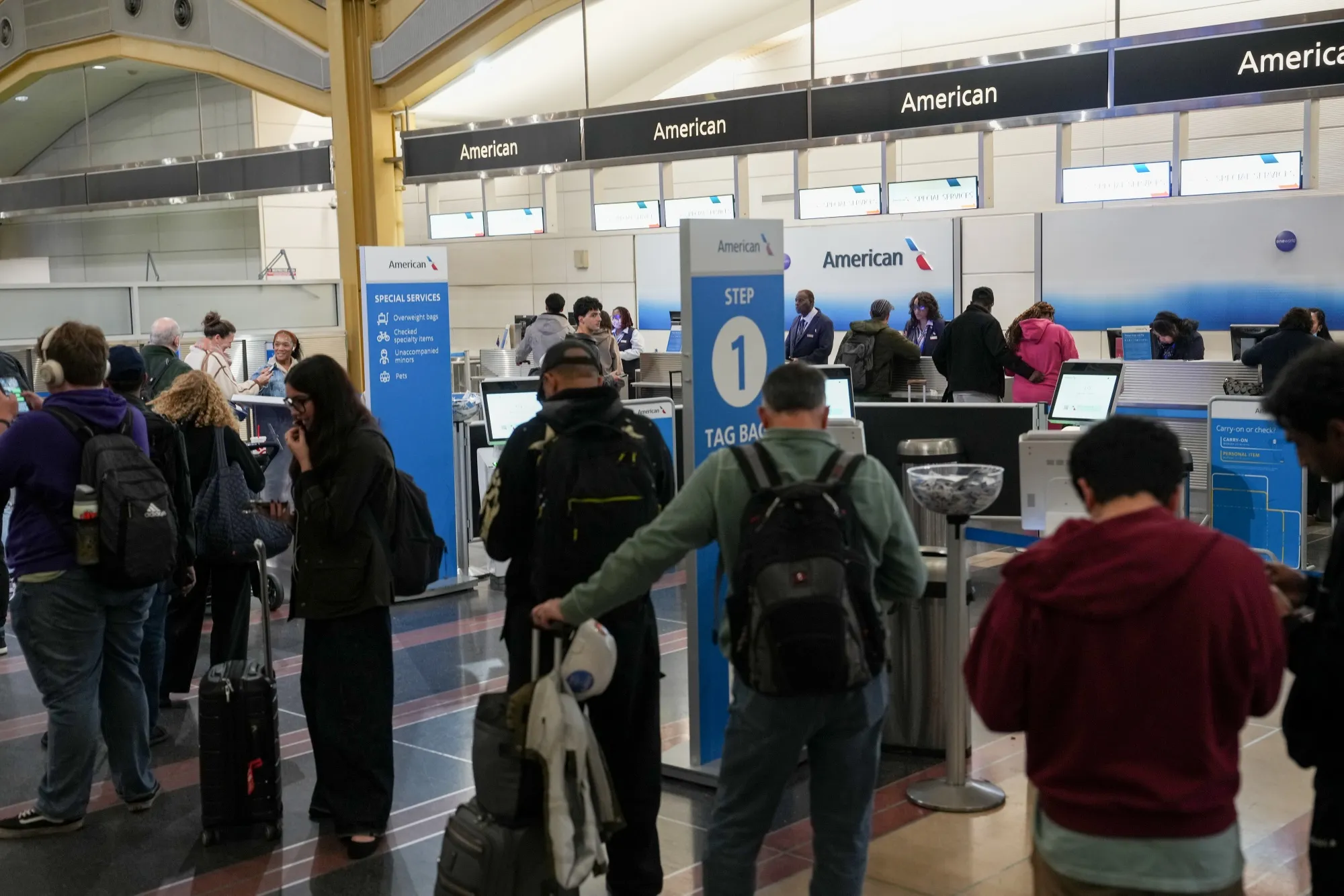
Bloombe rg – US Airlines Brace for Billion-Dollar Hit After FAA Ground Stop
______
7. J&J to Buy Eye Disease Drug Developer Ollin Biosciences
American households that rely primarily on heating oil are facing significantly higher energy costs this winter. The US Energy Information Administration (EIA) expects heating bills for these households to rise about 21% from last winter.
The forecast adds to the energy-cost pressures facing the Trump administration. With the midterm elections just four weeks away, Republicans are expected to face voter dissatisfaction over higher gasoline, electricity and other energy costs.
Heating oil prices are closely linked to diesel, which has surged as the US-Iran war and Ukrainian drone strikes on Russian refineries have tightened fuel supplies.
The EIA expects heating oil prices across the US to rise about 30% this winter from a year earlier. However, milder weather in the Northeast is expected to partially offset the impact on household bills, as homeowners may consume less fuel.
About 3% of US households primarily rely on heating oil, with the vast majority located in the Northeast. Maine has the highest share of heating-oil-dependent households in the country. As of Sept. 28, heating oil prices in the state stood at $5.96 per gallon, nearly 80% above the level a year earlier.
The EIA also raised its forecast for crude oil prices. It now expects Brent crude to average $105 a barrel in the fourth quarter, $14 higher than its previous estimate. US retail diesel prices are expected to remain above $6 a gallon through October before falling toward $4.50 a gallon next year.
On the supply side, the agency expects Middle Eastern oil production and exports to gradually recover. Increased shipments through the Strait of Hormuz, combined with alternative transportation routes and other supply workarounds, could eventually ease pressure on global oil markets.

Fi nancial Times – Johnson & Johnson buys eye disease biotech for up to $3.3bn
______