—— Apple and OpenAI Face First Major Court Showdown; Houthi Attacks Hit Saudi Cities and Aramco Complex; OpenAI Employee Arrested Over Alleged Hidden Recording Device; Bank of America Earnings Hit by Trading Slump and $1.2 Billion Charge; CoreWeave Bonds Slide Into Distressed Territory; US Inflation Accelerates to 3.7%; Netflix to Cut About 1,000 Jobs
1. Apple and OpenAI Face First Major Court Showdown
Apple Inc. and OpenAI are heading into a pivotal court hearing over allegations that the artificial intelligence company conspired to obtain confidential information about Apple’s future products. The hearing on Wednesday will address two central questions: Apple’s request for an immediate order barring OpenAI from using alleged trade secrets, and OpenAI’s separate bid to have the lawsuit dismissed entirely.
The legal dispute marks a sharp deterioration in relations between the companies, despite a partnership established two years ago that integrated ChatGPT into Apple’s software ecosystem. Tensions have escalated as hundreds of Apple employees have moved to OpenAI, putting the dispute in the spotlight as the startup seeks a valuation of $1.4 trillion in a new funding round and prepares for a potential public listing.
Apple sued OpenAI, its head of hardware and a former iPhone hardware engineer in July. The company alleges that the defendants conspired to obtain confidential information from former Apple employees covering product design, manufacturing, component technologies, testing methods and supply-chain operations.
In its complaint, Apple said OpenAI was using the information to “advance OpenAI’s efforts to enter the consumer hardware market.” The company is seeking a court order that would immediately prevent OpenAI from using the allegedly misappropriated material while the litigation proceeds.
OpenAI has strongly denied the allegations. It argues that Apple’s lawsuit is intended to discourage employees from joining a competitor and amounts to portraying routine job interviews as trade-secret misappropriation.
“OpenAI is developing a new family of devices designed for the AI era,” the company said in an October court filing. “OpenAI has no need or desire for Apple’s trade secrets.”
Bloomberg – Apple, OpenAI Head to Court in High-Stakes AI Trade Secret Fight
______
2. Houthi Attacks Hit Saudi Cities and Aramco Complex
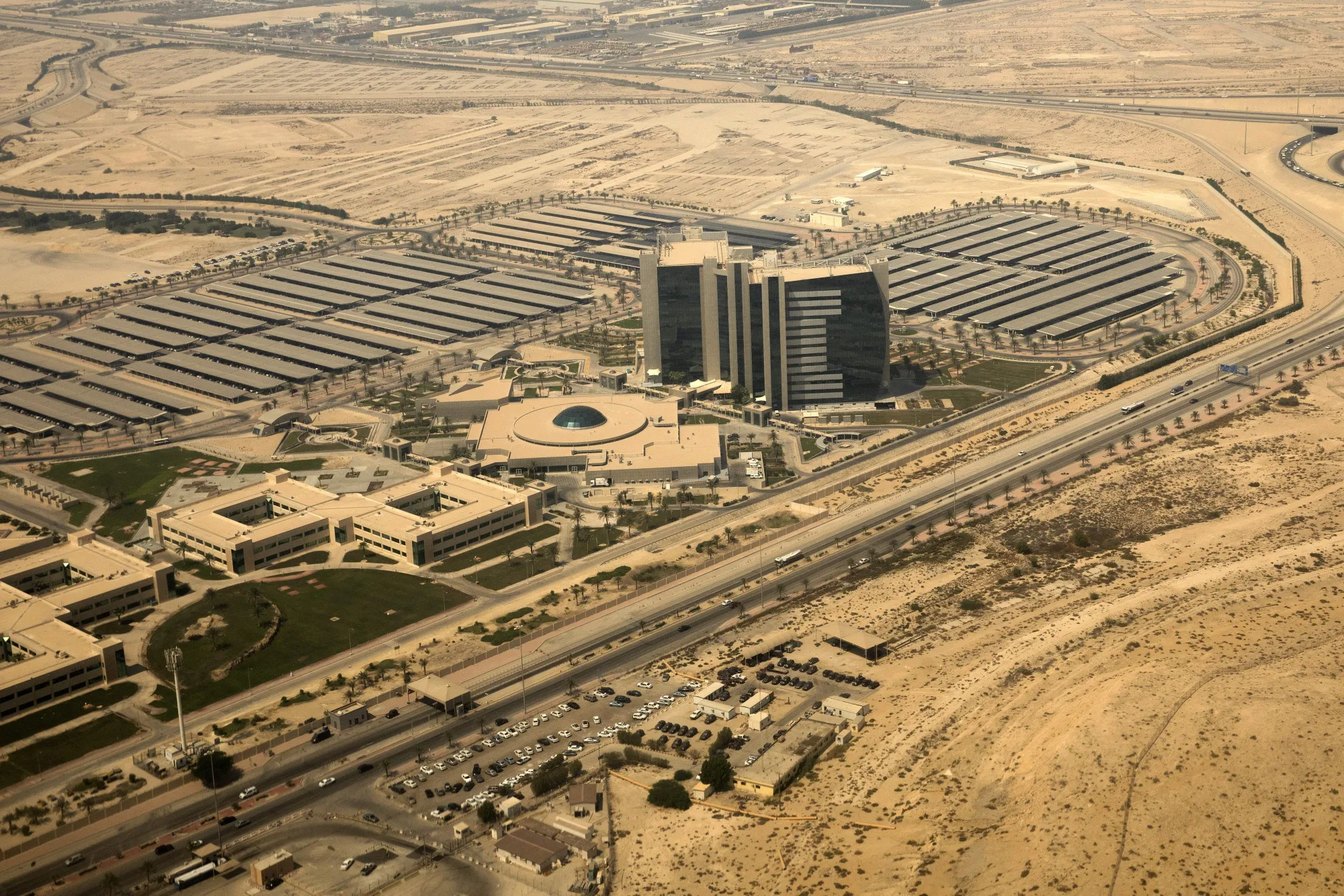
The conflict in the Middle East is intensifying as Iran-backed Houthi forces launch missile and drone attacks across Saudi Arabia, hitting several cities and setting off a limited fire at Saudi Aramco’s office complex in Dhahran. At the same time, attacks on vessels transiting the Strait of Hormuz are escalating, adding to concerns over the recovery of global oil supplies.
Saudi authorities said the fire at Aramco’s complex in the eastern kingdom caused no casualties. The attacks continued into Wednesday, following a week of fighting that has killed at least 18 people and injured hundreds in Saudi Arabia. Missiles targeted several cities, including the capital, Riyadh, while the Saudi-led coalition fighting the Houthis said it had intercepted multiple projectiles.
The coalition said it intercepted missiles aimed at Kharj, the kingdom’s southern region, Dhahran and Haradh. Shrapnel from an interception landed in a residential area of Dhahran, according to the coalition. Earlier, Saudi Arabia’s cabinet warned the Houthis that they would “bear the consequences” of repeated attacks on airports, civilian facilities and economic sites.
Energy infrastructure in Yemen has also been affected. The Saudi-led coalition had urged people near an oil facility in Sanaa, Yemen’s Houthi-controlled capital, to leave the area for their safety. Yemen Petroleum Co. later said the Al Sabah facilities and a refueling station had been hit, adding that fuel tanks had been emptied before the attack. Houthi-run Al Masirah TV also reported strikes in several areas of Saada and Al Jouf.
Saudi Arabia’s own energy infrastructure has faced repeated threats during the escalating hostilities. A refinery in Jazan, in the west of the kingdom, has remained shut since an earlier attack. A major oil export port on the Red Sea coast has also been targeted, while a key cross-country pipeline used by Aramco to transport crude to international markets was temporarily shut last month following an attack.
Bloomberg – Aramco HQ Hit as Houthis Widen Attacks on Saudi Arabia
______
3. OpenAI Employee Arrested Over Alleged Hidden Recording Device
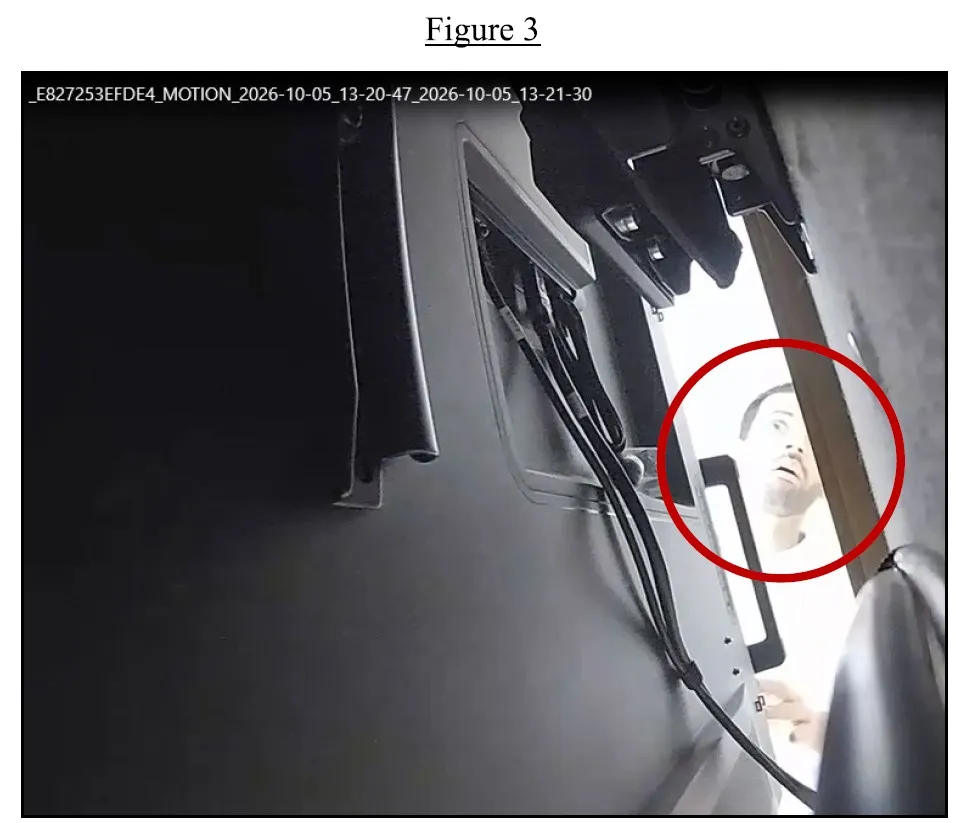
An OpenAI employee has been arrested and charged with allegedly installing a concealed recording device in one of the company’s San Francisco offices, according to statements from the AI company and the US Justice Department.
Abdulrahman Alfozan, a Saudi Arabian national, was arrested on Oct. 9, more than a week after OpenAI staff discovered an audio recording device hidden behind a television in an executive conference room, the Justice Department said Tuesday. Authorities allege that Alfozan placed the device.
Alfozan remains in federal custody and appeared in court in San Francisco on Tuesday. OpenAI said he joined the company in July 2025 and worked on its product team. The company fired him on the day of his arrest.
The case could intensify concerns about security at leading technology companies as countries compete aggressively to develop increasingly powerful artificial intelligence systems.
Bloomberg – OpenAI Says Staffer Arrested for Hidden Recording Device in Office
______
4. Bank of America Earnings Hit by Trading Slump and $1.2 Billion Charge
Bank of America Corp. reported weaker-than-expected trading results for the latest quarter, while a regulatory penalty related to money-laundering and sanctions violations further weighed on earnings. The announcement sent the bank’s shares sharply lower on Wednesday.
Bond-trading revenue fell 17% to $2.55 billion, while equity-trading revenue rose 10% to $2.51 billion, the bank said in a statement. Both figures missed analyst estimates.
The second-largest US bank also recorded a $1.2 billion non-tax-deductible charge, reducing net income by 17 cents per share. On Tuesday, the US Treasury Department said the bank had “effectively outsourced” a key part of its compliance efforts while seeking to protect revenue. Bank of America said the costs of addressing the underlying issues were already reflected in its expenses.
Chief Executive Officer Brian Moynihan addressed the regulatory order at the outset of the bank’s earnings call with analysts on Wednesday.
“We understand the seriousness of compliance and we are responsible for getting it right,” Moynihan said. “We’ve invested billions of dollars in technology and dedicated thousands of employees to combat financial crime. The team is far along with and committed to completing the work required to be addressed by the regulators.”
The regulatory issues continued to weigh on investor sentiment. Shares of the Charlotte, North Carolina-based bank fell 8.2% as of 9:59 a.m. in New York on Wednesday, extending their decline since the start of the year to 9.9%.
Bloomberg – BofA Shares Tumble After Fines, Weak Trading Drag Down Results
______
5. CoreWeave Bonds Slide Into Distressed Territory
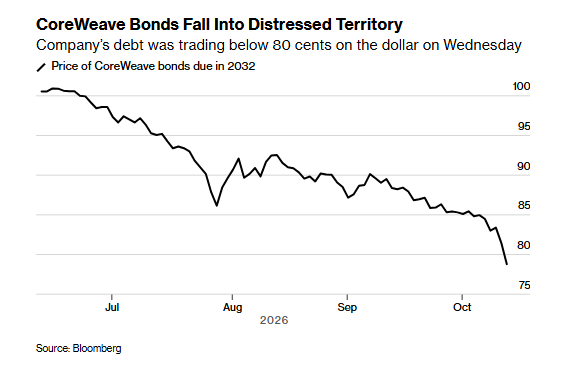
As investment in artificial intelligence infrastructure continues to expand, investors are paying closer attention to the financing costs and debt-servicing capacity of companies powering the boom. CoreWeave Inc., an AI cloud-computing provider, has seen its bonds plunge to levels typically associated with financial distress, drawing attention from Silicon Valley figures including Chamath Palihapitiya and Elon Musk.
The company’s unsecured bonds due in 2032 traded below 80 cents on the dollar on Wednesday, according to Trace pricing data. That level is widely viewed as a sign that a borrower may be under financial strain. At those prices, the bonds yield more than 15%. After Palihapitiya highlighted the yield, Musk responded on his social media platform with a brief reaction: “yikes.”
CoreWeave’s stock has also come under pressure, falling as much as 16% during Wednesday’s session. D.A. Davidson analyst Gil Luria, who has previously described the company as the “subprime tranche” of AI, warned on a podcast that the shares could go to zero if the AI funding boom falters and CoreWeave becomes unable to meet its costly debt obligations.
Based in Livingston, New Jersey, CoreWeave is considered one of the original “neocloud” providers — cloud-computing companies focused on the fast-growing AI market. Its business requires substantial capital, leaving it heavily reliant on high-yield debt markets to finance its infrastructure expansion. In recent months, the company has had to accept higher borrowing costs to secure that funding.
Meanwhile, CoreWeave’s credit-default swaps have returned to record highs. At current levels, the market is pricing in a probability of default exceeding 50% over the next five years.
Bloomberg – CoreWeave Bonds Tumble Into Distress, Drawing ‘Yikes’ From Musk
______
6. US Inflation Accelerates to 3.7%
Shares of dating-app company Bumble Inc. surged Monday after The Wall Street Journal reported that the company was in advanced talks to be taken private in a deal valuing it at about $1 billion.
The potential buyer is recently formed Ithaca Holdings, and an agreement could be announced as soon as this week, the Journal reported, citing people familiar with the matter. A takeover would be among Ithaca Holdings’ first major transactions. A Bumble spokesperson did not immediately respond to requests for comment.
Bumble was founded in 2014 by Whitney Wolfe Herd, a former Tinder co-founder. The app built its identity around a distinctive rule that allowed only women to make the first move in initiating conversations.
Like many dating-app companies, however, Bumble has struggled with declining usage as younger people grow weary of online dating and increasingly explore other ways to meet potential partners, including in-person events.
In August, Bumble abandoned its longstanding women-first model, introducing a messaging change that allows men to make the first move. The move was part of the company’s latest effort to improve user engagement.
Following the Journal’s report, Bumble shares jumped as much as 57% to $3.98 on Monday, marking their biggest intraday gain since March 12.
The reported talks come as Bumble seeks to reverse user declines and restore momentum. The potential transaction has not yet been formally announced, and its final terms remain unclear.
Financial Times – US inflation jumps to 3.7% as Iran war drives up prices
______
7. Netflix to Cut About 1,000 Jobs
American households that rely primarily on heating oil are facing significantly higher energy costs this winter. The US Energy Information Administration (EIA) expects heating bills for these households to rise about 21% from last winter.
The forecast adds to the energy-cost pressures facing the Trump administration. With the midterm elections just four weeks away, Republicans are expected to face voter dissatisfaction over higher gasoline, electricity and other energy costs.
Heating oil prices are closely linked to diesel, which has surged as the US-Iran war and Ukrainian drone strikes on Russian refineries have tightened fuel supplies.
The EIA expects heating oil prices across the US to rise about 30% this winter from a year earlier. However, milder weather in the Northeast is expected to partially offset the impact on household bills, as homeowners may consume less fuel.
About 3% of US households primarily rely on heating oil, with the vast majority located in the Northeast. Maine has the highest share of heating-oil-dependent households in the country. As of Sept. 28, heating oil prices in the state stood at $5.96 per gallon, nearly 80% above the level a year earlier.
The EIA also raised its forecast for crude oil prices. It now expects Brent crude to average $105 a barrel in the fourth quarter, $14 higher than its previous estimate. US retail diesel prices are expected to remain above $6 a gallon through October before falling toward $4.50 a gallon next year.
On the supply side, the agency expects Middle Eastern oil production and exports to gradually recover. Increased shipments through the Strait of Hormuz, combined with alternative transportation routes and other supply workarounds, could eventually ease pressure on global oil markets.
Financial Times – Netflix to cut 1,000 jobs as growth concerns mount
______