
—— Lower Manhattan Office Market Shows Early Signs of Revival; Canada Small Businesses Suffer as Trade War Escalates; Hedge Fund Millennium Management in Discussions with Geneva Authorities over Tax Deal; Qualcomm Wins Amazon as Data Center Chip Customer in $60 Billion Deal; US Consumer Borrowing Increases in July by More Than Expected; The $2tn Debt-Servicing Monster Threatening Global Leaders; Brent Oil Rises to Highest Since July on Mideast Supply Risks
1. Lower Manhattan Office Market Shows Early Signs of Revival
Lower Manhattan’s office market is showing early signs of a revival as companies seek a less costly alternative to the prestigious skyscrapers of Midtown.
This year through June, tenants scooped up about 4 million square feet (372,000 square meters) of space south of Canal Street, according to data from Cushman & Wakefield that excludes lease renewals. That’s more than double the volume from a year earlier and marks the best first half for the submarket since 2019.
The deals are giving a lift to the area known for Wall Street and the Financial District, which had struggled to make a full recovery in the 25 years since the 9/11 terrorist attacks. Most recently, the pandemic and its aftermath pushed companies toward buildings near Midtown’s transit hubs, generating a demand surge that tightened vacancies and pushed rents higher. Lower Manhattan, by comparison, offers plentiful options at cheaper rates and without the cutthroat competition. “There’s strong relocation activity, with more companies choosing to move to the district,” said Jessica Lappin, president of the Alliance for Downtown New York. “You’re getting great space that’s accessible for your employees at a lower price point.” Also fueling the momentum is American Express Co.’s decision early this year to move its headquarters to 2 World Trade Center, which enabled developer Silverstein Properties to start construction on the final major office property planned at the site of the 9/11 attacks. Ground was broken for the project in July.
“It’s a huge piece of the puzzle, and it’s a wonderful investment in the neighborhood and the city,” Lappin said. “People are very excited and inspired.”
Tech and artificial intelligence companies account for a significant share of new leases downtown. Mercor, an AI labor marketplace startup, and legal and compliance firm Norm Ai recently took space at 1 World Trade Center. Meta Platforms Inc.-backed Scale AI moved from its Chelsea location to a new office at 1 World Trade that can accommodate a much bigger team of roughly 500 people.
The tower, which opened in 2014 as the first new office building at the site of the attacks, has been slow to fill its 71 floors of offices. It’s now 97% occupied, according to co-developer the Durst Organization.

Bloomberg – New York City’s Office Market Recovery Spills Over to Downtown
______
2. Canada Small Businesses Suffer as Trade War Escalates
The economic pain that Canadian Prime Minister Mark Carney warned would come from a trade war is now harsh reality for some small businesses that export to the US.
Across Canada, companies are losing orders, contemplating job cuts and paying higher costs. For some, the threat is existential.
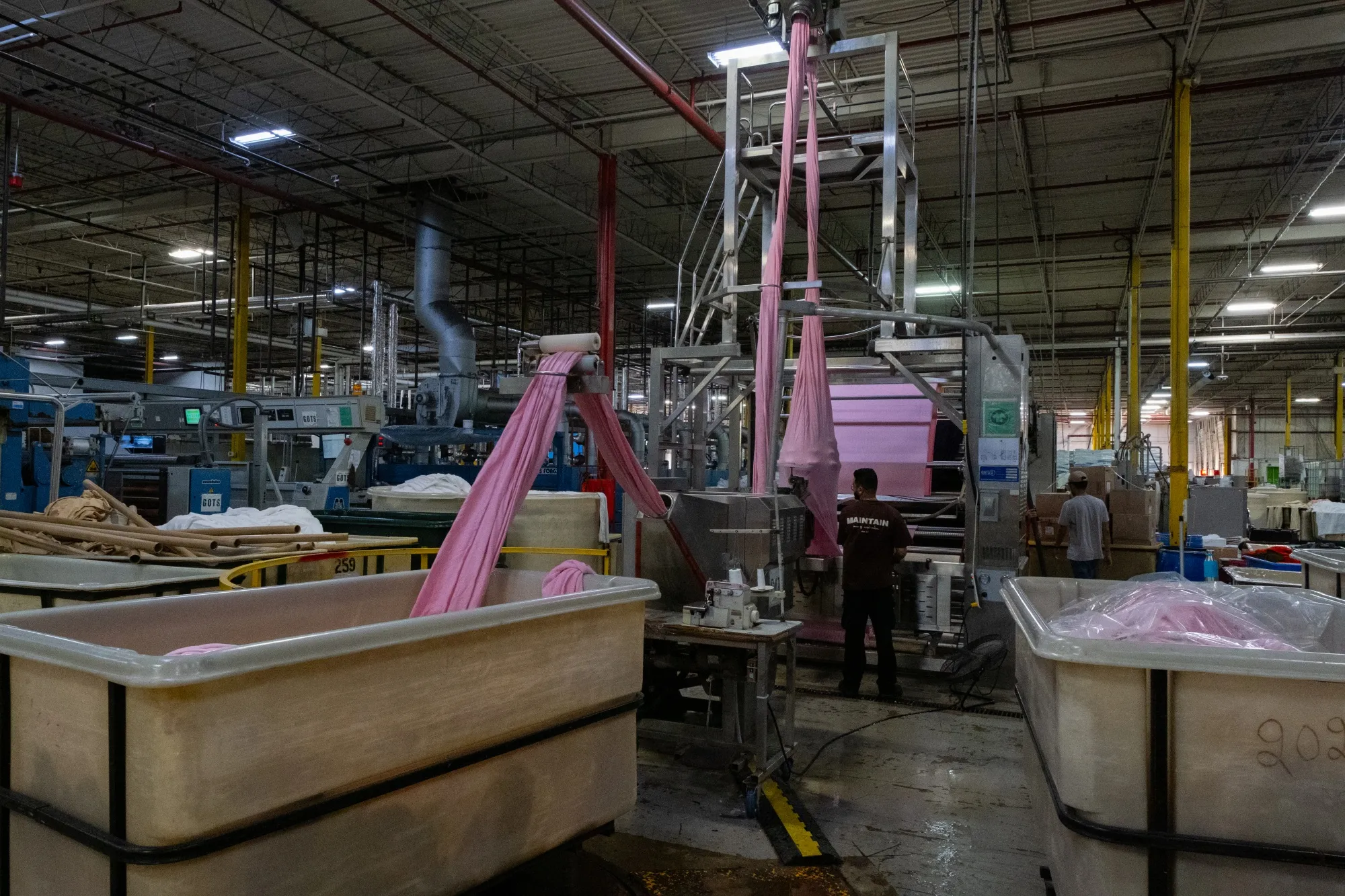
Toronto-based Fine Cotton Factory Inc. exports 30% to 50% of its products to the US. Since the tariffs kicked in, some US orders have been canceled or postponed, and new ones from both sides of the border have slowed, according to Executive Vice President Skip Kann. He fears he’ll need let go a small number of his 250 employees as soon as this month.
“We’re fighting for our life right now,” Kann said.
Talks between the two countries collapsed Aug. 21, triggering 50% US tariffs the next day on $20 billion of Canadian goods such as textiles, paint, apparel, alcohol and honey. Canada announced retaliatory duties on imports from the US worth roughly the same amount, which came into effect Tuesday. The risk is that the trade war will spiral further.
Many small Canadian manufacturers were shielded from earlier US tariffs because of exemptions under the North American trade pact. But the latest levies imposed by President Donald Trump in August ignore that deal. While the $20 billion accounts for only about 5% of Canada’s annual goods exports to the US, the new tariffs appear to disproportionately affect small and medium-sized businesses. In turn, those firms account for about half of Canada’s gross domestic product. The Canadian government bolstered loans and other financial support for such firms as part of a broader C$7.5 billion ($5.4 billion) package for businesses and workers hit by the latest round of tariffs. Those measures won’t put out the fire, Kann said. Like many entrepreneurs whose growth potential lies beyond Canada, he’s says already exhausted domestic opportunities. Plus, some federal supports, such as funding for market research and new technology, are longer-term fixes.
Fine Cotton’s survival isn’t just important for its workers. As owner of one of Canada’s only large-scale dye houses, the manufacturer is also crucial to Jerico, an Ontario clothing maker that prides itself on a fully domestic supply chain. If that dye facility closes, Jerico won’t be able to dye and finish knitted fabrics at scale in Canada, said Salmaan Andani, managing director at Jerico.
In Andani’s telling, manufacturers like his would be forced to source product overseas, and the country’s knitting and apparel manufacturing industry could unravel, link by link.
Bloomberg – ‘Fighting For Our Life’: Canadian Businesses Reel From US Tariff Shock
______
3. Hedge Fund Millennium Management in Discussions with Geneva Authorities over Tax Deal
Hedge fund Millennium Management is in discussions with Geneva authorities to strike a tax deal in the canton and expand its office there, amid fierce competition between the Swiss regions to lure high-net-worth individuals.
In Switzerland’s highly federalised system, cantons have considerable autonomy to set their own tax rates and routinely use them to compete for wealthy residents and companies.
Maximum personal income tax rates can hit about 45 per cent in Geneva, compared with 20 per cent in Zug, where Millennium also has an office.
New York-based Millennium is one of the world’s biggest hedge funds, with more than $92bn in assets under management, and it employs about 6,900 people. Part of Millennium’s pitch to investment staff and portfolio managers is that they can have significant geographic flexibility.
A successful tax ruling would boost Geneva’s attractiveness for the hedge fund’s employees and aims to cater to traders and potential hires who prefer the French-speaking canton. Although Millennium already has offices in both cities, Zug is currently the larger of the two.
The hedge fund has a substantial presence in financial centres including London, New York and Singapore, and allows staff to work from more than 140 locations around the world.
It opened its Dubai office in 2020 in response to demand from traders, and its presence there has subsequently grown.

Financial Times – Hedge fund Millennium seeks tax deal to boost Geneva presence
______
4. Qualcomm Wins Amazon as Data Center Chip Customer in $60 Billion Deal
Shares of PG&E Corp., Edison International and Sempra plunged Monday after an effort by California Governor Gavin Newsom to shift wildfire liabilities from the state’s utilities failed.
On Saturday, California lawmakers introduced a bill that would update the state’s wildfire response, but would not move liability away from publicly traded utilities, leading to at least three analysts cutting their recommendations on utilities stocks. Newsom and investors had advocated for the utilities to be shielded from wildfire-related lawsuits.
PG&E fell as much as 21%, its biggest intraday decline since 2020. Edison plunged 23% in its biggest drop since 2018. Shares of Sempra fell 5.6%, the biggest intraday decline since April 2025. BMO Capital Markets James Thalacker, who downgraded PG&E to market perform from outperform, sees the introduced legislation falling short of ensuring the California wildfire fund’s solvency and protecting the utilities from bankruptcy from wildfire risk. For PG&E, it will be “incrementally harder to attract capital relative not only to its utility peers given investors’ preference for accelerating, large-load-driven growth and aversion to significant wildfire-related liabilities, but also for generalist investors given the challenge of open-ended wildfire-related tail risk despite the company’s low absolute valuation,” he wrote in a note to clients. This risk is especially pronounced for PG&E which filed for Chapter 11 bankruptcy in 2019 after the company faced billions of dollars in wildfire liabilities.
PG&E “management has been clear over the last few quarters that absent a meaningful improvement in the state’s wildfire fund framework that both ensures the sanctity of the wildfire fund and protects the state’s investor-owned utilities from another bankruptcy, the company would have to explore alternative capital allocation strategy,” Thalacker wrote.

Bloomberg – Qualcomm Signs Deal to Provide Amazon With Custom AI Chips
______
5. US Consumer Borrowing Increases in July by More Than Expected
US consumer borrowing increased in July by more than expected, reflecting the biggest advance in non-revolving credit in three years.
Total credit outstanding rose $18.1 billion after a revised $14.6 billion advance in June, Federal Reserve data showed Tuesday. The median estimate among economists surveyed by Bloomberg called for an $11.3 billion advance.
Non-revolving credit, such as loans for vehicle purchases and school tuition, jumped $15.3 billion in July. Meantime, credit-card and other revolving debt outstanding rose $2.8 billion. The report doesn’t include mortgages. Consumer spending has generally remained resilient this year despite elevated prices.
But inflation has outpaced wage growth in recent months, potentially leading some Americans to lean on credit to maintain that spending.

Bloomberg – US Consumer Borrowing Rises on Surge in Non-Revolving Credit
______
6. The $2tn Debt-Servicing Monster Threatening Global Leaders
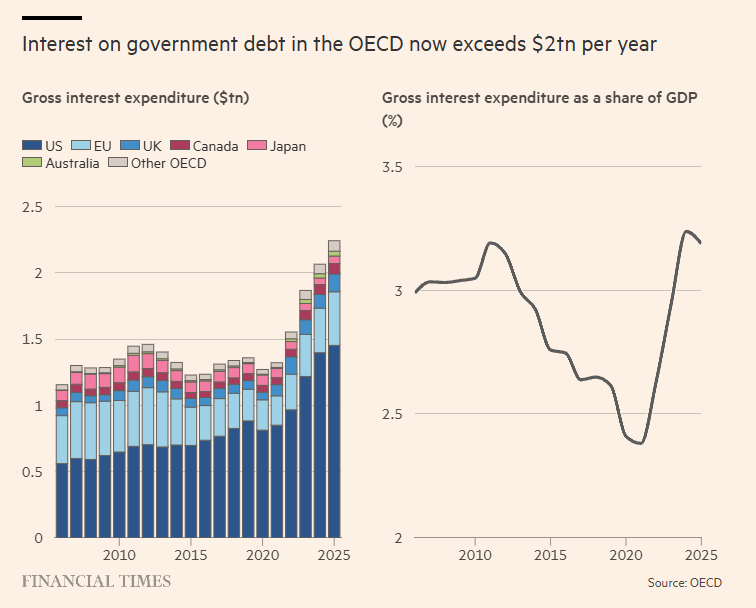
The world’s governments have created a $2tn monster — a debt-servicing burden that gobbles up tax revenues and has the power to overwhelm elected leaders.
More money is now spent on servicing the national debt than on defence in the UK, France and the US; the same is true for more than a dozen states in the 38-member OECD rich countries’ club.
Their problem is that borrowing costs have climbed to the highest in almost two decades just as governments are taking on record debt.
The total owed by the US government reached a record $40tn last month. This year, OECD nations are expected to borrow $18tn between them, another all-time high. In 2025, the group’s total debt-servicing bill exceeded $2tn, or 3 per cent of GDP.
That number is set to rise in the coming years because of the bond sell-off that has pushed up yields since the Covid-19 crisis, increasing the cost of debt for governments across the world.
“These massive sovereign debts are having to get refinanced at ever-increasing rates,” says Mike Riddell, a fund manager at Fidelity International. “Global investors are already starting to get scared.”
The summer rout in the global bond market has only augmented the post-Covid surge in yields triggered by inflation shocks, increased government borrowing and the end of central banks’ “quantitative easing” bond-buying programmes.
The average benchmark 10-year bond yield for G7 countries has reached 4 per cent for the first time since 2008, amid concerns about the inflationary impact of the Iran war and the sheer amount of debt being sought by both the public and private sectors — particularly tech groups.
Some economists counter that US yields in particular are being pushed up by improving growth expectations, which imply that interest rates will not need to be as low in the future to support the economy.
If there were a step change in growth, it could be a get-out-of-jail-free card for many countries, boosting tax receipts, making the stock of debt more manageable and reducing the trade-off between interest costs and other areas of spending.
Financial Times – The world’s $2tn interest bill
______
7. Brent Oil Rises to Highest Since July on Mideast Supply Risks
Former senior Bank of America Corp. investment banker Jason Satsky was accused by the US Securities and Exchange Commission of providing an insider-trading tip to a friend who allegedly made $18.5 million in illegal profits.
Satsky, who was previously Bank of America’s head of energy and power infrastructure banking, was sued Friday by the SEC along with the friend, Gavin Wolfe. According to the SEC, Satsky tipped Wolfe off on an acquisition offer for South Jersey Industries Inc. during a November 2021 basketball game.
Between November and December 2021, Wolfe bought at least $53 million in stock and the pair continued to converse, the SEC said.
The SEC suit doesn’t name Bank of America as Satsky’s then-employer, but Bloomberg has previously reported that federal prosecutors were probing trades around the deal.

Bloomberg – Oil Jumps on New Houthi Attacks, Reported Kharg Island Blasts
______