
—— GameStop Proposes $56bn Takeover of eBay in Bold E-Commerce Pivot; AI Chipmaker Cerebras Seeks $33bn Valuation in Bold IPO to Counter Nvidia; OpenAI Raises $4bn for New Enterprise Venture as IPO Plans Loom; Bitcoin Reclaims $80k Level as Hopes for US Crypto Legislation Fuel Bullish Sentiment; United 767 Grazes Vehicle and Light Pole on NJ Turnpike During Final Approach to Newark; Global Airlines Cut 2mn Seats in May as Jet Fuel Shortages and High Costs Bite; World Liberty Financial Sues Justin Sun for Defamation as Legal War Escalates
1. GameStop Proposes $56bn Takeover of eBay in Bold E-Commerce Pivot
Ryan Cohen’s bid for eBay represents one of the most audacious “meme-to-mainstream” maneuvers in corporate history. By leveraging GameStop’s hard-won capital and brand loyalty to acquire an e-commerce platform several times its size, Cohen is attempting to build a formidable challenger to Amazon’s dominance in the secondary and collectible markets. The success of this $56 billion proposal hinges on whether eBay’s board—and its institutional shareholders—view GameStop’s volatile stock as a legitimate long-term currency. If Cohen can unlock the $2 billion in annual synergies promised in his Sunday memo, the combined entity would control a vast ecosystem ranging from physical gaming hubs to one of the world’s largest digital marketplaces.
However, the 20% premium offered has yet to fully convince Wall Street, as evidenced by eBay’s stock trading well below the bid price. The reliance on $20 billion in debt financing at a time of broader economic uncertainty adds a layer of execution risk that could complicate the merger. For GameStop, this move is a survival imperative; as physical software sales continue to decline, acquiring eBay’s massive traffic and logistics infrastructure provides a definitive path toward digital permanence.
The market is now watching to see if this is the start of a genuine retail revolution or a high-stakes financial gamble by a leadership team accustomed to defying conventional market logic.

Bloomberg – Meme Stock GameStop Pitches $56 Billion Takeover of eBay
______
2. AI Chipmaker Cerebras Seeks $33bn Valuation in Bold IPO to Counter Nvidia
Cerebras Systems’ entry into the public markets marks a critical stress test for Nvidia’s dominance in the generative AI hardware stack. By marketing a “wafer-scale” architecture that claims to crush Nvidia’s processing speeds, Cerebras is positioning itself as the high-end alternative for enterprises and governments building sovereign AI clusters. The $10 billion in preliminary interest suggests that institutional investors are desperate for a viable “Nvidia hedge,” viewing Cerebras not just as a chip vendor, but as a vertically integrated data center powerhouse capable of rewriting the economics of LLM training.
The success of this $33 billion valuation hinges on Cerebras’s ability to move from bespoke laboratory success to mass-market industrial scale. While Nvidia’s Moat is protected by its CUDA software ecosystem, Cerebras is betting that raw hardware throughput and energy efficiency will dictate the next phase of the AI infrastructure cycle.
As the IPO prices mid-May, the market’s reception will signal whether Silicon Valley is ready to shift its capital toward radical new chip geometries or if the inertia of the current GPU-centric paradigm remains too strong to break.

Bloomberg – Nvidia Rival Cerebras Seeks to Raise $3.5 Billion in US IPO
______
3. OpenAI Raises $4bn for New Enterprise Venture as IPO Plans Loom
The launch of “The Deployment Company” marks OpenAI’s aggressive transition from a research-led lab into a formidable enterprise solutions provider. By partnering with private equity titans like TPG and Bain Capital, OpenAI is securing the operational “boots on the ground” and industry-specific expertise required to navigate the complex integration of AI into legacy corporate infrastructures. This $4 billion war chest allows the company to aggressively scale its commercial footprint without overextending its core engineering resources, effectively outsourcing the labor-intensive task of enterprise deployment to a well-funded, specialized subsidiary.
This structural move also serves as a strategic “window dressing” for OpenAI’s anticipated 2026 IPO. By segregating its enterprise deployment arm into a $10 billion joint venture, OpenAI can present a more diversified and de-risked business model to public market investors. As rivals like Anthropic eye similar private-equity-backed structures for their Claude technology, the battle for AI supremacy is shifting from model performance to “last-mile” integration.
The involvement of SoftBank and major consulting firms suggests that the next phase of the AI boom will be defined by who can most effectively translate raw algorithmic power into measurable corporate productivity and ROI.
Bloomberg – OpenAI Finalizes $10 Billion Joint Venture With PE Firms to Deploy AI
______
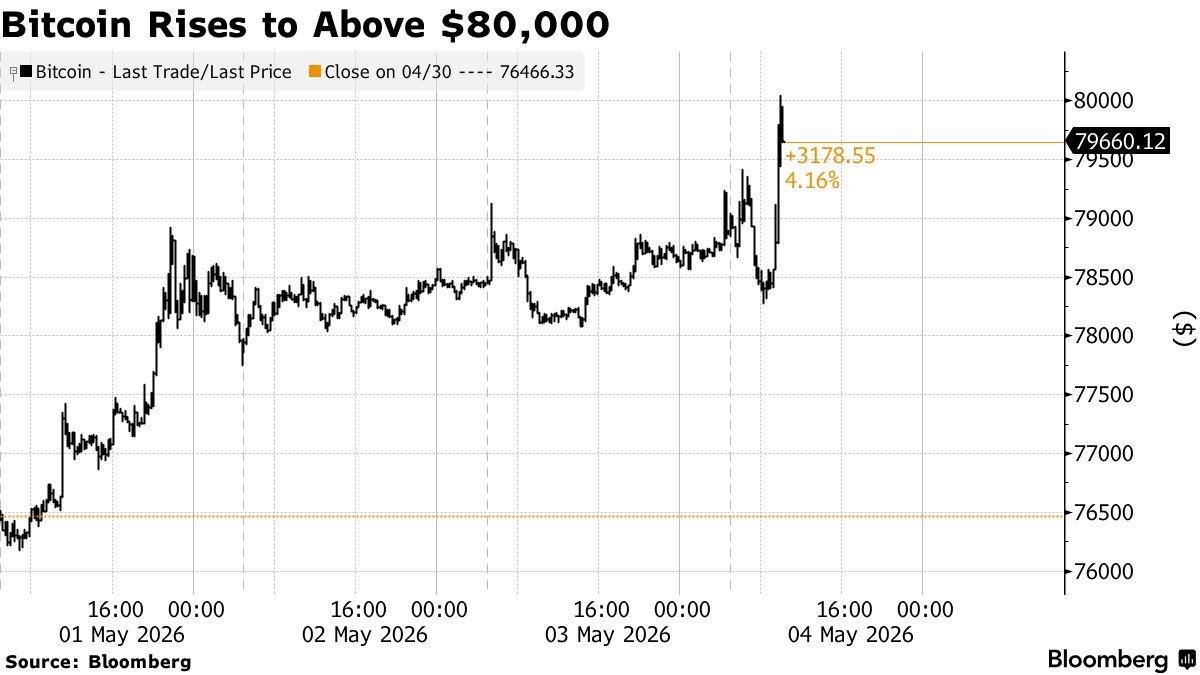
4. Bitcoin Reclaims $80k Level as Hopes for US Crypto Legislation Fuel Bullish Sentiment
Bitcoin’s resurgence past the $80,000 milestone underscores its evolving role as a “digital hedge” that remains paradoxically tethered to global risk appetite. Despite the geopolitical volatility in the Strait of Hormuz and the $25 billion cost of the ongoing conflict, the crypto market is increasingly focused on domestic policy breakthroughs. The potential for a Senate deal on stablecoin yields represents a watershed moment for institutional legitimacy, potentially unlocking a new wave of regulated capital that has remained on the sidelines during the recent price fluctuations.
The broader “risk-on” environment is being further catalyzed by a blockbuster earnings season from big tech, with MSCI’s Asian equity gauge nearing its February pre-war peak. While President Trump’s plan to escort non-conflict vessels through the Strait of Hormuz introduces new maritime risks, crypto investors appear more attuned to the “infrastructure trap” and capital expenditure cycles of firms like Microsoft and Apple.
As Bitcoin approaches its next resistance level, the decoupling of digital assets from traditional energy-driven inflation suggests that the market is pricing in a future where regulatory clarity in Washington outweighs supply-chain disruptions in the Middle East.
Bloomberg – Apple Forecast Tops Estimates Even as Mac Shortages Linger
______
5. United 767 Grazes Vehicle and Light Pole on NJ Turnpike During Final Approach to Newark
The incident at Newark Liberty International Airport adds a troubling new chapter to the ongoing debate over US aviation safety and infrastructure integrity. Unlike mid-air technical failures, this “near-catastrophic” grazing of a public highway during a final approach suggests a potential breach in altitude discipline or a localized navigation anomaly. With the FAA and NTSB launching parallel investigations, the focus will likely shift to whether environmental factors, pilot fatigue, or instrumentation errors allowed a commercial widebody to descend below the minimum clearance required for one of the nation’s busiest traffic corridors.
The timing of this accident is particularly sensitive for United Airlines and Boeing, as both companies remain under heightened regulatory scrutiny following several high-profile incidents over the past 15 months. While the safe landing and lack of casualties on board provide immediate relief, the collision with a civilian vehicle on a major interstate highlights a terrifying intersection between aviation and ground transportation.
As maintenance crews assess the structural damage to the 767-400, the broader aviation industry is facing renewed pressure to explain why “low-probability” runway and approach incursions are becoming a recurring headline in 2026.

Bloomberg – United Jet Hits Pole, Truck During Newark Landing Approach
______
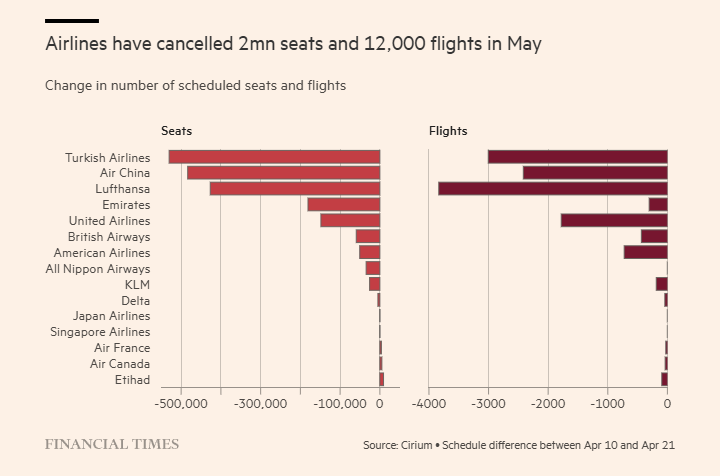
6. Global Airlines Cut 2mn Seats in May as Jet Fuel Shortages and High Costs Bite
The sudden removal of 2 million seats from May schedules underscores a growing paralysis in the global aviation sector as the dual pressures of skyrocketing jet fuel prices and physical supply shortages take hold. With fuel costs doubling in just over two months, the economic viability of long-haul routes—especially those previously reliant on Gulf hubs—has been shattered. Airlines are no longer just managing profit margins; they are conducting emergency network triage, prioritizing fuel-efficient fleets and abandoning routes where refueling certainty cannot be guaranteed. This “capacity retreat” reflects a strategic pivot toward operational survival in a fragmented global airspace.
For international travelers, this shift signals a return to high-cost, limited-choice connectivity reminiscent of the early pandemic era. As major carriers like United and British Airways reshuffle their networks to avoid Asian bottlenecks, the absence of Gulf transit options is creating a massive supply-demand vacuum.
The warning from analysts about unprecedented fuel shortages suggests that the disruption may extend well beyond May, potentially redefining summer travel patterns as airlines refuse to risk stranding expensive aircraft in regions where jet fuel has become a scarce strategic commodity.
Financial Times – Airlines slash flights as fuel shortage fears mount
______
7. World Liberty Financial Sues Justin Sun for Defamation as Legal War Escalates
The Department of Justice’s decision to drop its investigation into the Federal Reserve’s headquarters renovation marks a pivotal shift in the central bank’s leadership transition. By handing the inquiry over to the Fed’s Office of Inspector General, the DOJ has effectively removed a significant political and legal cloud hanging over Kevin Warsh’s confirmation process. Warsh, known for his more dovish leanings compared to the current hawkish consensus, is widely expected to prioritize growth and potential rate cuts—a prospect that immediately resonated with bond markets.
The market’s reaction underscores the high stakes of the Fed’s “Warsh pivot.” The decline in short-dated Treasury yields reflects a growing bet among institutional investors that the upcoming leadership change will usher in a period of monetary easing to support the administration’s economic agenda.
While US Attorney Jeanine Pirro maintained a stern tone regarding future accountability, the immediate removal of the DOJ from the process is being interpreted by Washington insiders as a “green light” for the Senate to proceed with Warsh’s confirmation hearings without the distraction of an active criminal probe.

Bloomberg – Trump-Linked World Liberty Sues Justin Sun for Defamation
______