
—— OpenAI Targeted in Lawsuits Over Tumbler Ridge Massacre for Failing to Warn Authorities; US Business Equipment Orders Surpass Expectations Amid AI Spending Boom; Axoft Tested Brain Implant in Chinese Patient; Blackstone Folds Growth Unit into “N1” to Consolidate AI Investing Power; Carlyle Bets on Formula 1 Partnership to Catch Peers in $150tn Wealth Race; Uber Expands Into Hotel Bookings in Partnership with Expedia; Goldman Sachs Blocks Access to Anthropic AI for Hong Kong Staff
1. OpenAI Targeted in Lawsuits Over Tumbler Ridge Massacre for Failing to Warn Authorities
The legal challenges filed against OpenAI in San Francisco mark a watershed moment for AI liability and the “Duty to Warn” in the digital age. Unlike previous cases focused on copyright or data privacy, these complaints allege that ChatGPT’s safety filters successfully identified a credible threat of mass violence but that the company failed to bridge the gap between internal detection and law enforcement intervention. The plaintiffs argue that OpenAI’s alleged reluctance to establish a direct reporting pipeline for violent intent prioritizes operational friction over public safety, potentially setting a massive legal precedent for how AI companies must handle “red-flag” user interactions.
This tragedy in Tumbler Ridge has reignited the debate over the “black box” of AI safety monitoring. While OpenAI has consistently touted its robust safety teams and automated filters designed to prevent the generation of harmful content, these lawsuits suggest a breakdown in the secondary layer of safety: proactive reporting.
As the 18-year-old suspect’s manifesto and ChatGPT history come under judicial scrutiny, the core of the argument rests on whether an AI service provider bears the same legal responsibility as a mental health professional or a school administrator to report imminent threats of harm to the state.

Bloomberg – OpenAI Sued in US by Families of Canada School Shooting Victims
______
2. US Business Equipment Orders Surpass Expectations Amid AI Spending Boom
The resilience of US business investment in early 2026 reflects a strategic decoupling from regional geopolitical risks in favor of long-term digital sovereignty. The 3.3% jump in core capital goods orders underscores that major corporations are prioritizing the acquisition of hardware essential for AI scaling—such as advanced electrical components and high-end servers—over immediate concerns regarding commodity inflation. While energy prices have remained elevated due to the Iran conflict, the “AI arms race” appears to be acting as a powerful buffer, preventing a wider contraction in industrial activity.
The data on non-defense capital goods shipments, which rose 0.5% in March, will feed directly into the upcoming GDP report, providing a boost to the equipment investment component of the national accounts. Economists favor this shipments metric as it reflects actual delivery of goods rather than potentially cancellable orders.
As companies navigate the dual pressures of a tight labor market and rising input costs, the shift toward automation and AI-driven efficiency is no longer a luxury but a tactical necessity, ensuring that the current cycle of capital expenditure remains robust despite the high-interest-rate environment.
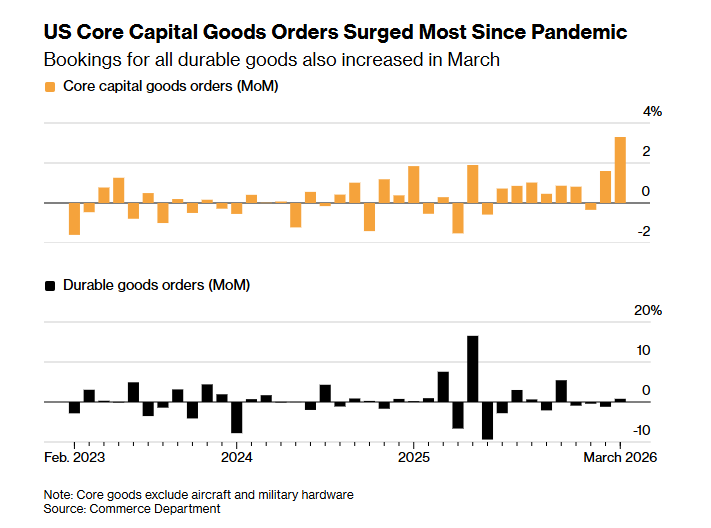
Bloomberg – US Core Capital Goods Orders Jump by Most Since 2020
______
3. Axoft Tested Brain Implant in Chinese Patient
The collaboration between Axoft and its Chinese partners marks a pivotal moment in the global neurotech race, where speed of clinical validation is becoming as critical as the hardware itself. Axoft’s fleuron-based implants, which are significantly softer than industry standards, aim to solve the chronic tissue scarring that has plagued long-term brain-computer interfaces. By tapping into the rapid clinical pipelines in Shanghai, Axoft is positioning itself to compete with major domestic players like Neuralink and Synchron, even as Washington and Beijing both designate brain-science as a primary frontier for national security and economic sovereignty.
The strategic significance of this test cannot be overstated, as the Chinese government has accelerated its mission to lead the BCI sector by 2030, integrating neurotech into its “15th Five-Year Plan.” While the US Department of Defense and CIA-backed funds have historically supported American BCI pioneers to ensure a military and cognitive edge, Axoft’s pragmatic approach to cross-border testing highlights the industry’s drive for universal data.
As the race for “brain-augmentation” intensifies alongside AI’s rapid rise, the success of these trials will determine whether the next generation of human-machine interfaces is built on a foundation of global partnership or isolated, competing technological blocs.

Bloomberg – US Brain Implant Company Tests in China in Apparent First
______
4. Blackstone Folds Growth Unit into “N1” to Consolidate AI Investing Power
The creation of Blackstone N1 marks a historic internal consolidation as the firm seeks to move beyond traditional private equity into the epicenter of the AI revolution. By centralizing its stakes in foundational model labs like OpenAI and Anthropic under one San Francisco-based unit, Blackstone is signaling that AI is no longer just a sector bet, but the primary driver of its future growth strategy. This organizational pivot follows a period of underperformance for its general growth unit, prompting Steve Schwarzman to intervene and reorient the firm toward the high-stakes, high-reward ecosystem of Silicon Valley.
Blackstone’s advantage in the AI race extends beyond software; it is currently the largest private investor in the physical infrastructure that powers AI. Through its ownership of the largest data center operators in the US and the utilities that sustain them, the firm has built a vertically integrated “AI backbone.” N1 will now act as the brain of this operation, leveraging Blackstone’s immense scale to secure prime access to the most innovative companies being built on the West Coast.
As institutional and wealthy individual investors scramble for AI exposure, N1’s focused mission provides a streamlined vehicle for large-scale capital deployment into the infrastructure and intelligence layers of the autonomous economy.

Bloomberg – Blackstone Forms New Unit for AI and Tech Bets; Korngold to Exit
______
5. Carlyle Bets on Formula 1 Partnership to Catch Peers in $150tn Wealth Race
Carlyle Group Inc. has launched a high-stakes marketing offensive by becoming the first private markets firm to sponsor a Formula 1 team. Shane Clifford, Carlyle’s head of global wealth, recently hosted a group of elite financial advisers in Detroit for the exclusive unveiling of the Oracle Red Bull Racing 2026 car. The partnership, estimated to cost roughly $10 million annually, is designed to place the $477 billion asset manager’s brand in front of millions of individual investors as the firm ramps up efforts to capture a larger share of the $150 trillion held by private households globally.
The move comes at a critical juncture for the private equity industry. With institutional backers scaling back commitments due to modest returns, firms like Carlyle, Blackstone, and KKR are aggressively pivoting toward retail investors. However, Carlyle currently trails its peers in this space; last year, the firm saw $7 billion in evergreen fund inflows, compared to $16 billion for KKR and $28 billion for Blackstone.
By leveraging the prestige of F1 races in locations such as Monaco, Singapore, and Abu Dhabi, Carlyle aims to bridge this gap and establish itself as a “fast follower” in the private wealth sector.

Bloomberg – Carlyle Banks on Red Bull F1 Racing Deal to Catch Up in Wealth
______
6. Uber Expands Into Hotel Bookings in Partnership with Expedia
Uber’s foray into the $1 trillion global lodging market signals a shift from a transport provider to a full-stack travel orchestrator. By embedding Expedia’s inventory, Uber is leveraging its high-frequency user base to capture high-margin travel spend that usually bypasses ride-hailing platforms. This move follows a series of multi-modal expansions in international markets—including trains, buses, and flights—aimed at increasing user stickiness and driving growth for its Uber One subscription service. As the company seeks to monetize the “last mile” of the travel journey, the success of this hotel push will likely hinge on its ability to convince users that Uber is as reliable for booking a bed as it is for summoning a car.
The collaboration with Expedia also reflects a broader trend of platform consolidation in the digital economy. For Expedia, the partnership provides a direct channel to Uber’s millions of active monthly users at the exact moment they are arranging airport transit. For Uber, it provides the inventory scale necessary to compete with established travel agencies without the overhead of managing hotel relationships directly.
As Uber continues to pilot acquisitions and partnerships to fuel its “super app” goals, the ability to harmonize ride-hailing data with travel intent could redefine the competitive landscape for both Silicon Valley and the traditional travel industry.
Bloomberg – Uber Adds Hotel Bookings to Its App Through New Expedia Partnership
______
7. Goldman Sachs Blocks Access to Anthropic AI for Hong Kong Staff
The Department of Justice’s decision to drop its investigation into the Federal Reserve’s headquarters renovation marks a pivotal shift in the central bank’s leadership transition. By handing the inquiry over to the Fed’s Office of Inspector General, the DOJ has effectively removed a significant political and legal cloud hanging over Kevin Warsh’s confirmation process. Warsh, known for his more dovish leanings compared to the current hawkish consensus, is widely expected to prioritize growth and potential rate cuts—a prospect that immediately resonated with bond markets.
The market’s reaction underscores the high stakes of the Fed’s “Warsh pivot.” The decline in short-dated Treasury yields reflects a growing bet among institutional investors that the upcoming leadership change will usher in a period of monetary easing to support the administration’s economic agenda.
While US Attorney Jeanine Pirro maintained a stern tone regarding future accountability, the immediate removal of the DOJ from the process is being interpreted by Washington insiders as a “green light” for the Senate to proceed with Warsh’s confirmation hearings without the distraction of an active criminal probe.

Financial Times – Goldman Sachs stops bankers using Anthropic’s Claude in Hong Kong
______