—— BofA’s Hartnett Warns of “2008 Analog”; Apple’s Foldable iPhone to Feature iPad-Like Multitasking; US January Consumer Spending Edges Up 0.1%; BYD’s Denza Z9GT Targets Europe; NYC Entry-Level Job Openings Plunge 37% in Two Years; NYC Mayor Mamdani Proposes 90% Cut to Estate Tax Exemptionl; Apple Slashes “Apple Tax” in China: Commission Drops to 25%.
1. BofA’s Hartnett Warns of “2008 Analog”
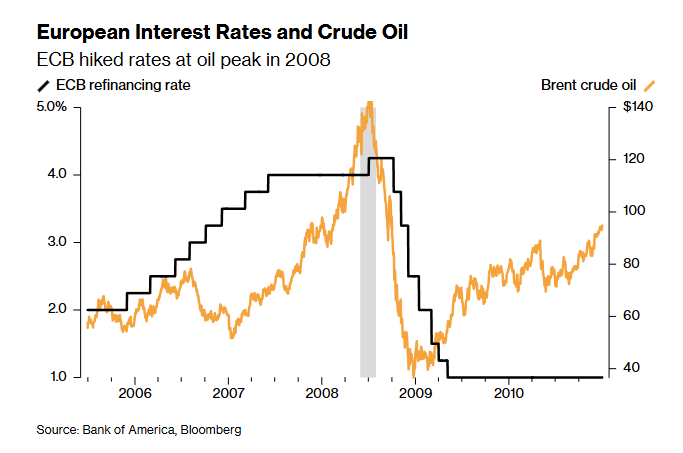
Bank of America strategist Michael Hartnett warned on Friday that the current combination of spiking energy prices and cracks in private credit is causing market activity to look “ominously close” to the lead-up to the 2008 global financial crisis. Following the eruption of the Iran war on February 28, oil prices have surged over 60%, drawing parallels to the 2007-2008 period when crude doubled to $140 just before the subprime collapse. Hartnett noted in a client memo that Wall Street is currently “trading the ’07-’08 analog,” with asset performance in 2026 tracking the price action seen during the onset of the Great Recession.
The growing unease centers on banks’ exposure to private credit, an asset class currently grappling with a surge in fund redemptions and heightened scrutiny of lending standards. As soaring energy costs fuel fears of stagflation, ECB Governing Council member Peter Kazimir has signaled that interest rates may need to rise sooner than anticipated. While the broader market still banks on the belief that “policymakers always ride to the rescue,” Hartnett cautioned that the ECB’s July 2008 rate hike—occurring exactly as oil peaked—turned out to be one of the greatest policy errors in history.
With corporate earnings now under threat from tightening financial conditions, Hartnett recommends selling the S&P 500 if it slips below 6,600 and offloading Brent crude above the $100 per barrel mark.
Bloomberg – BofA’s Hartnett Warns Markets Are Starting to Look Like 2008
______
2. Apple’s Foldable iPhone to Feature iPad-Like Multitasking
Apple Inc.’s long-awaited foldable iPhone will include a major iOS update enabling iPad-style layouts and side-by-side application support for the first time, according to people familiar with the project. The device is expected to feature an expansive interior foldable display roughly the size of an iPad mini, paired with an external cover screen comparable to a standard small iPhone display.
Given that current foldables often rely on narrower aspect ratios, Apple’s decision to opt for a wider format is intended to maximize its appeal for professional multitasking and video consumption. While chief rival Samsung Electronics launched its first foldable seven years ago, Apple is under pressure to revitalize the category through its signature hardware-software synergy. As the product nears its anticipated fall 2026 debut, developers will find it easier to adapt iPhone apps into software that mirrors the iPad experience.
Currently, this “mini-tablet” approach represents Apple’s most significant design shift in years, aimed at reclaiming leadership in the premium smartphone market through superior user interface fluidity.

Bloomberg – Apple’s Foldable iPhone to Feature iPad-Like Interface When Opened
______
3. US January Consumer Spending Edges Up 0.1%
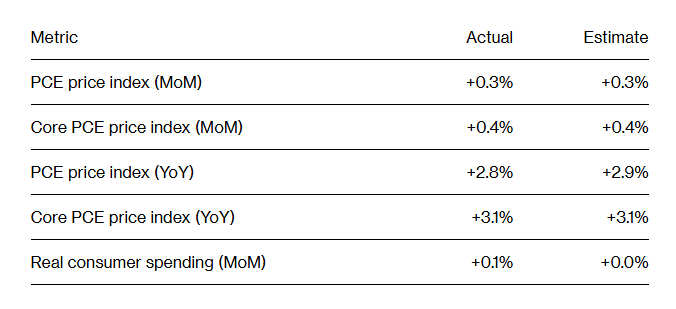
New data from the Bureau of Economic Analysis (BEA) reveals that the US economy grew at an annualized rate of just 0.7% in the final quarter of 2025—a significant downgrade from the initial 1.4% estimate, largely attributed to the record-breaking 43-day government shutdown. In January 2026, inflation-adjusted consumer spending rose a meager 0.1%. Meanwhile, the core Personal Consumption Expenditures (PCE) price index—the Federal Reserve’s preferred inflation gauge—rose a firm 0.4% in January, pushing the annual rate to 3.1%.
Since the eruption of the war with Iran on February 28, a spike in energy costs has driven national gasoline averages to $3.60 per gallon, weighing heavily on household sentiment. As 30-year fixed mortgage rates climbed to 6.11% this week, affordability concerns are beginning to cool the housing market. While firm wage growth and an 11% increase in year-to-date tax refunds may provide a buffer, the threat of war-driven stagflation has complicated the Federal Reserve’s path.
Currently, President Donald Trump is demanding an “immediate” rate cut; however, the persistent pickup in core inflation and geopolitical volatility likely mean the Fed will remain on hold at next week’s meeting, pushing the prospects for any 2026 easing further into the second half of the year.
Bloomberg – US Consumer Spending Barely Rises After Weaker GDP Growth
______
4. BYD’s Denza Z9GT Targets Europe
China’s BYD is set to take on European luxury mainstays like Porsche and BMW with the launch of its premium Denza Z9GT model next month. The flagship EV features a groundbreaking “flash charging” technology that allows the battery to reach 70% capacity in just five minutes, rivaling the speed of a traditional petrol fill-up. Even in temperatures as low as minus 30C, the vehicle can be nearly fully charged within 12 minutes. Boasting a range of 800km, the Z9GT is scheduled to arrive in the UK this summer, though official pricing has yet to be disclosed.
The global rollout of flash charging marks a strategic shift for BYD, according to international chief Stella Li. Since the Chinese government has recently cracked down on aggressive domestic price wars, BYD’s home sales plummeted 41% in February compared to 2025. As domestic pressure mounts, the automaker is aggressively expanding its footprint in Europe and the UK to pivot toward high-margin luxury segments.
While BYD has historically focused on the mass market, its full acquisition of the Denza joint venture from Mercedes-Benz in 2024 positions the firm to compete directly for high-end buyers throughout 2026.

Financial Times – China’s BYD takes on Porsche and BMW with 5-minute ‘flash charging’
______
5. NYC Entry-Level Job Openings Plunge 37% in Two Years
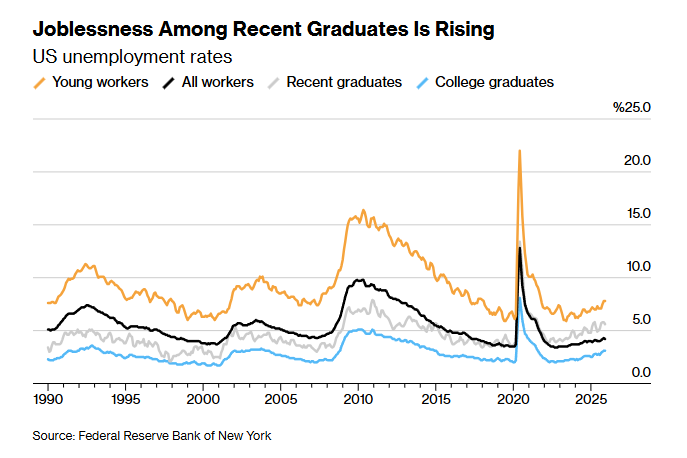
The once-thriving market for recent college graduates in New York City is rapidly deteriorating. A new report from the Center for an Urban Future reveals that entry-level job availability in the city fell 37% between 2022 and 2024, representing a loss of nearly 30,000 positions. Paid internships have also been hit hard, dropping from 11,000 in 2019 to fewer than 7,000 in 2024. For graduates like Kayla Cruz, even a degree from a prestigious university and extensive co-op experience no longer guarantees success, with hundreds of applications often yielding only a handful of interviews.
As the US economy slows, businesses are increasingly reluctant to hire amid uncertainties over President Trump’s trade policies and the disruptive potential of artificial intelligence. New York City added only 44,200 jobs in 2025—a 0.9% increase that marks the weakest growth since 2020. Since hiring remains concentrated in low-wage sectors like education and healthcare, traditional corporate entry points have largely stagnated. While the city continues to draw hundreds of thousands of new degree holders, the unemployment rate for college-educated workers has climbed to 3%.
Currently, this structural shift suggests that having a bachelor’s degree no longer provides the competitive edge it once did in the 2026 New York labor market.
Bloomberg – For Young New York Job Hunters, Entry-Level Roles Are Vanishing
______
6. NYC Mayor Mamdani Proposes 90% Cut to Estate Tax Exemption
New York City Mayor Zohran Mamdani is pushing for a drastic overhaul of the state’s estate tax, proposing to slash the exemption threshold from over $7 million to just $750,000. Included in a recent memo to state lawmakers, the plan also calls for raising the top estate tax rate from 16% to 50%. Mamdani, who is currently navigating a $5.4 billion city budget deficit for the upcoming fiscal year starting July 1, is seeking revenue-raising measures from Albany to stabilize the city’s precarious financial position.
Given that neither Governor Kathy Hochul nor the state legislature included the proposal in their respective budget plans this week, the measure faces an uphill battle for enactment this year. Since NYC Comptroller Mark Levine estimates a cumulative $28 billion deficit over the next four years, the Mayor’s office is exploring increasingly aggressive fiscal levers. While most US states impose no tax on inherited wealth, New York’s threshold would become the lowest in the nation if this change were adopted.
Currently, Mamdani’s vocal support for redistributive levies has unsettled wealthy New Yorkers, many of whom have expressed concerns over his progressive mandate and his 2025 campaign stance that “billionaires should not exist.”

Mamdani Wants New York Estate Tax Threshold Cut 90% to $750,000
______
7. Apple Slashes “Apple Tax” in China: Commission Drops to 25%
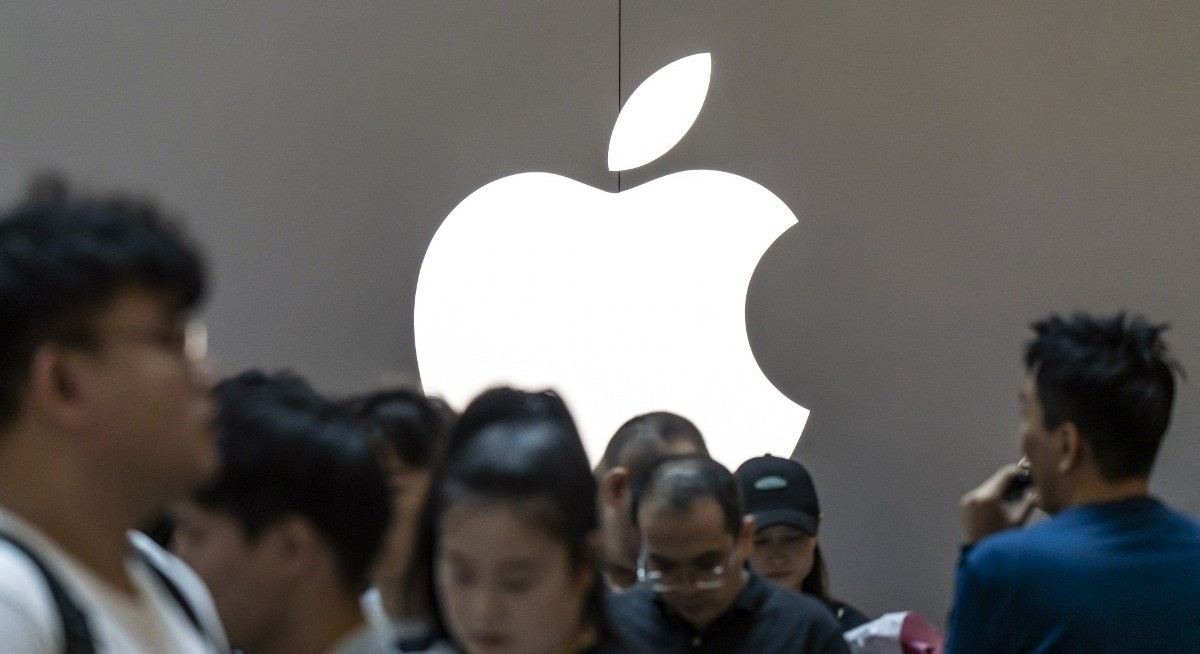
Apple Inc. announced on Thursday that it will lower its standard App Store commission in mainland China from 30% to 25%, effective March 15. The policy shift, applying to both iOS and iPadOS, follows what the company described as “discussions with the Chinese regulator.” Given the looming threat of antitrust intervention by local authorities, the move marks a significant concession in one of Apple’s most lucrative global markets.
The iPhone maker is also trimming the rate for “mini-apps”—the lightweight programs hosted within platforms like Tencent’s WeChat—from 15% to 12%. Developers earning less than $1 million annually will also qualify for the reduced 12% rate. Since Chinese internet giants like Tencent and ByteDance have effectively challenged Apple’s ecosystem by hosting vast third-party services within their “super-apps,” this climbdown is seen as an effort to resolve long-standing disputes.
Currently, as China remains Apple’s most critical market outside the US, the fee reduction highlights a tactical pivot to maintain its competitive edge throughout 2026.
Bloomberg – Apple Cuts China Fees in Big Concession to Beijing and Tencent
______