
—— Google AI Agents Deployed to Pentagon Workforce; US Existing Home Sales Rose Unexpectedly by 1.7% in February; Net Migration Turns Negative for First Time in 50 Years; Bill Ackman Launches Dual Pershing Square IPO; BYD Explores Formula One and Le Mans Entry; Salesforce Plans 25 Billion Dollar Debt Sale to Fund Massive Share Buyback; China Exports Surge 21.8% in January and February.
1. Google AI Agents Deployed to Pentagon Workforce
Alphabet Inc.’s Google is introducing artificial intelligence agents across the Pentagon’s three-million-strong workforce to automate routine administrative and operational workflows. Emil Michael, the under secretary of defense for research and engineering, confirmed that Google’s Gemini-powered AI agents—capable of undertaking complex tasks independently—are now live on unclassified networks. While focusing on the unclassified tier initially to maximize reach, Michael noted that negotiations are ongoing to extend these capabilities to classified and top-secret environments, expressing high confidence in Google’s partnership on all security levels.
The military’s aggressive push for rapid AI adoption has triggered significant controversy within the tech industry. The Department of Defense has pivoted away from Anthropic PBC after the startup refused to drop safety guardrails prohibiting its technology from being used for mass domestic surveillance or fully autonomous weaponry. Following Anthropic’s refusal to align with the Pentagon’s requirements, the government designated the firm a “supply chain risk,” prompting a high-stakes lawsuit from the AI lab.
As the Pentagon moves to integrate OpenAI and Google’s frontier models into its daily battle rhythm, Michael stated that the department is effectively “moving on” from the Anthropic standoff, prioritizing the rapid integration of new AI capabilities to maintain dominance in the digital theater as 2026 progresses.

Bloomberg – Google to Provide Pentagon With AI Agents for Unclassified Work
______
2. US Existing Home Sales Rose Unexpectedly by 1.7% in February
Sales of previously owned US homes rose 1.7% in February to a seasonally adjusted annual rate of 4.09 million units, according to National Association of Realtors (NAR) data released Tuesday. The rebound exceeded most economic forecasts and was driven by a significant improvement in housing affordability. The NAR Housing Affordability Index reached 117.6 last month, its most favorable reading since March 2022. NAR Chief Economist Lawrence Yun noted that consumers are responding to the fact that wage growth is now outpacing home price growth by nearly 4 percentage points, coupled with lower borrowing costs compared to last year.
The median existing-home price stood at $398,000 in February, representing a modest 0.3% year-over-year increase—one of the smallest advances since the pandemic-era housing boom. Inventory levels also showed improvement, rising 2.4% from January to 1.29 million units, the highest February total since 2020. While mortgage rates touched a three-year low of 5.98% in late February according to Freddie Mac, renewed volatility from the Iran conflict has since pushed daily averages back toward 6.3% in early March.
Nevertheless, the February data suggests that the 2026 spring selling season is off to a resilient start as buyers seize on improved inventory and relatively lower rates to enter the market.
Bloomberg – US Existing-Home Sales Increase as Affordability Improves
______
3. Net Migration Turns Negative for First Time in 50 Years
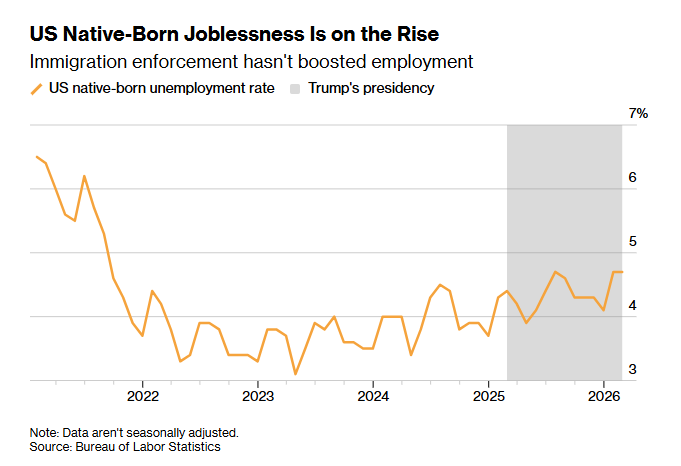
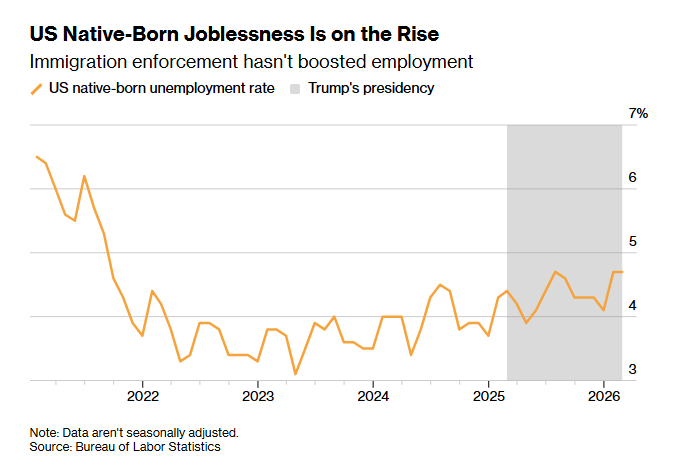
One year into President Donald Trump’s intensified immigration enforcement, new estimates from the Brookings Institution and the American Enterprise Institute suggest that net migration into the U.S. turned negative in 2025 for the first time in half a century. Despite the administration’s promises, the squeeze on foreign-born labor has not translated into a hiring boom for American workers. Instead, the jobless rate for the native-born rose to 4.7% in February 2026, up from 4.4% a year ago. Economists argue this reflects a structural mismatch: employers in labor-intensive sectors like construction and food production cannot easily replace departing immigrants with native-born job seekers.
The labor crunch is being felt acutely by small businesses. Jane Carroll, a Hudson Valley-based frozen meal entrepreneur who appeared on “Shark Tank” in 2025, noted that job applications for her plant have dwindled from 20 per day to just 5. Although white-collar layoffs have mounted in early 2026, few native-born workers are turning to manual labor roles. Data from the National Foundation for American Policy shows the native-born labor force participation rate ticked down to 61.0% in February, signaling that the withdrawal of immigrants has not drawn Americans off the sidelines as promised.
As 2026 progresses, this persistent labor gap threatens to constrain GDP growth and sustain inflationary pressures in service industries.
Bloomberg – Trump’s Immigration Crackdown Fails to Deliver Jobs for US-Born Workers
______
4. Bill Ackman Launches Dual Pershing Square IPO
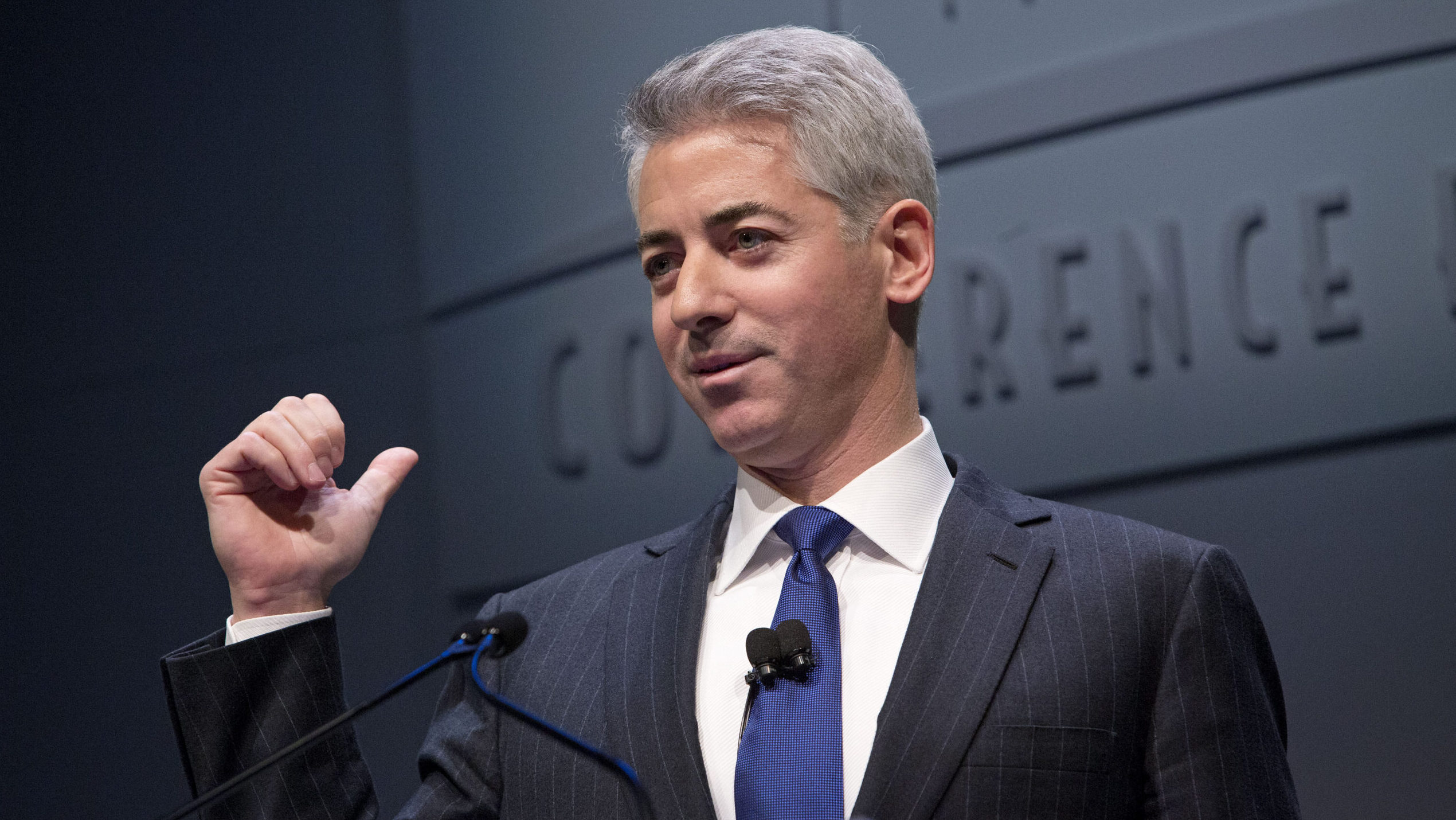
Billionaire investor Bill Ackman officially filed for a pair of initial public offerings in New York on Tuesday, seeking to expand his asset management firm to public market investors. The transaction features a unique dual-listing structure involving a new closed-end fund, Pershing Square USA Ltd. (ticker: PSUS), and the management company itself, Pershing Square Inc. (ticker: PS). According to SEC filings, Ackman aims to raise between $5 billion and $10 billion for PSUS, having already secured $2.8 billion in commitments from institutional investors including pension funds and family offices. As an incentive, investors who purchase 100 shares of PSUS at $50 each will receive 20 shares of the management firm PS at no additional cost.
The move marks a major strategic pivot after Ackman’s previous attempt to raise $25 billion for a similar vehicle in 2024 was scrapped. In recent communications, Ackman emphasized that the 2026 market volatility stemming from Middle Eastern conflicts creates a favorable environment for PSUS’s investment program. As of December 2025, Pershing Square managed approximately $30.7 billion in assets, generating $762.5 million in revenue last year. Ackman has long sought to replicate Warren Buffett’s Berkshire Hathaway model by building a permanent capital vehicle.
If completed, PSUS will serve as his primary vehicle for both US retail and institutional investors, focusing on a concentrated portfolio of 12 to 15 undervalued North American large-cap companies with a 2% management fee and enhanced liquidity features.
Bloomberg – Ackman’s Pershing Square Seeks Up to $10 Billion in NYSE IPO
______
5. BYD Explores Formula One and Le Mans Entry
BYD Co., the world’s leading manufacturer of new energy vehicles, is examining options to enter elite motorsports including Formula One and the 24 Hours of Le Mans, according to people familiar with the matter. The automaker is encouraged by F1’s upcoming 2026 regulation shift, which mandates a near-50/50 split between internal combustion and electrical power alongside 100% sustainable fuels. BYD is reportedly weighing whether to build an original works team or pursue a strategic acquisition of an existing grid slot. While the estimated $500 million annual cost of F1 remains a significant hurdle, the move aligns with BYD’s mission to elevate its high-end Yangwang brand on the global stage.
The move follows a precedent of Chinese success in motorsport, such as Geely’s dominant run in touring cars with Lynk & Co and Nio’s early victory in Formula E. For 2026, BYD has set an ambitious overseas sales target of 1.3 million vehicles, and a presence in top-tier racing would provide a critical marketing engine for its expansion into Europe and Latin America. FIA President Mohammed Ben Sulayem has recently voiced support for a Chinese manufacturer joining the grid, calling it the “next logical step” for the sport’s evolution.
If BYD proceeds, it would mark a historic direct attempt by a Chinese firm to compete in a domain traditionally dominated by European and American legacies, signaling a new era of automotive competition in 2026.

Bloomberg – China’s BYD Explores F1 Entry in First Auto Racing Push
______
6. Salesforce Plans 25 Billion Dollar Debt Sale to Fund Massive Share Buyback
Salesforce Inc. is preparing to sell as much as $25 billion in debt to finance its aggressive share repurchase program, according to sources familiar with the matter. The software giant is targeting a US bond offering of at least $20 billion, which would represent its largest-ever note sale. The company has mandated JPMorgan, Bank of America, Barclays, Citigroup, and Wells Fargo to organize investor calls on Tuesday. This move follows the company’s February 26 announcement of a record-breaking $50 billion stock buyback authorization and a 5.8% increase in its quarterly dividend to $0.44 per share.
The strategy of using debt to fund buybacks has prompted immediate scrutiny from credit agencies. Moody’s Ratings downgraded Salesforce one notch to A2 on Tuesday, citing a material shift in financial policy and a higher tolerance for debt within its capital structure. S&P Global Ratings also revised its outlook for the company to negative. Analysts suggest that the aggressive capital return is an attempt to support a stock price that has fallen over 24% in 2026 amid Wall Street anxieties regarding AI’s impact on established software vendors.
While Salesforce reported strong Q4 2026 revenue of $11.2 billion, up 12% year-over-year, its cautious future guidance has kept investors wary of its long-term growth trajectory in the generative AI era.

Bloomberg – Salesforce Plans to Raise Up to $25 Billion to Fund Buybacks
______
7. China Exports Surge 21.8% in January and February
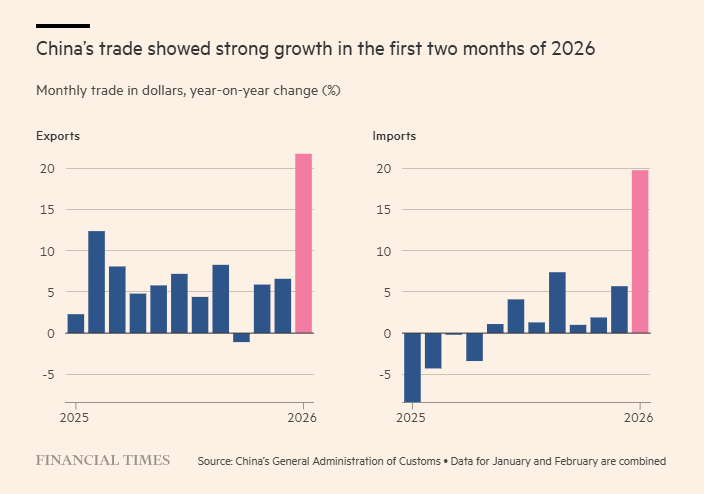
China’s trade performance for the first two months of 2026 has significantly outperformed market expectations. In dollar terms, exports jumped 21.8% year on year, far exceeding the 7.1% growth forecast by analysts and the 6.6% increase recorded in December. Imports also saw a massive surge of 19.8%, compared to a projected growth of 6.3%. These figures propelled China’s trade surplus for the January-February period to a record-breaking $213.6 billion, marking a 25.3% increase over the same period last year. The data suggests that China remains on track for another year of historic trade surpluses.
The surge in trade activity comes just weeks before a high-stakes meeting between President Donald Trump and President Xi Jinping in Beijing at the end of March. Despite the U.S. administration’s long-standing focus on reducing the trade imbalance, China’s surplus hit an unprecedented $1.2 trillion last year. Economists noted that the rapid growth in imports is a particularly encouraging sign for China’s trading partners. Lynn Song, chief China economist at ING, stated that the solid import figures prove that China’s pledges to boost domestic consumption and increase foreign purchases are being realized.
As 2026 progresses, these dynamics will likely play a central role in diplomatic negotiations regarding global manufacturing competition and market access.
Financial Times – China’s exports surge 21.8% in first 2 months of this year
______