—— Qatar Energy Minister Warns Mideast War Could “Bring Down Global Economies”; US Economy Sheds 92,000 Jobs in February; US Retail Sales Slide 0.2% in January; SoftBank Seeks Record 40 Billion Dollar Loan to Fund Massive OpenAI Expansion; New Study Confirms Significant Acceleration in Planetary Warming; US Government Refuses to Refund 150 billion dollars in Illegal Tariffs
1. Qatar Energy Minister Warns Mideast War Could “Bring Down Global Economies”
Qatar’s Energy Minister Saad al-Kaabi warned Friday that the conflict in the Middle East could “bring down the economies of the world,” predicting that all Gulf energy exporters would be forced to shut down production within days, potentially driving oil prices to $150 a barrel. Qatar, the world’s second-largest LNG producer, was forced to declare force majeure this week following an Iranian drone strike at its Ras Laffan liquefied natural gas plant. Kaabi told the FT that even if the war ended immediately, it would take “weeks to months” for Qatar to return to a normal delivery cycle.
While Qatar exports only a small fraction of its gas to Europe, Kaabi noted that the continent would suffer significantly as Asian buyers outbid Europeans for available supply. He expects every exporter in the Gulf region to declare force majeure in the coming days if the conflict continues, noting the legal liabilities of failing to do so. Following the publication of his comments, Brent crude rose 2.5% to $87.6 a barrel in European trading on Friday morning, its highest level since the war began.
European gas prices also gained 5% as concerns mount over the widespread economic repercussions of the US-Israel war with Iran on the oil-rich region throughout 2026.

Financial Times – Qatar warns war will force Gulf to stop energy exports ‘within days’
______
2. US Economy Sheds 92,000 Jobs in February
The US labor market suffered a sharp setback in February as nonfarm payrolls dropped by 92,000, according to Bureau of Labor Statistics data released Wednesday. The figure fell drastically short of the 55,000 increase projected by economists and marked a stark reversal from January’s unexpectedly robust gain of 126,000 jobs. The decline was spearheaded by a slump in healthcare employment due to widespread strike activity, alongside continued contractions in the tech sector and federal government workforce. Consequently, the national unemployment rate bounced back to 4.4%, fueling fears that the labor market’s recovery remains fragile after a sluggish 2025 performance.
Financial markets reacted immediately to the disappointing report, with Treasury yields plunging as investors ramped up expectations for interest rate cuts. The dollar weakened 0.3% against the euro to $1.58, while S&P 500 futures slid more than 1% as traders piled into safe-haven assets. This latest data reinforces concerns over the structural health of the US economy in 2026, especially after a year where monthly job gains averaged a two-decade low of just 15,000.
While some sectors show signs of resilience, the combined impact of industrial action and government downsizing suggests that the “holding pattern” of the current administration’s economic policy may be facing its toughest challenge yet.
Financial Times – US economy sheds 92,000 jobs in February in sharp slide
______
3. US Retail Sales Slide 0.2% in January
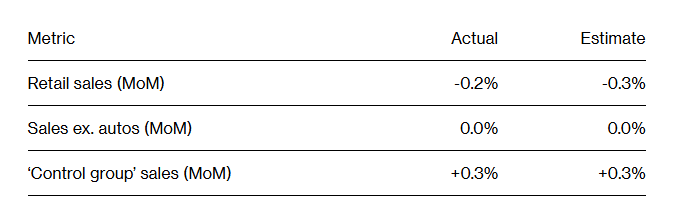
US retail sales declined 0.2% in January following a flat reading in December, according to Commerce Department data released Friday. The downturn was primarily driven by a 0.9% drop in motor vehicle sales, as severe winter weather disrupted dealership activity and deterred shoppers. Seven out of 13 retail categories posted decreases, with notable weakness in apparel, gasoline stations, and personal care stores. Excluding the volatile auto sector, sales remained virtually unchanged, signaling that American consumers are becoming increasingly selective amid persistent cost-of-living pressures and a cooling economy.
The report offered one bright spot: “control-group sales”—a metric used to calculate GDP that excludes food services, autos, and building materials—rose by 0.3%. However, this modest gain is overshadowed by broader economic headwinds. Separate data released Friday showed a shock contraction in the labor market, with payrolls falling by 92,000 and the unemployment rate climbing to 4.4% in February. This combination of slowing retail demand and rising joblessness suggests that the financial buffer of middle- and lower-income households is thinning as 2026 progresses.
Investors are now recalibrating their outlook for the first half of the year, anticipating that the Federal Reserve may need to address the twin threats of declining consumption and labor market instability.
Bloomberg – US Retail Sales Fell in January on Fewer Vehicle Purchases
______
4. SoftBank Seeks Record 40 Billion Dollar Loan to Fund Massive OpenAI Expansion
SoftBank Group Corp. is seeking a bridge loan of as much as $40 billion, primarily to finance its expanding investment in US AI giant OpenAI, according to people familiar with the matter. This would mark SoftBank’s largest-ever borrowing denominated solely in dollars, underscoring founder Masayoshi Son’s aggressive push to position the firm as a linchpin of the global AI boom. The 12-month facility is expected to be underwritten by four major lenders, including JPMorgan Chase & Co. While discussions are ongoing and details may shift, the scale of the request reflects the immense capital requirements of Son’s latest strategic pivot.
The proposed $30 billion bet follows a previous $30 billion injection into the startup, which has become the centerpiece of SoftBank’s portfolio. By the end of December 2025, the Japanese conglomerate held an 11% stake in OpenAI. To bankroll this massive concentration, SoftBank has offloaded other key assets, including its entire stake in Nvidia Corp. Alongside its 90% ownership of Arm Holdings Plc, OpenAI now represents one of SoftBank’s most significant holdings. This concentration has effectively tethered SoftBank’s market valuation to the relative performance of ChatGPT against rivals like Google’s Gemini and Anthropic’s Claude.
Analysts warn that while the move mirrors Son’s early successes with Alibaba, the entry price and competitive landscape of 2026 present a much higher risk profile for the Japanese investment giant.
Bloomberg – SoftBank Seeks Record Loan of Up to $40 Billion for OpenAI Stake
______
5. New Study Confirms Significant Acceleration in Planetary Warming
Planetary warming has significantly accelerated over the past 10 years, with temperatures rising at a higher rate since 2015 than in any previous decade on record, according to a paper published Friday in the journal Geophysical Research Letters. The Earth warmed approximately 0.35 degrees Celsius in the decade leading to 2025, compared to an average of just under 0.2C per decade between 1970 and 2015. This marks the first statistically significant evidence of an acceleration in global warming. While the 1.5C target of the Paris Agreement refers to a 20-year average, breaching it in 2024 highlights that current efforts to slow climate change remain insufficient.
To isolate the acceleration, researchers filtered out “noise” from natural fluctuations such as El Niño phases, volcanic eruptions, and solar irradiance. Grant Foster, a US-based statistics expert and co-author, stated that the evidence is “strong” that this trend is not merely a result of unusually hot years in 2023 and 2024, but a fundamental departure from the previous, slower warming path starting in 2015. These findings align with a separate study published this week, which suggests that sea-level increases along coastlines have been systematically underestimated.
Collectively, the research indicates that climate change is impacting the planet more rapidly and profoundly than previously understood by the scientific community throughout 2026.

Bloomberg – Earth Is Warming Faster Than Previously Estimated, New Study Shows
______
6. BlackRock Private Credit Faces New Blow
BlackRock Inc. wiped out the value of a $25 million private loan to Infinite Commerce Holdings at the end of 2025, marking the second sudden collapse in its private-credit division in recent months. The loan to the Amazon aggregator—which buys and scales online sellers—was assessed at 100 cents on the dollar as recently as September before being declared worthless in fourth-quarter filings. The move follows BlackRock TCP Capital Corp.’s January disclosure that it was preparing to mark down the net value of its total assets by 19%, highlighting a critical “fault line” in the industry: the significant lag between valuations of illiquid loans and the deteriorating reality of the underlying businesses.
The write-off is particularly notable because it occurred shortly after Infinite Commerce merged with another BlackRock debtor, Razor Group, in August. While BlackRock had previously valued Razor’s debt at distressed levels, the post-merger structure was initially marked at par before the sudden collapse. This mirrors recent incidents involving Renovo Home Partners and Zips Car Wash, where private credit backers maintained par valuations until shortly before bankruptcy filings.
As 2026 begins, financial analysts warn that such abrupt markdowns are fueling skepticism over the transparency of the $1.7 trillion private debt market, as investors fear valuations may not accurately reflect the impact of higher interest rates and cooling consumer demand.
Bloomberg – BlackRock Slashed Private Loan Value From 100 to Zero
______
7. US Government Refuses to Refund 150 billion dollars in Illegal Tariffs
US bank stocks suffered their steepest single-day decline since President Trump’s “liberation day” tariff announcements rattled markets last April. The KBW bank index fell 5.8%, with Goldman Sachs dropping 7.5%, Morgan Stanley sliding 6.9%, and Wells Fargo losing 6.4%.
The selloff was driven by intensifying concerns over banks’ exposure to private credit markets. A large KKR-managed credit fund this week reported a surge in troubled loans and falling investment income, stoking broader fears about the health of private markets amid AI disruption risks. KKR, Ares, and Apollo each fell more than 5%, while Blackstone dropped 3.3%. Jim Caron, Chief Investment Officer at Morgan Stanley Investment Management, pointed squarely to private credit exposure as the central concern weighing on bank stocks.
Adding to the turmoil, Wall Street lenders were scrambling to assess losses from approximately £2 billion in financing extended to Market Financial Solutions, a UK-based mortgage lender that collapsed on Wednesday amid fraud allegations. Barclays, Jefferies, and Apollo’s structured credit arm Atlas SP Partners were among those with exposure.
The London-headquartered firm, which had previously lent to a Bangladeshi politician, is accused of double-pledging its collateral prior to its insolvency filing.
Financial Times – US companies are being denied refunds on Trump’s illegal tariffs
______