—— Microsoft’s AI Spending Surge to Record High Sparks ROI Concerns; Tesla to Spend $20B on AI Pivot; White House and Senate Move Toward Deal to Avert Shutdown; SAP Shares Plunge in Biggest One-Day Drop Since 2020; US Trade Deficit Nearly Doubles in November; Super Bowl Ad Prices Hit $10 Million Ceiling; Palantir and Deloitte Among Firms Reaping $22B from Trump’s Immigration Crackdown
1. Microsoft’s AI Spending Surge to Record High Sparks ROI Concerns
Microsoft Corp.’s fiscal second-quarter earnings report, released Wednesday, January 28, highlighted a growing tension between massive AI infrastructure investment and immediate revenue returns. Capital expenditures surged to a staggering $37.5 billion, a 66% year-over-year increase that blew past the $36.2 billion analyst estimate. While total revenue grew 17% to $81.3 billion and EPS reached $5.16 (boosted significantly by a $10 billion accounting gain from OpenAI’s restructuring), shares tumbled 7% in late trading. The catalyst for the sell-off was the slight deceleration in Azure cloud growth to 38% on a constant-currency basis—meeting but not exceeding the high bar set by Wall Street.
CFO Amy Hood defended the spending spree, noting that Microsoft is deliberately allocating significant GPU capacity to internal teams to power first-party AI products like Copilot. She argued that Azure’s growth would have exceeded 40% if that capacity had been redirected to external cloud customers. CEO Satya Nadella highlighted a milestone of 15 million paid M365 Copilot subscriptions, framing the current period as the “beginning phase of AI diffusion.”
However, investor scrutiny intensified following the disclosure that OpenAI now accounts for 45% of Microsoft’s $625 billion total commercial backlog (RPO), raising questions about revenue concentration and the long-term path to margin recovery as Microsoft maintains a $148 billion annual CapEx run-rate for 2026.
Bloomberg – Microsoft Drops Amid Slowing Cloud Growth, Record Spending
______
2. Tesla to Spend $20B on AI Pivot
Tesla Inc. shares rose over 3% in pre-market trading on Thursday, January 29, after the company unveiled a massive $20 billion capital expenditure plan for 2026. Despite reporting its first annual revenue decline and a 61% plunge in Q4 GAAP net profit to $840 million, Tesla’s adjusted earnings per share of $0.50 beat Wall Street estimates. CEO Elon Musk signaled a historic shift in the company’s identity, announcing that the veteran Model S sedan and Model X SUV will be discontinued in Q2 2026 to repurpose their California production lines for the Optimus humanoid robot.
Beyond robotics, Tesla disclosed a strategic $2 billion investment in Musk’s AI startup, xAI, and outlined plans for a domestic “TeraFab” semiconductor facility to mitigate future supply chain risks. Musk framed the 2026 strategy as a transition from a traditional automaker to a “physical AI company,” betting heavily on autonomous “Cybercabs” and robotics as vehicle sales faced a 15.6% delivery decline in the final quarter of 2025.
While analysts raised concerns over the record spending and the loss of high-margin legacy models, Musk told investors that the radical reshuffling is necessary to “hit the chip wall” before competitors do and secure Tesla’s dominance in the age of autonomy.

Bloomberg – Tesla Plots $20 Billion Splurge to Support Musk’s AI Future
______
3. White House and Senate Move Toward Deal to Avert Shutdown
The Trump administration and Senate Minority Leader Chuck Schumer reached a tentative framework early Thursday, January 29, to prevent a broad government shutdown as the Friday midnight deadline looms. Under the proposed plan, Congress would advance a five-bill spending package to fund essential agencies like the Departments of Defense and Treasury through the end of the fiscal year, while placing the Department of Homeland Security (DHS) on a short-term stopgap measure. This “decoupling” strategy is designed to avert a total collapse of federal services while allowing lawmakers to continue heated negotiations over new restrictions on ICE and Border Patrol operations.
The standoff was ignited by the recent fatal shootings of two US citizens in Minneapolis, which prompted a near-unanimous revolt among Senate Democrats. Schumer has laid out non-negotiable demands for DHS funding, including a “masks off, body cameras on” policy for federal agents and stricter judicial warrant requirements for immigration arrests. While some House Republicans remain opposed to stripping DHS from the larger package, the White House has shown a new willingness to engage following widespread public outcry.
However, even with a deal in place, congressional staffers warn that a “weekend lapse” remains possible due to the procedural hurdles required to pass the revised legislation before Saturday morning.

Bloomberg – Trump, Democrats Make Some Progress in Talks to Avert Shutdown
______
4. SAP Shares Plunge in Biggest One-Day Drop Since 2020
Birkenstock Holding Plc presented its first major strategic roadmap since going public during an investor event in New York on Wednesday, January 28. The German sandal maker aims to generate double-digit growth in both revenue and adjusted earnings per share (EPS) through 2028, targeting an incremental €1 billion ($1.2 billion) in sales over the next three fiscal years. Central to this plan is an ambitious push to double its business in the Asia-Pacific region, while maintaining double-digit growth in its core Americas and EMEA markets through a constant-currency revenue CAGR of 13% to 15%.
CEO Oliver Reichert reiterated the company’s “engineered scarcity” model, which keeps demand consistently ahead of supply to preserve pricing power. In fiscal 2025, this strategy resulted in 38 million pairs sold with a 90% full-price sell-through rate. Despite facing a 200-basis-point headwind from U.S. tariffs and unfavorable exchange rates, Birkenstock expects to maintain an EBITDA margin of 30.0% to 30.5% in 2026.
The company is leaning on its vertically integrated “Made in Germany” supply chain and its new Pasewalk facility to scale production toward 60 million pairs by 2027, while expanding its global retail footprint to 150 owned stores to further boost high-margin direct-to-consumer sales.
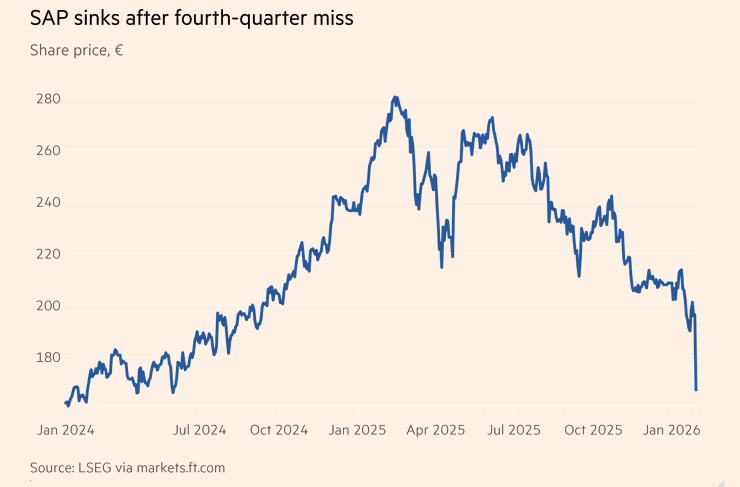
Financial Times – SAP suffers biggest fall in five years amid concerns over cloud business
______
5. US Trade Deficit Nearly Doubles in November
The U.S. trade deficit widened by a staggering 94.6% in November, reaching $56.8 billion after hitting a 16-year low in October. According to Commerce Department data released Thursday, January 29, the goods and services gap nearly doubled from the previous month’s $29.2 billion, exceeding all estimates in a Bloomberg survey of economists. This historic volatility is largely attributed to the Trump administration’s aggressive and shifting tariff policies, which have prompted businesses to recalibrate supply chains and engage in large-scale “front-running” of shipments to beat incoming levies.
The widening was fueled by a 5% rebound in imports to $348.9 billion, led by significant jumps in pharmaceutical preparations (up $6.7 billion), computers (up $6.6 billion), and semiconductors (up $2.0 billion). Conversely, total exports fell 3.6% to $292.1 billion, weighted down by a sharp reversal in non-monetary gold shipments—which had artificially narrowed the deficit in October—and a slide in drug exports. While the administration maintains that overall year-to-date trade gaps are narrowing, market analysts point out that non-recurring flows in gold and pharmaceuticals are clouding the underlying trade picture.
The surge in capital goods imports tied to AI infrastructure remains a constant, even as other sectors retreat amid the highest average effective tariff rates seen in the U.S. since 1935.

Bloomberg – US Trade Gap Widens From Smallest Since 2009 as Imports Rise
______
6. Super Bowl Ad Prices Hit $10 Million Ceiling
Prices for commercials during Super Bowl LX have reached as high as $10 million for premium slots, according to NBCUniversal’s global advertising chief Mark Marshall. While the average price for a 30-second spot remains steady at $8 million—consistent with the record set in 2025—the early sellout of all inventory underscores the NFL’s unrivaled pull in a fragmented media landscape. Ahead of the February 8 broadcast featuring the Seattle Seahawks and the New England Patriots, Marshall noted that nearly 40% of this year’s advertisers are newcomers, highlighting a significant shift in the sponsor mix.
The 2026 advertiser roster sees a surge in spending from the pharmaceutical, wellness, and entertainment sectors, joining traditional heavyweights in food and beverage. NBC is also leveraging its Peacock streaming platform to democratize access, offering discounted local ad slots that account for roughly 10% of total inventory. To attract brand-sensitive advertisers, NBCUniversal is debuting AI-powered tools this year that allow real-time monitoring and contextual targeting, ensuring ads avoid association with controversial live news segments.
With Bad Bunny set to headline the first-ever solo Latino halftime show, Marshall expects viewership to potentially break all-time records, justifying the $266,000-per-second price tag for brands seeking immediate mass awareness.

Bloomberg – Super Bowl Ad Rates Hit $10 Million for 30-Second Spot, NBC Says
______
7. Palantir and Deloitte Among Firms Reaping $22B from Trump’s Immigration Crackdown
A Financial Times analysis of government contracting data reveals that a group of technology, consulting, and logistics firms have secured more than $22 billion in contracts tied to the U.S. government’s aggressive immigration enforcement over the past year. The surge in spending, which began after Donald Trump’s second inauguration last January and accelerated following the passage of the “Big Beautiful Bill” in July, has primarily benefited agencies such as ICE and CBP. Despite the current political fallout and potential funding blocks triggered by the recent fatal shootings in Minneapolis, these private entities have seen record-breaking revenue from federal immigration mandates.
Among the top tech and consulting beneficiaries, Palantir has received $81 million in ICE contracts since January 2025, while Deloitte was awarded over $100 million in combined work from ICE and CBP. The single largest contract winner in the construction sector is Fisher Sand & Gravel, headed by Republican donor Tommy Fisher, which has earned more than $6 billion since July for southern border wall projects. In the logistics sector, CSI Aviation has secured over $1.2 billion for charter flight services to facilitate deportations since the administration took office.
These findings highlight the massive financial infrastructure supporting the administration’s domestic policy, even as congressional Democrats threaten to halt future funding for ICE operations.

Financial Times – Companies reap $22bn from Trump’s immigration crackdown
______