—— Alphabet Overtakes Apple as World’s Second-Most Valuable Company; US Productivity Surges at Fastest Pace in Two Years; Minneapolis Schools Close as Protests Over ICE Shooting Turn Violent; Tech Stocks Slide on Profit-Taking; Defense Shares Surge on $1.5 Trillion Spending Plan; Supreme Court Set to Decide Fate of Trump Tariffs as 1,000+ Firms Seek $133 Billion Refund; JPMorgan to Replace Goldman as Apple Card Partner; Billionaires Flee California to Avoid Proposed 5% Wealth Tax
1. Alphabet Overtakes Apple as World’s Second-Most Valuable Company
Reflecting its emergence as a dominant winner in the artificial intelligence race, Google parent Alphabet Inc. has surpassed Apple Inc. in market capitalization for the first time since 2019. Shares of Alphabet rose 2.4% on Wednesday, closing with a valuation of $3.89 trillion. Meanwhile, Apple’s market cap dipped to $3.85 trillion following a six-day slump that erased nearly $200 billion in value. The divergence continued into Thursday morning, with Alphabet gaining further ground as Apple opened lower.
Alphabet’s ascent follows a stellar 2025, where the stock surged over 65%, making it the top performer among the “Magnificent Seven” tech giants. Investors have cheered the rapid integration of the Gemini 3 AI model and the growing independence of Alphabet’s in-house Tensor Processing Units (TPUs).
While Nvidia remains the world’s most valuable company at approximately $4.6 trillion, the reshuffle between Alphabet and Apple highlights a shift in market sentiment: Wall Street is increasingly favoring integrated AI platforms and cloud infrastructure over legacy hardware ecosystems.
Bloomberg – Alphabet Overtakes Apple, Becoming Second to Nvidia in Size
______
2. US Productivity Surges at Fastest Pace in Two Years
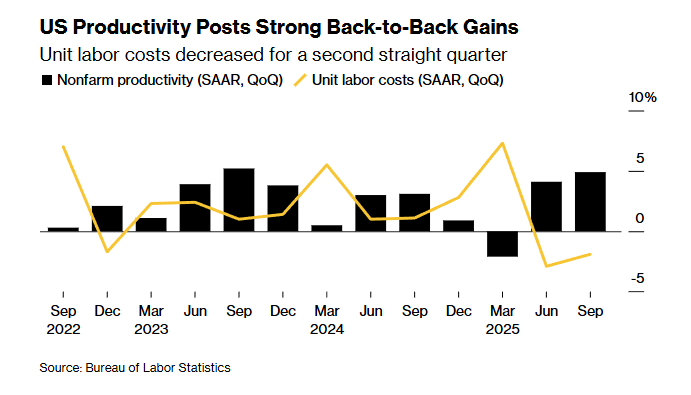
U.S. labor productivity accelerated sharply in the third quarter, providing fresh evidence that efficiency gains are helping to keep a lid on inflation. Nonfarm employee output per hour soared at a 4.9% annualized rate, surpassing the upwardly revised 4.1% gain in the second quarter, according to Bureau of Labor Statistics data released Thursday.
The surge in productivity allowed the U.S. economy to grow at its fastest clip since 2023 despite a cooling job market. Crucially, unit labor costs—the price businesses pay for the labor required to produce one unit of output—dropped 1.9% following a decline in the previous quarter. This marks the first back-to-back decrease in labor costs since 2019. For the Federal Reserve, these efficiency gains are a welcome development, as they suggest that solid economic growth can persist without fueling wage-push inflation.
As labor remains the largest expense for most firms, the shift highlights how companies are increasingly turning to technology and capital equipment to optimize their existing workforce.
Bloomberg – US Productivity Accelerates to Fastest Pace in Two Years
______
3. Minneapolis Schools Close as Protests Over ICE Shooting Turn Violent
The Minneapolis public school system has canceled all classes for the remainder of the week following a deadly shooting by an ICE officer that ignited a fresh wave of civil unrest. On Thursday morning, tensions boiled over outside the Whipple Federal Building in St. Paul, where live footage showed federal agents in a standoff with demonstrators. Officers used pepper balls to disperse the crowd after protesters began shoving agents, leading to multiple arrests on the scene.
The outrage stems from the Wednesday killing of 37-year-old Renee Nicole Good, whose death inside her vehicle was captured on video and went viral. While the Trump administration described the shooting as self-defense during a targeted immigration operation, Minneapolis city officials have fiercely disputed that narrative. The incident has intensified the national debate over the use of heavily armed federal agents in major cities, a hallmark of the administration’s mass deportation push. As Treasury Secretary Scott Bessent prepares to speak at the Economic Club of Minnesota today, security has been heightened amid fears of further disruptions.
Protests have already spread to New York City, with demonstrators demanding an end to ICE operations in urban centers.

Bloomberg -Minneapolis Cancels School as Killing Inflames Anti-ICE Protests
______
4. Tech Stocks Slide on Profit-Taking; Defense Shares Surge on $1.5 Trillion Spending Plan
U.S. equities faced downward pressure on Thursday as a sell-off in big tech weighed on major averages. The Nasdaq 100 slid as much as 1%, snapping a three-day winning streak as investors locked in profits from the high-flying AI trade, sending shares of Nvidia and Apple lower. In contrast, defense contractors like Lockheed Martin and Kratos Defense surged more than 7% after President Trump signaled a massive defense budget expansion to $1.5 trillion for 2027.
The global bond rally stalled as the 10-year Treasury yield rose to 4.18%. Stronger-than-expected labor data, including corporate layoffs hitting a 17-month low in December and resilient weekly jobless claims, helped soothe fears of a hard landing for the U.S. economy. Markets are currently pricing in at least two 25-basis-point rate cuts for the year, pending further clarity from Friday’s critical non-farm payrolls report.
Geopolitical headlines also remained in focus, with traders monitoring the administration’s maneuvers regarding Greenland and shifting dynamics in Venezuela.
Bloomberg – Nasdaq 100 Drops 1% While Defense Names Outperform: Markets Wrap
______
5. Supreme Court Set to Decide Fate of Trump Tariffs as 1,000+ Firms Seek $133 Billion Refund
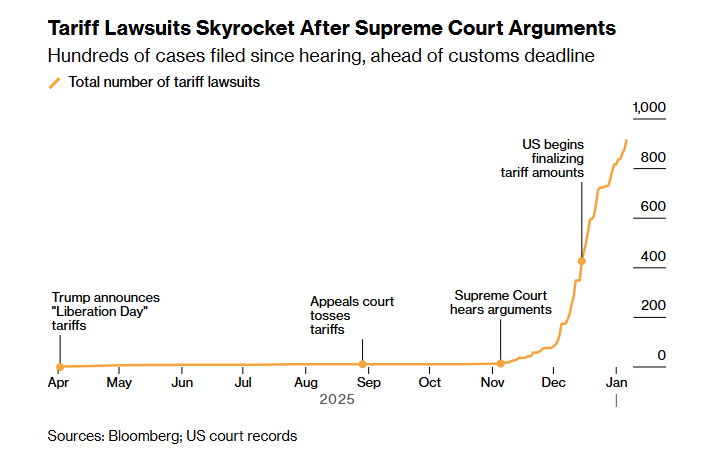
The U.S. Supreme Court is poised to issue a landmark ruling as early as Friday that could determine the legality of President Donald Trump’s primary tariff policy. In anticipation of a potential strike-down, more than 1,000 corporate entities have filed lawsuits to recoup their share of the approximately $133 billion in duties collected under emergency authority as of mid-December. The flood of litigation followed a November hearing where several justices signaled skepticism toward the administration’s use of a 1977 emergency powers law to bypass Congress.
Trump has warned that a ruling forcing the government to issue refunds would constitute a “National Security catastrophe,” arguing that the presidency must maintain the power to “wheel and deal” with tariffs. If the Court rules against the administration, legal experts expect the justices to defer the complex refund process to lower courts, specifically the U.S. Court of International Trade. This would require every individual importer seeking a refund to initiate their own legal challenge.
The original cases, filed in April by a small group of businesses and states, challenge the “Liberation Day” tariffs aimed at trade deficits and separate levies linked to fentanyl trafficking.
Bloomberg – More Than 1,000 Companies Are Suing Trump Over His Tariffs
______
6. JPMorgan to Replace Goldman as Apple Card Partner
JPMorgan Chase & Co. will take over Apple Inc.’s credit-card business from Goldman Sachs Group Inc., marking the conclusion of Goldman’s expensive and strategic retreat from consumer finance. The companies announced Wednesday that the transition of the approximately $20 billion portfolio is expected to be completed within the next 24 months.
The exit provides an immediate accounting boost for Goldman, which expects a $0.46 increase in earnings per share for the fourth quarter of 2025. This reflects the release of $2.48 billion in loan loss reserves, offset by a $2.26 billion hit to net revenue from marking down the outstanding loan book and terminating contractual obligations.
Goldman CEO David Solomon noted the move allows the firm to double down on its “core franchises” in investment banking and asset management. According to RBC Capital Markets, Goldman has lost more than $7 billion on its consumer-lending ventures since 2020.
For JPMorgan, the nation’s largest bank, the deal adds a high-profile co-branded product to its dominant card portfolio, further scaling its consumer reach.

Bloomberg – JPMorgan to Take Over Apple Credit-Card Business, Report Says
______
7. Billionaires Flee California to Avoid Proposed 5% Wealth Tax
A proposed 5% one-time tax on the net worth of California’s wealthiest residents has triggered a pre-New Year exodus of billionaires seeking to establish residency elsewhere. Financial advisers report that at least a half-dozen ultra-high-net-worth individuals left the state before January 1, the critical “tax obligation date” set by the potential ballot initiative. Relocation experts noted that even more are expected to follow if the measure gains further momentum.
The exodus includes high-profile figures such as Peter Thiel and David Sacks, both of whom announced new office locations in Florida and Texas just before the year ended. Alphabet co-founder Larry Page has also reportedly moved out of state. The “2026 Billionaire Tax Act” aims to raise an estimated $100 billion for public health and K-14 education, but critics warn the departure of the state’s top taxpayers could lead to a permanent loss in income tax revenue.
While the initiative still needs to collect nearly 875,000 signatures to qualify for the November ballot and faces opposition from Governor Gavin Newsom, the mere threat of the levy is reshaping the landscape of Silicon Valley’s elite.
Bloomberg – Billionaires Are Ramping Up Their California Exits on Threat of Wealth Tax
______