—— US Labor Cost Growth Slows to the Weakest Pace in Four Years; US Truck Drivers Face New Risk; Musk’s Wealth Could Surge to $952 Billion if SpaceX Goes Public at $1.5 Trillion; Nearly 1 Million New Yorkers Expected to Lose Coverage; ICE Says Over Half of Its Institutional Clients Are Interested in Polymarket Prediction Data; US to Buy Six Boeing 737 Jets to Boost Deportation Flights; Fed Cuts Rates to Three-Year Low in Divisive Decision
1. US Labor Cost Growth Slows to the Weakest Pace in Four Years
Annual growth in US labor costs decelerated in the third quarter to the slowest pace in four years, adding to evidence that a softening job market is helping limit inflationary pressures.
The employment cost index, which tracks changes in wages and benefits, increased 3.5% in the 12 months ended in September, according to Bureau of Labor Statistics figures out Wednesday. On a quarterly basis, the gauge rose 0.8%.
The latest figures highlight a job market that has lost momentum as many employers temper the pace of hiring, while some reduce headcounts. For Federal Reserve officials, who are expected to lower interest rates later Wednesday, tamer growth in employment costs is seen helping restrain inflation.
Figures out Tuesday from the BLS showed hiring fell and layoffs climbed to the highest level since early 2023. Meanwhile, the rate of voluntary quits fell to the lowest since 2020, underscoring fading worker confidence in finding another job.
That years-long shift has coincided with slower wage growth, with younger employees seeing some of the most pronounced pullbacks.
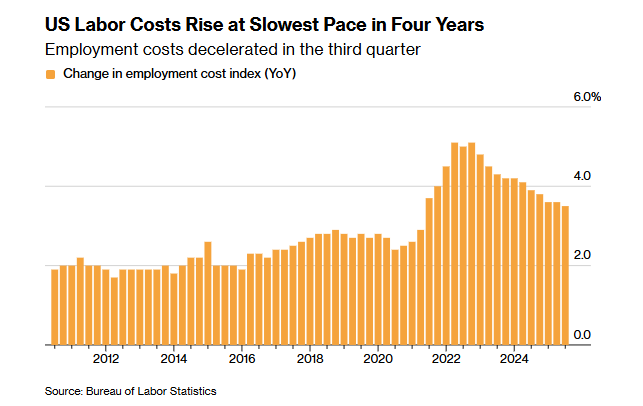
Bloomberg – US Employment Costs Rise at Slowest Pace Since Mid-2021
______
2. US Truck Drivers Face New Risk
Truck drivers are encountering a new risk on the highway: Law enforcement officers are empowered by the Trump administration to pull them off the road if they fail an English test.
The government argues the rules are critical to safety. For Vadym Shpak, they’re a costly and frustrating disruption.
Shpak, the owner of an Illinois-based trucking company, has had to book planes and car rentals for drivers who’ve had to abandon their rigs while on the road. Some of his employees, who are mostly Eastern European, refuse to go to southern states for fear of being targeted. He says his insurance premiums are climbing because of an increased number of violations.
“These are good drivers, experienced drivers, but they get pulled over and the officer says their English isn’t good enough,” he said. “And you know what happens? I have to pay for everything.”
The language crackdown is part of a broader Trump administration campaign that’s upending the trucking industry, a critical pillar of the US economy. In September, Transportation Secretary Sean Duffy sought to sharply limit commercial driver’s licenses for foreign-born applicants, a move since paused by a federal court. In recent months, hundreds of truckers have been swept up in Immigration and Customs Enforcement raids across Oklahoma, Texas, Indiana and New York.
What began as a push for highway safety has expanded into a far-reaching enforcement drive that immigrant advocates say indiscriminately targets foreign-born truckers who are legally permitted to be in the country. The Department of Transportation, tasked with ensuring safety and efficiency, has become part of Trump’s broader immigration agenda — deepening uncertainty in an industry already mired in a slowdown marked by sluggish demand and low freight rates.
“There have been reports of areas where drivers are unwilling to go, and it generally is going to correspond to wherever ICE recently was,” said Aaron Graft, chief executive officer of Triumph Financial Inc., a banking platform for the freight industry. For days afterwards, trucking rates in those areas increase as the supply of drivers goes down, he said.
Shelley Simpson, CEO of JB Hunt Transport Services Inc., said she’s expecting as many as 400,000 drivers — about 11% of the supply — to leave the business over the next few years because of enforcement actions, a number she has called “meaningful.”
Commercial truckers face stricter language requirements because their jobs require frequent communication and decision-making as they operate massive vehicles. While rules on language proficiency date back decades, violations typically only resulted in citations during the Obama administration. That changed after an April executive order from President Donald Trump calling for “commonsense rules of the road.”
Within weeks, the DOT issued new guidance prompting inspectors to place drivers out of service who didn’t speak sufficient English. “Federal law is clear, a driver who cannot sufficiently read or speak English — our national language — and understand road signs is unqualified to drive a commercial motor vehicle in America,” Duffy said.
Since the policy went into effect in late June, violations have spiked — and there have been more than 9,500 cases of drivers being pulled off the road, according to a Bloomberg News analysis of federal data. Texas and Wyoming led the way in enforcement. Drivers in specific commercial zones near the US border are exempt from out-of-service orders, but they may still receive citations.

Bloomberg – Truckers Who Fail English Tests Are Pulled Off Roads in Trump Crackdown
______
3. Musk’s Wealth Could Surge to $952 Billion if SpaceX Goes Public at $1.5 Trillion
The richest man in the world could more than double his $460.6 billion fortune if SpaceX succeeds in going public next year at a valuation of $1.5 trillion.
Elon Musk’s stake in his space company alone would be worth more than $625 billion if that were to occur, according to calculations by the Bloomberg Billionaires Index, up from $136 billion today. That doesn’t include his multibillion-dollar stakes in a number of other enterprises, including Tesla Inc.
His total fortune would be $952 billion, up about $491 billion from its current level, based on a $1.5 trillion pre-money valuation. An IPO opens another clear path for Musk to become the world’s first trillionaire, after receiving the first 12-figure compensation package at Tesla last month.
Musk owns roughly 42% of Starbase, Texas-based SpaceX, according to filings from the Federal Communications Commission and dilution estimates from recent funding rounds.
To value Musk’s current stake, the index uses a December 2024 secondary sale involving $1.25 billion at a nearly $350 billion valuation. After applying a liquidity discount for private companies, the stake is worth about $136 billion.
Some SpaceX shares were sold earlier this year at about a $400 billion valuation, but because the transaction size was unclear, it wasn’t used. Pitchbook estimated that sale involved less than $50 million.

Bloomberg – Musk’s Fortune Would More Than Double on $1.5 Trillion SpaceX
______
4. Nearly 1 Million New Yorkers Expected to Lose Coverage
Nearly 1 million New Yorkers are expected to lose health coverage as a result of President Donald Trump’s federal budget, a shift that will strain the city’s already struggling public hospital system.
As part of eligibility changes enacted under Trump’s One Big Beautiful Bill Act, an estimated 800,000 New York City residents are expected to lose Medicaid coverage, state Comptroller Thomas DiNapoli said in a report Wednesday. Another 150,000 residents will likely lose coverage under the state’s Essential Plan, which provides health care to low-income New Yorkers.
The surge in uninsured residents will disproportionately impact Health and Hospitals, the city’s system of 11 publicly run hospitals, DiNapoli said. Federal cuts and eligibility changes “will hurt the agency’s bottom line, even as a growing uninsured population is likely to push more patients into its facilities,” he noted. Any increase in the uninsured rate “will create a financial burden for H+H since its primary mission is to provide care regardless of a patient’s ability to pay.”
H+H, the largest public hospital system in the US, already serves a substantial share of the city’s Medicaid and uninsured population, including many undocumented immigrants. Last year, Medicaid, Medicare and Essential Plan beneficiaries accounted for 84% of patient discharges, and 72% of system revenue came from Medicaid or the Essential Plan.
The system has long struggled to stabilize its finances. Since 2016, H+H has relied heavily on the city’s ability to obtain supplemental federal Medicaid payments to support its savings plans. Those payments, however, are volatile, requiring state and federal approval and often arriving inconsistently or with significant delays.
“Given the expected rise in the uninsured population, H+H will likely need to revisit its cost-cutting plans, which could lead to difficult decisions such as consolidating or eliminating services,” DiNapoli said.
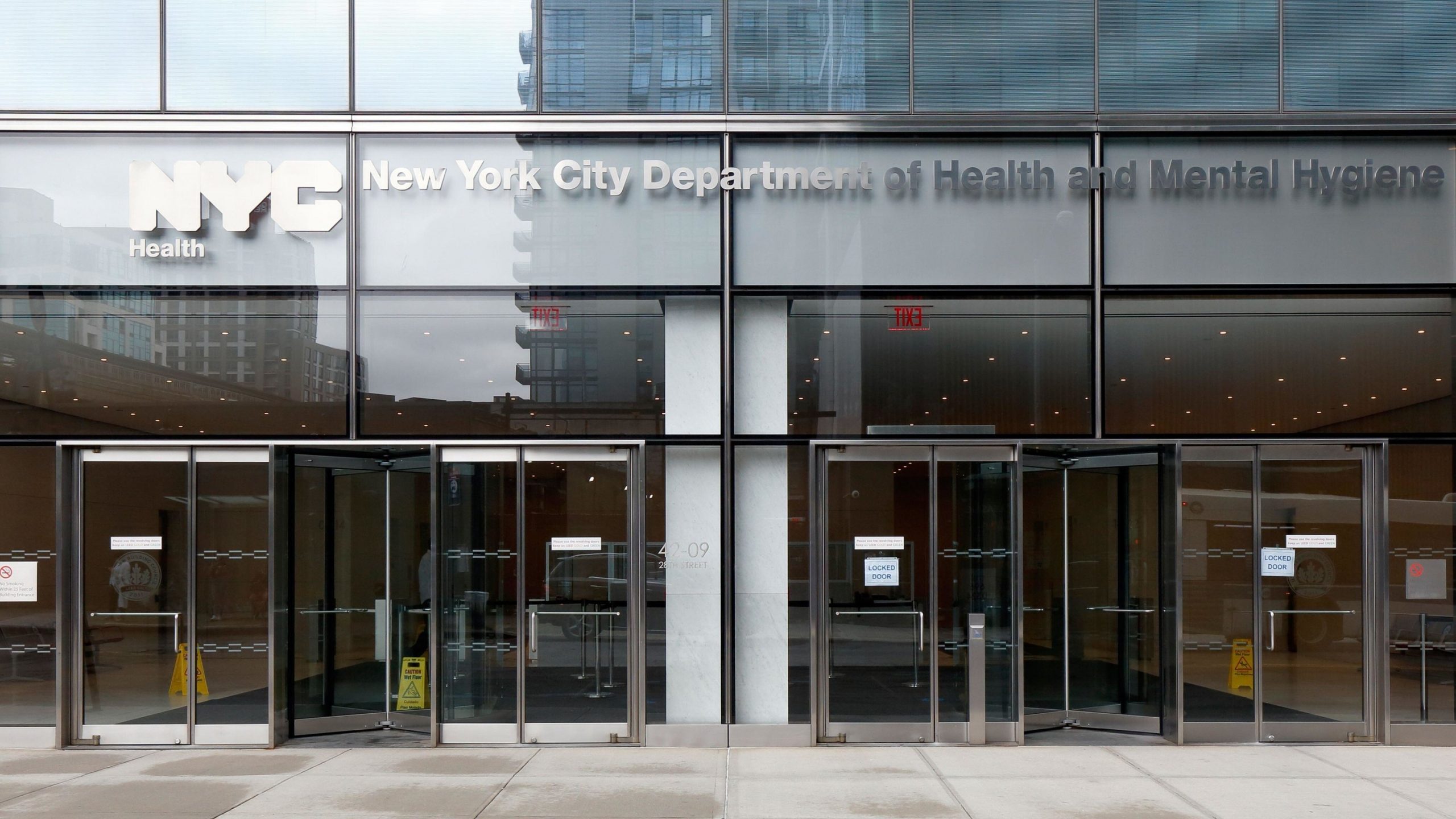
Bloomberg – NY Warns 950,000 People to Lose Health Coverage Under Trump Cuts
______
5. ICE Says Over Half of Its Institutional Clients Are Interested in Polymarket Prediction Data
More than half of Intercontinental Exchange Inc.’s institutional clients are interested in accessing prediction-market data obtained through its new partnership with Polymarket, according to Chief Executive Officer Jeffrey Sprecher.
Speaking at a Goldman Sachs financial services conference on Tuesday, Sprecher said that many of ICE’s 10,000 customers — who typically trade traditional commodities such as oil, gas and cocoa — are now paying close attention to prediction markets to assess how such information might influence their current and future financial positions.
“We think 5,000 of them or so would be interested in this, and so we’re helping to take this data, which is unstructured, and deliver it as the market gets created,” Sprecher said. “In real time, it was deemed worthy of dissemination, and so we’re working with them to put it into an institutional environment.”
Earlier this year, ICE, the parent company of the New York Stock Exchange, agreed to invest as much as $2 billion in Polymarket, the crypto-based betting platform. The investment valued Polymarket at roughly $8 billion. The platform allows traders to wager on real-world events such as elections and sports outcomes, and saw a surge in activity during the 2024 US presidential election.
As part of the agreement, ICE will distribute Polymarket’s event-driven data, providing clients with sentiment indicators related to market-moving topics. ICE and Polymarket also agreed to collaborate on future tokenization initiatives, leveraging Polymarket’s expertise in decentralized finance. Sprecher said that Polymarket’s engineering talent and crypto experience were major attractions for ICE.
“We wanted access to their engineers, and we wanted to get educated on exactly how they were doing what they were doing,” he said. “This is all about technology. This isn’t about sports betting or predictions or anything.”

Bloomberg – NYSE Owner Sees Half of Clients Interested in Prediction Markets
______
6. US to Buy Six Boeing 737 Jets to Boost Deportation Flights
The US government will purchase six Boeing Co. 737 aircraft to support deportation flights, expanding the administration’s efforts to increase removals of people living in the country without legal status.
The planes will be acquired from Daedalus Aviation under a contract valued at roughly $140 million, according to a report first published by the Washington Post, which cited two people familiar with the deal.
Tricia McLaughlin, a spokesperson for the Department of Homeland Security, confirmed the agreement by email and on social media. Contract documents had not yet appeared on federal procurement websites. ICE Air Operations, the agency’s main transport division, currently relies on a mix of chartered aircraft and commercial flights. It deploys 12 aircraft from hubs in Arizona, Texas, Louisiana and Florida to transfer detainees between US detention facilities and conduct deportation flights overseas. The new planes would allow ICE to operate more flights directly rather than contracting them out, a move DHS says will result in cost savings.
ICE Air has long been one of the agency’s more opaque operations, with limited data available on routes, costs and the conditions under which migrants are transported.
Boeing 737 jets are commonly used for domestic and short-to-medium-haul international routes, typically carrying as many as 200 people depending on the model and configuration. Depending on the model, the aircraft can fly nonstop to Central America, the Caribbean and parts of South America, as well as hubs across the US.

Bloomberg – US Buys Own Boeing 737 Fleet to Speed Trump’s Deportation Push
______
7. Fed Cuts Rates to Three-Year Low in Divisive Decision
OpenAI has hired Slack Chief Executive Officer Denise Dresser to be its chief revenue officer as the ChatGPT maker pushes to expand business adoption of its artificial intelligence products.
Dresser was named CEO at Slack in late 2023, after the workplace communication provider was acquired by Salesforce Inc. Dresser previously served as a longtime executive at Salesforce.
OpenAI now has more than 1 million businesses paying to use its enterprise AI products, but it faces growing competition from Anthropic PBC and Alphabet Inc.’s Google. The company is under pressure to grow revenue fast enough to justify its immense investments in AI development. OpenAI has said it’s committed to spend $1.4 trillion on infrastructure to support AI.
“I’ve spent my career helping scale category-defining platforms,” Dresser said in a statement. “I’m looking forward to bringing that experience to OpenAI as it enters its next phase of enterprise transformation.”

Financial Times – Federal Reserve cuts rates to lowest level in three years
______